














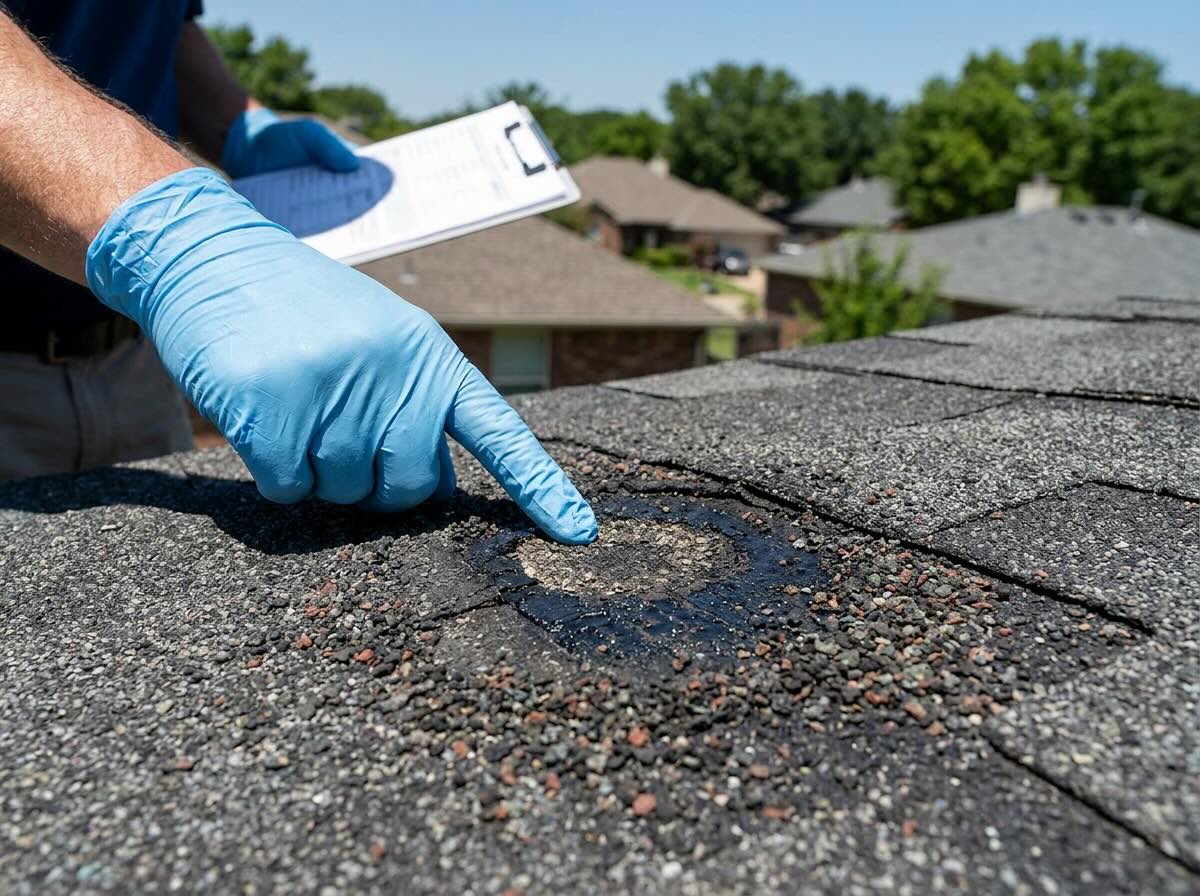
A professional roof inspection in San Antonio typically reveals one or more of five recurring issues: hail-induced granule loss, UV-accelerated shingle aging, failed flashing around penetrations, improper attic ventilation, and storm-lifted ridge caps. In San Antonio specifically, the combination of hail and intense UV creates accelerated aging that isn’t visible from the ground. Roofs that look fine from the street often show significant wear at the inspection level. M&M Roofing has performed thousands of inspections across Bexar County and the surrounding suburbs, and these patterns appear in the majority of homes over 8 years old.
Most San Antonio homeowners assume their roof is fine until it leaks. By the time water comes through the ceiling, the damage is usually 2 to 3 years old. It started as a granule loss pattern from a hail strike, then UV got into the exposed asphalt, and then a flashing seal failed during heavy rain. An inspection finds these problems at the stage when they’re still cheap to fix.
The most common mistake M&M sees is waiting for visible signs. By the time you can see the problem from the driveway, you’ve already been funding the damage for seasons.
This article walks through the specific findings M&M documents most often on San Antonio roofs, what those findings mean, and what typically needs to happen next. It’s based on thousands of inspections across Stone Oak, Helotes, Boerne, Cibolo, New Braunfels, and Alamo Heights. The same five things keep showing up.
The 5 Things We Find on Almost Every San Antonio Roof Over 8 Years Old
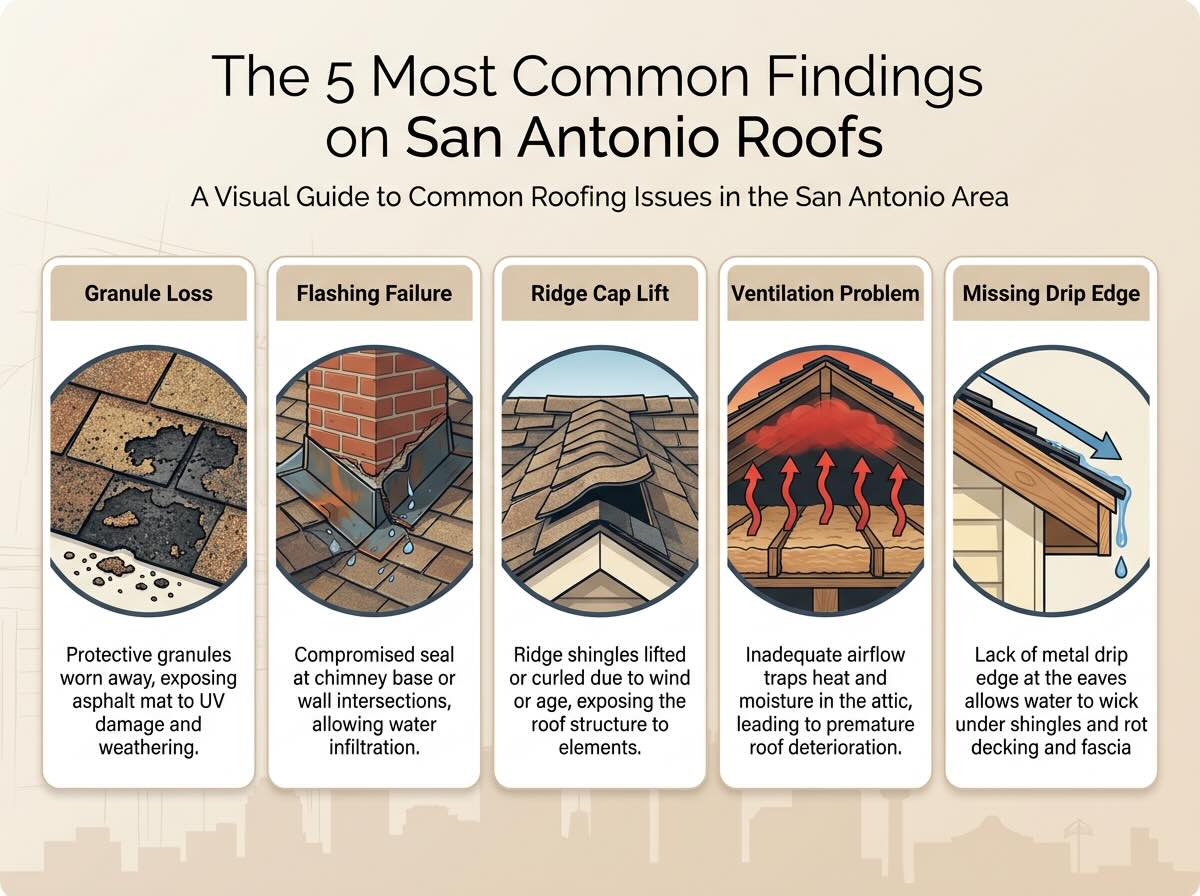
1. Granule Loss — Usually From Hail, Not Just Age
Bexar County sits in Texas Hail Alley and averages 3 to 4 significant hail events per year. The April 2016 storm alone carved a 70-mile swath through north San Antonio and Helotes, causing over $1.36 billion in insured losses and requiring total roof replacements on thousands of homes. [1] Since then, the area has logged significant hail reports in most subsequent storm seasons.
When hail strikes asphalt shingles, it knocks granules loose. Those granules aren’t decorative: they’re the UV shield. Lose the granules, and San Antonio’s 220+ sunny days per year start working directly on the exposed asphalt matting underneath. The matting dries, cracks, and loses its waterproofing capacity. [2]
M&M finds granule loss on the majority of San Antonio homes over 8 years old. The problem: from the street, the roof looks fine. Granule loss is a roof-level finding, not a driveway finding. By the time it’s visible from the ground, significant UV exposure has already occurred.
The tell on inspection: granule buildup in gutters, irregular dark patches on the shingle surface, and soft or spongy texture where the matting has dried beneath depleted areas.
2. Flashing Failures Around Chimneys, Vents, and HVAC Curbs
Flashing is the number one source of active roof leaks in San Antonio homes. It’s not the shingles that fail first. It’s the metal-to-shingle interface at every chimney, vent pipe, and HVAC penetration.
The mechanism: San Antonio’s temperature swings, 30°F nights in winter and 105°F summer afternoons, cause metal flashing to expand and contract repeatedly. [3] Over the years, that cycling works the flashing loose from the sealant and counter-flashing that holds it in place. Caulk cracks first, then step flashing gaps open at the base, then counter-flashing lifts at the top.
M&M finds cracked caulk, separated step flashing, and lifted counter-flashing on the majority of San Antonio homes that have chimneys or mechanical penetrations. It’s a predictable failure mode in this climate, not neglect on the homeowner’s part, just the inevitable result of decades of thermal cycling. The repair is usually straightforward. Left unaddressed, flashing gaps are where active leaks develop.
3. Ridge Cap Lift From Wind Events
San Antonio’s spring storm season brings sustained winds and sudden gusts. The ridge cap, the row of shingles running along the peak of the roof, is the most wind-exposed surface on any house. It catches direct uplift from every direction.
Ridge cap lift is among the most common urgent findings M&M documents on San Antonio roofs after storm season. The adhesive bond breaks, nails work loose, and the cap is held by friction. It looks completely intact from the street. From the roof, the separation is obvious. One more wind event takes it off entirely, exposing the ridge board at the highest point of the roof, directly above the attic.
A San Antonio homeowner can look at their roof from the driveway and see nothing wrong, while M&M finds a 10-foot section of ridge cap that’s been progressively lifting for three months. This is precisely why post-storm inspections matter.
4. Attic Ventilation Problems That Are Cooking the Roof From the Inside
San Antonio’s summer heat can push roof deck temperatures above 160°F on south-facing slopes when attic ventilation is inadequate. That temperature on the underside of the deck accelerates adhesive failure, causes shingles to cup and curl from below, and in severe cases voids manufacturer warranties on the shingles themselves.
M&M flags ventilation deficiencies on a significant portion of San Antonio homes inspected. This is frequently a builder error from original construction, not homeowner neglect. Homes built during the expansion years in Stone Oak, Cibolo, and New Braunfels were sometimes ventilated to code minimums that aren’t adequate for Central Texas heat loads. The result shows up at inspection 8 to 15 years later as shingles that are aging faster than their chronological age would explain.
The fix, adding ridge ventilation and soffit intake to achieve proper thermal balance, is typically a fraction of the cost of shingle replacement. But it has to be identified to be addressed.
5. Improper or Missing Drip Edge
Drip edge is the metal flashing along the eave line that directs water off the roof edge and away from the fascia. When it’s missing or incorrectly installed, water wicks back under the first shingle course and runs directly into the fascia board and soffit above.
M&M finds missing or incorrectly installed drip edge frequently on San Antonio homes, particularly those that have had previous roof work done by contractors cutting scope to stay under bid. It doesn’t create an immediate leak in the traditional sense. It creates a slow rot problem at the eave line: fascia boards absorbing water during every rain event, developing rot over the years.
By the time the rot is visible from the street as paint failure or soft spots in the fascia, the damage has been progressing for years. The drip edge fix is inexpensive. The fascia replacement that follows years of wicking isn’t.
What a San Antonio Roof Inspection Actually Looks Like
Most homeowners have a vague idea of what “getting the roof inspected” means. Here’s what M&M actually does on a San Antonio inspection, from arrival to written report.
Ground assessment before the roof. Before going up, M&M notes what’s visible from street level: ridge profile, obvious missing shingles, gutter condition, and any visible sagging or deformation. This takes five minutes and establishes what the homeowner can see vs. what only shows up from the roof surface.
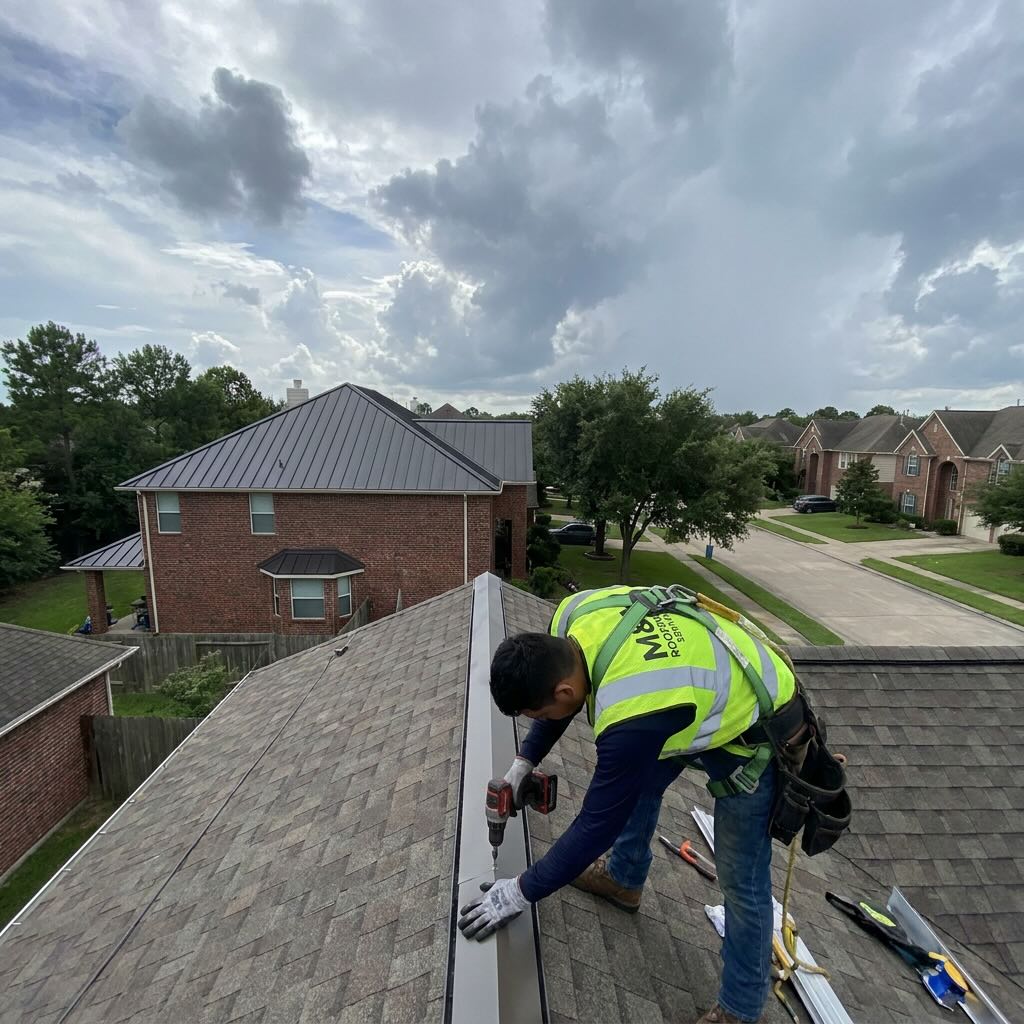
Roof surface walk. M&M walks the entire roof surface, not just the area the homeowner flagged. Granule condition across all slopes, seam and ridge cap integrity, flashing condition at every penetration, valley condition, and any areas of soft or spongy decking beneath the surface. Every finding is photographed with a measurement note of the location.
Attic inspection. The attic side of the roof deck is inspected for moisture staining, visible daylight through any penetrations, insulation condition, and ventilation ratio. Active leaks often show their source more clearly from inside than from the roof surface. Attic temperature differentials also reveal ventilation problems before they show up in the shingles.
Written findings report. Before M&M leaves, the homeowner receives a written summary of every finding, its location, and its severity. Not a tablet handed over at the door: a document they can use for insurance claims, for getting a second opinion, or simply for reference when they decide what to do next.
Schedule your free San Antonio roof inspection — same-day available for requests before noon.
The Pattern We See That No One Talks About: The Hail + UV Double Punch
After thousands of San Antonio inspections, M&M has identified a pattern that doesn’t appear in any manufacturer spec sheet and isn’t part of any standard contractor’s inspection narrative. It explains why San Antonio roofs age faster than their chronological age would suggest.
The sequence runs like this.
Spring hail event. Stone strikes knock granules loose from the south-facing slope, sometimes visibly, sometimes in quantities too small to notice immediately. The homeowner sees a few granules in the gutter and notes it, or doesn’t.
Then summer arrives. San Antonio’s intense solar radiation, 220+ sunny days a year with UV intensity that’s among the highest in the US, hits the now-partially-unprotected asphalt matting on those south-facing slopes. Where granules were knocked loose, the matting absorbs UV directly. Asphalt becomes brittle, loses flexibility, and develops micro-cracks.
By fall, what started as a moderate hail strike has accelerated into the equivalent of two to three additional years of aging on the affected slope. A roof that’s chronologically 10 years old is performing like a 13 to 15-year-old roof on the damage side.
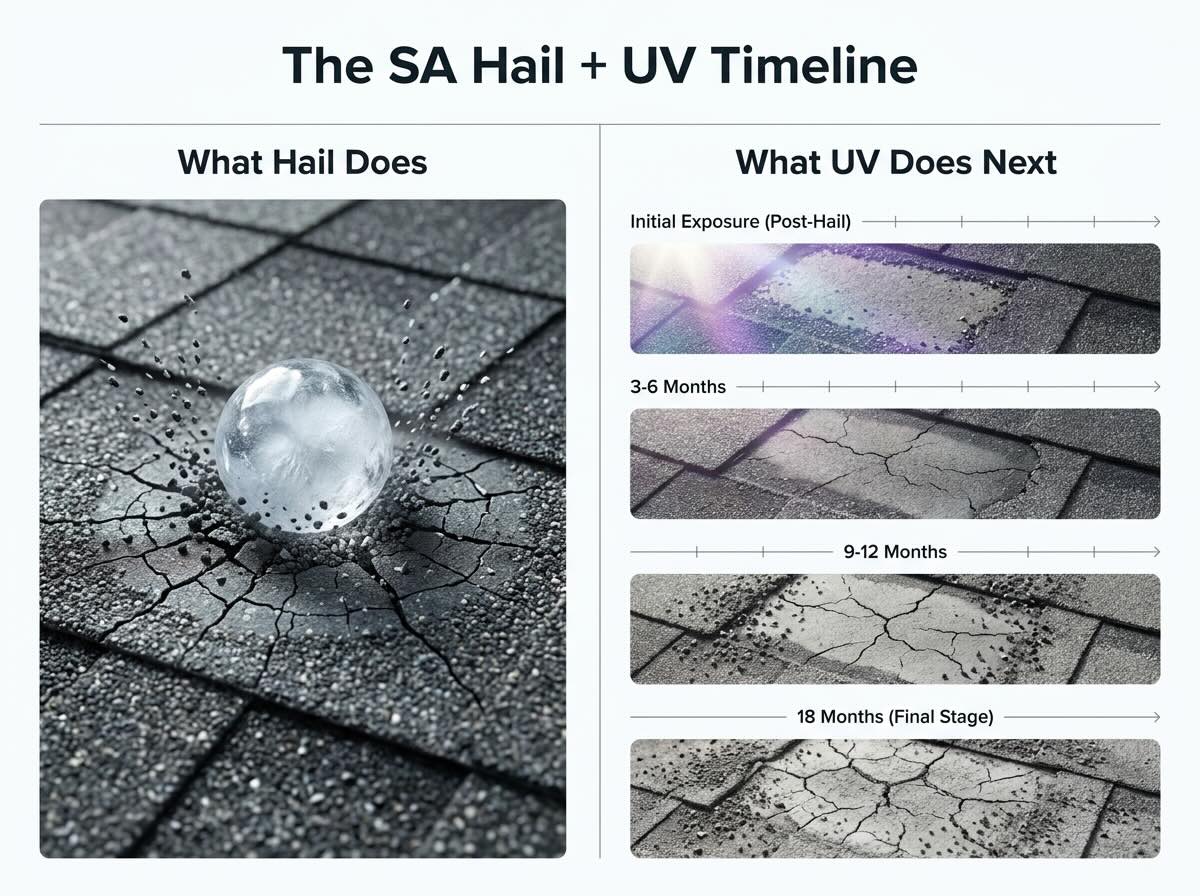
M&M regularly documents this compound effect during inspections. A Stone Oak homeowner whose May 2023 storm-damaged roof was inspected in 2024 showed granule depletion across 40% of the south-facing slope, with corresponding asphalt brittleness that a standard inspector, counting “shingles present,” would miss. The roof wasn’t leaking yet. It was 18 to 24 months from its first flashing failure.
This pattern has a direct practical implication: homeowners filing hail damage insurance claims two to three years after a storm face harder claim processes. By then, subsequent UV degradation has blurred the direct hail-to-damage causal chain that adjusters need to approve coverage. The documentation from an inspection within 60 days of the event captures the damage while the attribution is still clean.
M&M inspects post-hail damage all across San Antonio and Bexar County. The consistent finding is that the homeowners who call within 60 days get cleaner documentation and cleaner claims. The homeowners who wait two years often find themselves in a dispute about whether the damage is “hail-caused” or “age-related.” It’s often both, but the timing of the inspection determines which story the evidence tells.
For more on navigating storm damage claims, see M&M’s guide to whether to contact insurance or your roofer first.
What Happens After M&M Inspects Your Roof
Three outcomes. Here’s what each one looks like.
Your roof is fine. M&M tells you that, documents it in writing, and gives you a recommended re-inspection timeline. For a San Antonio home under 8 years old with no significant hail history, that might be two years. For a 12-year-old home in the hail corridor, it might be annually. Having a documented baseline is valuable when you sell the home or need to file a future claim.
Maintenance items found. Minor repairs needed: flashing recaulk, a few replaced ridge caps, drip edge correction. M&M documents each item with a cost range and a priority tier: what to address in the next 30 days vs. what can wait until fall. No pressure to do everything at once.
Replacement recommended. M&M explains specifically why: the combination of factors (roof age, granule loss extent, UV damage, attic ventilation impact) that have moved the roof past the point where targeted repairs extend useful life. M&M provides a written replacement cost estimate and walks through insurance claim documentation if a hail event contributed to the findings.
M&M doesn’t push replacements unnecessarily. The lifetime labor warranty on new installations means M&M is invested in recommending the right work, not the most profitable work. If your roof has 5+ good years left with minor repairs, that’s what M&M says.
If We Find Storm Damage — Here’s How M&M Helps With Insurance
Every finding on a San Antonio inspection is photographed with location, condition notes, and measurement. That documentation is formatted to support insurance claims and can be submitted directly to your adjuster.
M&M can also be present during the adjuster visit to walk through what was found and where. On hail events with widespread Bexar County damage, adjuster schedules fill quickly. Having a contractor-prepared documentation package often accelerates the claim process.
For complete guidance on navigating the insurance side, see M&M’s roof insurance claims page.
How Often Should San Antonio Homeowners Schedule a Roof Inspection?
The minimum is once per year, ideally before or just after storm season (peak runs March through June in San Antonio). The specific answer depends on your roof’s age and hail history.
Under 10 years, no known hail events: Every 2 years is reasonable unless a significant storm hits.
10 to 15 years, active hail market: Annually. Bexar County’s hail frequency means most roofs in this age range have been struck at least once. You want to know what condition the granule layer is in before a second event compounds the first.
15+ years: Twice annually. Fall inspection catches summer heat damage and prepares for storm season. Spring inspection catches winter wind damage and documents the condition before the peak hail season.
After any hail event with stones larger than 1 inch: Within 60 days, without exception. That window is when the hail-to-damage causal chain is cleanest for documentation and insurance purposes. Waiting longer complicates the claim.
San Antonio’s storm season accelerates damage faster than homeowners expect. M&M’s consistent finding is that the difference between a manageable repair and a full replacement often comes down to whether someone got on the roof at the right time.
Frequently Asked Questions
How much does a roof inspection cost in San Antonio?
M&M Roofing offers free roof inspections in San Antonio, with no fee and no obligation. The inspection includes a full roof walk, attic check, and a photo-documented written findings report.
How long does a roof inspection take?
Most residential inspections take 45 minutes to 1.5 hours, depending on roof size, complexity, and what’s found. You receive a written summary before M&M leaves.
Can I get a roof inspection just for documentation, even if I don’t think anything is wrong?
Yes, and M&M recommends it, especially before storm season. A documented baseline is valuable if you need to file a claim later or when selling the home. Buyers and their lenders increasingly ask for recent roof inspection reports.
What’s the difference between a roof inspection and an appraisal?
A contractor inspection assesses the condition and identifies repair or replacement needs. A roofing appraisal, typically required by insurance, is a formal valuation process. M&M can help you understand which you need based on your situation.
My roof is only 5 years old. Do I still need an inspection after hail?
Yes. Hail damage is not age-dependent. M&M has documented significant granule loss on roofs installed less than 2 years prior to major hail events. The sooner you inspect after hail, the cleaner your documentation for any potential insurance claim.
What neighborhoods in San Antonio does M&M serve?
M&M serves all of San Antonio and the surrounding suburbs, including Stone Oak, Helotes, Boerne, Cibolo, Schertz, New Braunfels, Alamo Heights, and the broader Bexar County area. For local service details, see San Antonio roofing services.
The Bottom Line for San Antonio Homeowners
San Antonio’s climate, the combination of hail frequency, UV intensity, and temperature swings, creates a specific set of recurring roof problems that most homeowners don’t see until they’re expensive. The five findings in this article appear in the majority of San Antonio homes over 8 years old. The hail-plus-UV compound damage pattern shortens roof life in ways that aren’t visible from the street.
A free inspection is the only way to know where your roof actually stands before something expensive happens.
M&M has been doing this across San Antonio and Bexar County for over 40 years, with thousands of SA inspections behind the patterns in this article. Schedule your free San Antonio roof inspection.
References
[1] YPA Public Adjusters — Texas Hail Damage Statistics
[2] Texas Star Roofing & Construction — San Antonio Hail Damage Roof Guide
[3] Apex Roofing — Storm Damage Roof Repair in San Antonio, TX
[4] M&M Roofing — San Antonio Roof Inspection Service

M&M Roofing, Siding & Windows has served homeowners across Texas and Louisiana for more than 40 years. Backed by over 100,000 completed home improvement projects, M&M offers expert insight on roofing, siding, windows, gutters, storm damage, and exterior restoration, helping homeowners make confident, informed decisions about their property.