








A commercial roof maintenance plan is a structured schedule of inspections, cleaning, and minor repairs designed to extend roof life and prevent costly failures. For Houston commercial buildings, a proper plan includes monthly visual monitoring, bi-annual professional inspections in spring and fall, and an annual deep-dive assessment. Buildings following a documented maintenance program can add 10–15 years to their roof’s service life while avoiding the majority of emergency repair costs.
Here’s a scenario that plays out more often than most Houston property managers want to admit.
A warehouse manager in Katy skips the spring roof inspection two years in a row. Budget pressure, competing priorities, the roof looks fine from the ground. Then a tropical system rolls through in August and drops six inches of rain in four hours. Water comes through a seam failure near an HVAC curb. Interior damage: $47,000. The insurance adjuster asks for maintenance records. There are none. The claim is denied.
That’s not a freak outcome. It’s a predictable one.
Most commercial roofs don’t fail suddenly. They fail gradually, through a series of small problems that go unnoticed until a weather event turns them catastrophic. The difference between a $600 repair and a $47,000 disaster is almost always documentation and timing.
A formal commercial roof maintenance plan is what separates those two outcomes. This guide gives you the complete schedule: what to check monthly, what to hire out twice a year, and what the annual deep-dive should cover for Houston’s specific climate conditions.
Why Do Houston Commercial Buildings Need a Formal Roof Maintenance Plan?
Houston is one of the toughest roofing environments in the country. That’s not an exaggeration. It’s a measurable fact that shows up in membrane lifespans, insurance claims, and emergency repair frequencies.
Here’s what the Gulf Coast does to commercial roofs year-round.
Houston averages 49 inches of rain annually, well above the U.S. average of 38 inches [1]. Most of it arrives in intense bursts rather than steady drizzle. Flat commercial roofs that can’t drain fast enough develop ponding water, and ponding water accelerates membrane degradation faster than almost any other factor.
Summer rooftop surface temperatures routinely exceed 150°F on uncoated TPO and EPDM membranes. That kind of thermal cycling, expanding and contracting every day for months, stresses seams and flashings in ways that aren’t visible until they fail. Houston’s average relative humidity sits above 75% year-round [2]. Any moisture that finds its way under a membrane or into insulation creates conditions for mold in days, not weeks.
Then there’s hurricane season, June 1 through November 30. The Gulf Coast sits in the primary Atlantic storm track. Even systems that don’t make direct landfall push 40–60 mph sustained winds and multi-inch rain events that test edge attachments, perimeter flashing, and drain capacity simultaneously.
None of these stressors is optional. They happen whether a maintenance plan exists or not. The only question is whether you find the problems before or after they become expensive.
What Does Skipping Maintenance Actually Cost?
The numbers make the argument better than any abstract warning.
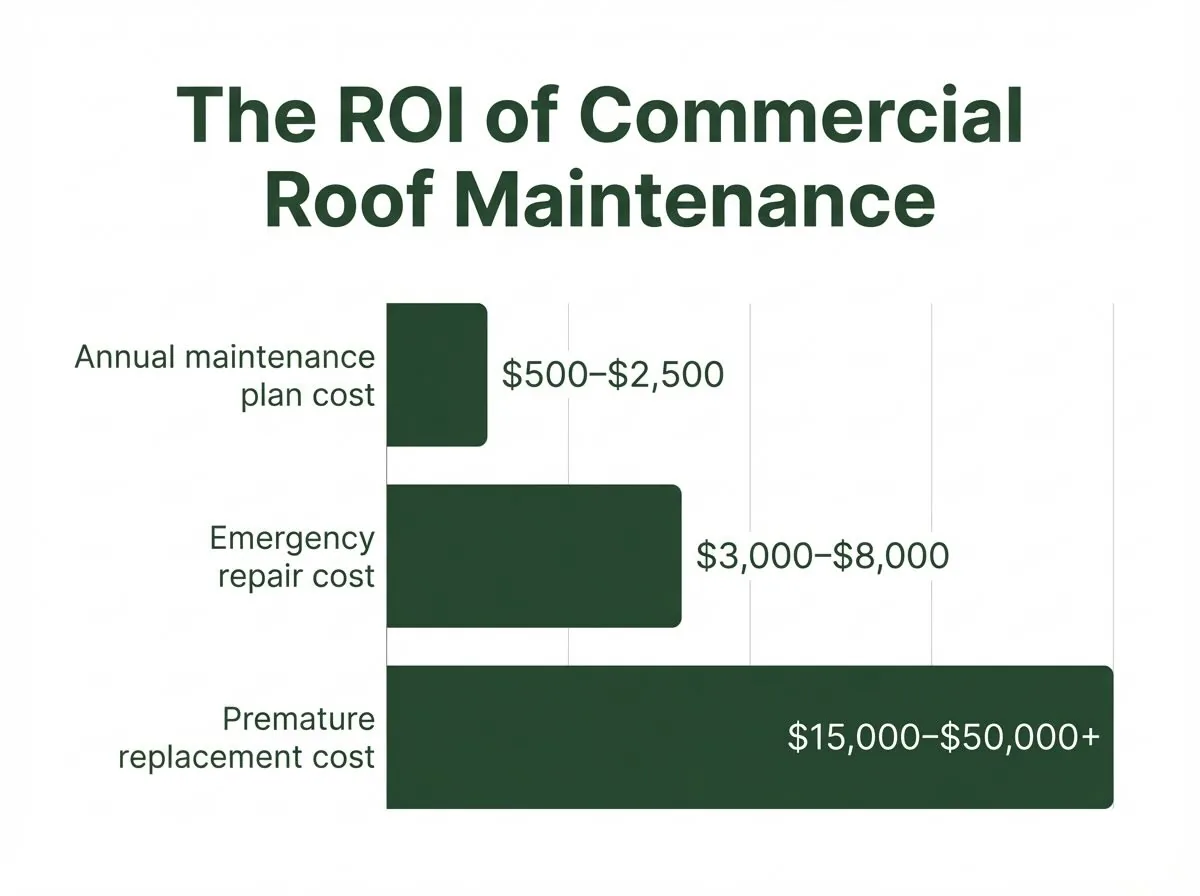
A professional commercial roof maintenance contract typically runs $500–$2,500 per year, depending on roof size, system type, and scope. That’s the preventive cost.
The reactive costs look very different. An average emergency commercial roof repair runs $3,000–$8,000 [3]. A partial replacement caused by deferred maintenance: $15,000–$50,000+. Industry data consistently shows that every $1 spent on documented roof maintenance saves $5–$10 in emergency repair and early replacement costs. Buildings with documented maintenance programs also extend roof service life by 30–40% compared to unmaintained roofs [3].
Those aren’t just numbers. They’re the difference between a line item in the facilities budget and a line item that explains why Q3 results look terrible.
What Does Insurance Actually Require?
Most commercial property policies include language requiring “reasonable maintenance” as a condition of coverage. This isn’t fine print. It’s a standard clause that insurance adjusters use when evaluating disputed claims.
After a major weather event, the first thing a claims adjuster often asks for is maintenance documentation. A signed inspection report from a licensed contractor, with dates and findings, is the strongest evidence that reasonable maintenance occurred. A stack of unverified “looks fine from the parking lot” assumptions is not.
M&M Roofing has helped Houston commercial building owners navigate insurance claims for over 40 years, including after every major Gulf Coast storm since Hurricane Alicia. The pattern is consistent: buildings with documented maintenance records get their claims processed. Buildings without them face denials or significant disputes.
What Is the Complete Commercial Roof Maintenance Schedule?
This is the plan. It’s designed for Houston’s specific climate, with inspection timing built around hurricane season and the thermal cycles that damage Gulf Coast commercial roofs faster than anywhere else in the country.
Monthly Tasks (Property Staff Can Handle)
Monthly maintenance doesn’t require a contractor. It requires thirty minutes, a phone with a camera, and a systematic approach.
After every significant rain event (1 inch or more): Walk the building interior. Look at ceilings near HVAC curbs, skylights, and parapets. Water stains, ceiling tile swelling, or active drips are early indicators of membrane or flashing failures. Don’t wait until the next professional inspection.
Monthly walkable-perimeter check: If roof access is safe and protocol-compliant, do a perimeter walk. Look for standing water (it should drain within 48 hours of rain). Check visible drain covers for debris blockage. Note any blistering, surface bubbling, or visible seam separation.
Document everything with photos and dates. A dated photo log is maintenance documentation. It takes two minutes per check and becomes critical evidence if an insurance dispute arises.
The goal of monthly checks is early detection, not diagnosis. Property staff doesn’t need to know whether a blister is a warranty issue or a moisture problem. They need to know something has changed, so a professional can assess it before it fails.
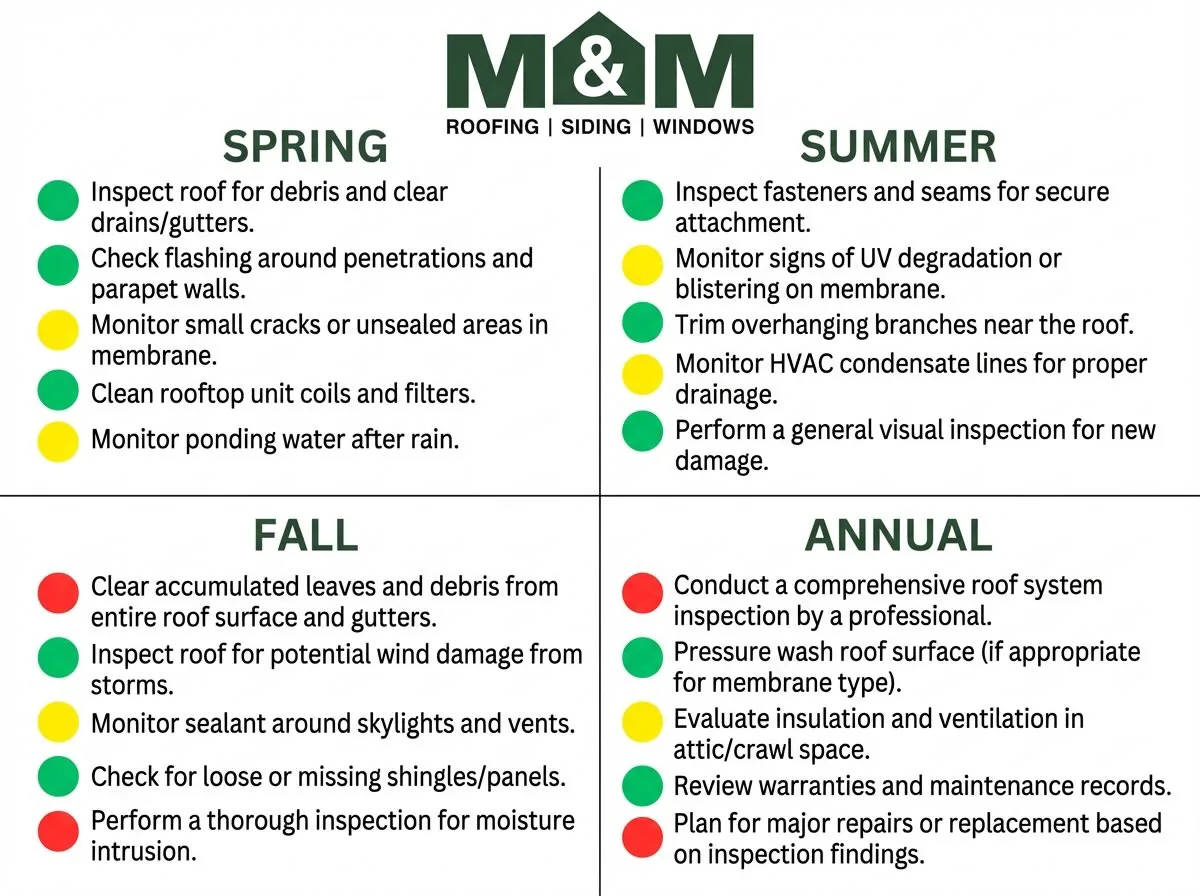
Spring Inspection (March–April): Pre-Hurricane Season Prep
This is the most important inspection of the year for Houston commercial buildings.
Spring inspection must happen before June 1 (the official start of Atlantic hurricane season). An inspection done in late June after the season has already started isn’t pre-season prep; it’s reactive management.
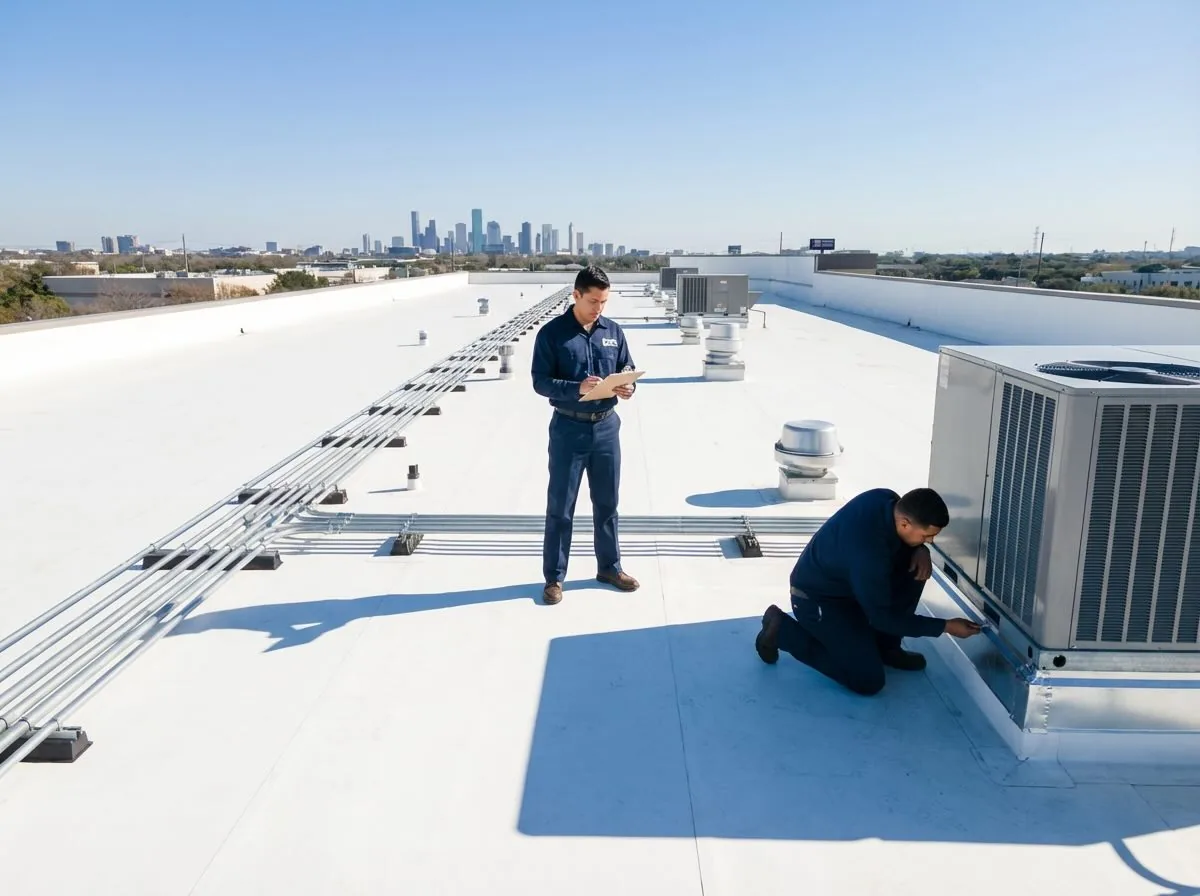
The spring inspection should be performed by a licensed commercial roofing contractor. Here’s what it should cover:
Membrane inspection: Full visual assessment for cracks, blisters, punctures, and seam separations from winter temperature cycling. Special attention to areas around HVAC curbs and rooftop equipment, which see the most thermal movement.
Flashing inspection: Every penetration point (HVAC units, skylights, vents, pipes, and parapet walls) should be checked for sealant cracking or separation. Flashing failures cause the majority of Houston commercial roof leaks after storm events.
Drain clearing and flow testing: All drains should be cleared and flow-tested. A drain that flows slowly in spring will overflow in a tropical rain event. That’s not hypothetical; it’s physics.
Roof-to-wall connections: Parapet walls and edge terminations are high-failure zones in high-wind events. They should be inspected every spring without exception.
Written report: Every spring inspection should produce a written report with dated photos. No documentation, no insurance protection.
M&M Roofing offers same-day inspections for requests received before noon. Schedule your spring inspection before hurricane season starts.
Summer Monitoring (May–August): Heat and UV Checks
Summer maintenance is about catching thermal damage early.
Houston’s rooftop temperatures can exceed 150°F from June through August. That heat accelerates two specific failure types: membrane blistering from trapped moisture vapor expanding under the membrane surface, and seam stress from repeated thermal expansion and contraction cycles.
Monthly visual checks are more important during summer than any other season. Watch for new blistering on TPO or EPDM surfaces that wasn’t present after the spring inspection. Check that HVAC condensate drain lines are routing water away from the roof surface. Condensate pooling on a hot membrane is a moisture intrusion problem in the making.
One operational note that matters: avoid unnecessary foot traffic on the roof during peak summer heat. High-temperature membrane surfaces are significantly more vulnerable to puncture damage than the same membrane at 70°F. Maintenance foot traffic should be scheduled for early morning.
Fall Inspection (September–October): Post-Hurricane Season Assessment
The fall inspection is the second professional inspection of the year. It comes after the peak of hurricane season and before the winter rain events that follow.
Storm damage assessment: Any wind uplift at roof edges, debris punctures, or flashing displacement from the summer storm season needs to be documented and repaired before year-end. Wind damage to perimeter flashings is often minor in isolation, but becomes significant water intrusion in a November or December rain event.
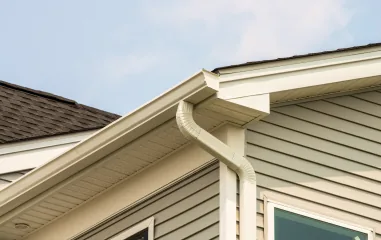
Drain and gutter clearing: Summer debris accumulation, including leaves, sediment, and storm-deposited material, should be cleared from all drains and gutters in September or October.
Sealant inspection: Sealant around all penetrations and flashings should be re-evaluated before winter rains. Sealant that survived summer heat may be cracked or brittle by October.
Insurance documentation: If Houston experienced named storms or tropical systems during the season, the fall inspection report becomes critical insurance documentation. Get the written report before year-end. For help navigating post-storm claims, see M&M’s guide to commercial storm damage roof repair.
Annual Deep-Dive Assessment (January–February): Full Roof Evaluation
The annual assessment goes deeper than the bi-annual inspections. It’s not just a check; it’s a planning tool.
Infrared or moisture scan: For Houston commercial flat roofs, an infrared moisture scan is the single most valuable diagnostic tool available. It detects subsurface water intrusion in insulation and substrate layers that aren’t visible to the naked eye. In Houston’s high-humidity environment, trapped moisture under a membrane that isn’t caught early becomes mold, structural degradation, and eventually a full tear-off situation. An infrared scan costs a fraction of what it prevents.
Maintenance record review: The annual assessment is the time to compile and update the full maintenance log. Every inspection report, every repair record, and every photo log from monthly checks should be organized and filed.
Remaining service life assessment: How many years does this roof have left? What repairs will it need in the next 12–24 months? What’s the realistic replacement timeline? A qualified contractor should give written projections, not verbal estimates.
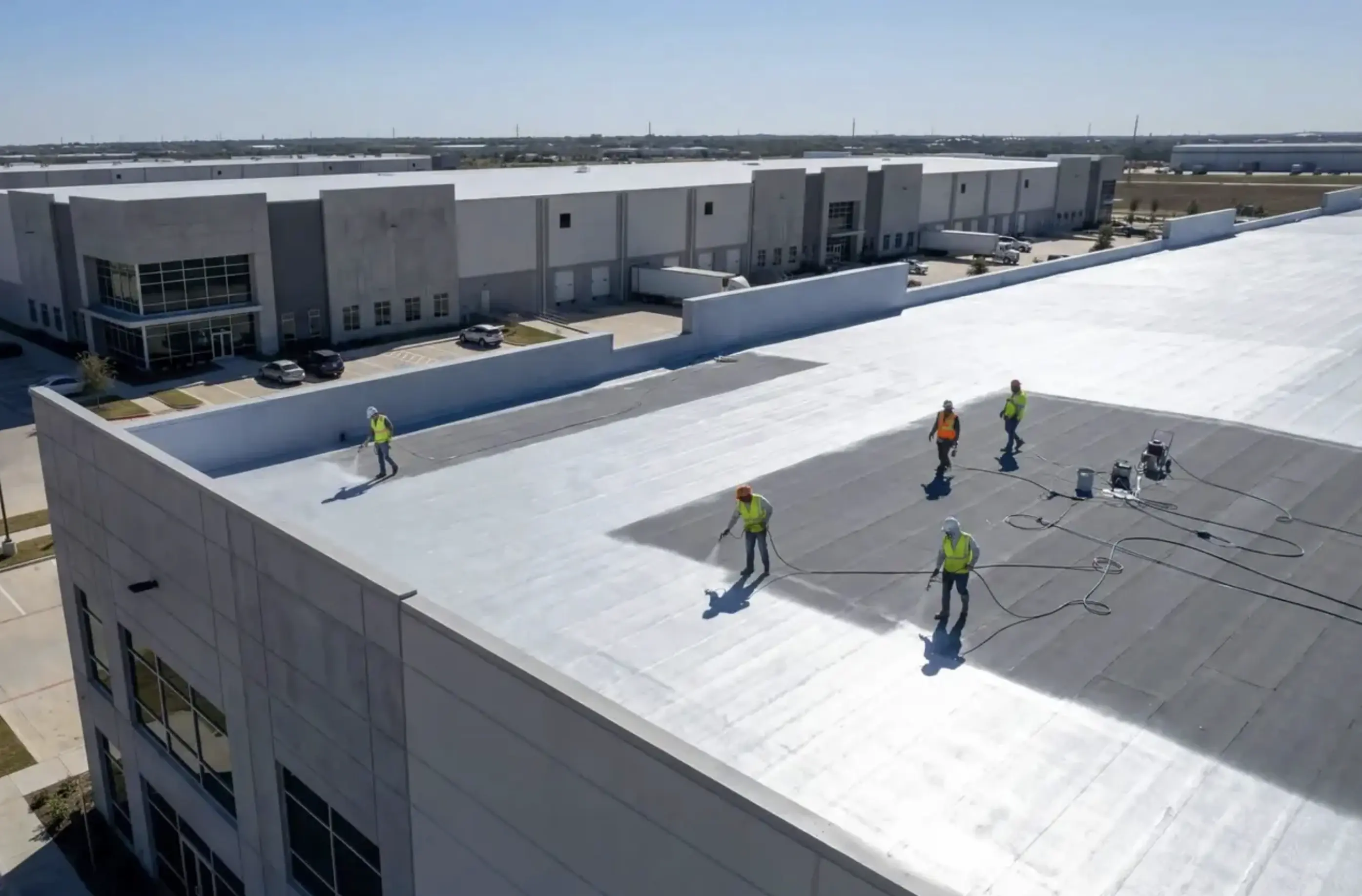
Coating vs. replacement evaluation: Many Houston commercial roofs are candidates for a fluid-applied coating system that can extend service life 10–20 years at a fraction of replacement cost. Learn more about energy-efficient roofing and coating options. The annual assessment is the right time to evaluate whether the roof qualifies.
After M&M’s annual assessments, Doug Moncure personally reviews findings with building owners. Not a project manager, not a report sent by email. Doug calls. That direct accountability is what 40 years and 100,000+ projects look like in practice.
| Inspection Type | Frequency | Who Performs It | Key Focus |
|---|---|---|---|
| Visual walk-through | Monthly | Property staff | Ponding water, interior leak signs, visible surface changes |
| Spring inspection | March–April | Licensed contractor | Pre-hurricane membrane, flashing, drain assessment |
| Summer monitoring | May–August | Property staff | Blistering, HVAC condensate, thermal damage |
| Fall inspection | September–October | Licensed contractor | Storm damage documentation, sealant, post-season assessment |
| Annual deep-dive | January–February | Licensed contractor + IR scan | Moisture scan, service life projection, full record review |
What Should a Commercial Roof Maintenance Plan Actually Include?
A maintenance contract is only as valuable as what’s spelled out in writing. Before signing with any contractor, confirm the plan includes each of these components.
Written scope of services. What gets inspected on each visit. What gets cleaned. What gets documented. Vague scope means vague accountability.
Inspection frequency. Two professional inspections per year are the minimum for Houston commercial buildings. Any contract offering only one annual inspection doesn’t meet the standard for this climate.
Emergency response protocol. How quickly will the contractor respond after a storm event? Same-day for calls before noon is M&M’s standard. Multi-week response windows aren’t appropriate for post-hurricane situations.
Written inspection reports with photos. Every visit should produce a report with dated photographs. This is the documentation that protects insurance claims and proves reasonable maintenance to adjusters.
Warranty maintenance requirements. GAF Master Elite certification (which M&M holds) requires documented maintenance to preserve system warranty coverage. If your building has a manufacturer’s warranty, the maintenance plan must satisfy those documentation requirements, or the warranty becomes void.
Escalation triggers. A good maintenance plan defines what findings automatically trigger a repair recommendation versus a monitoring note. This prevents both over-selling repairs and under-reporting genuine problems.
Cost transparency. The plan should define what’s included in the annual contract price versus what triggers additional charges. Repair work outside the scope should come with written estimates before authorization.
Get a free assessment and custom maintenance plan from M&M Roofing.
How Do You Choose a Commercial Roof Maintenance Contractor in Houston?
The contractor selection criteria here aren’t abstract. They’re a direct response to what goes wrong when property managers choose the wrong vendor.
Verifiable Houston experience. Gulf Coast commercial roofing is a specialty. Hurricane-zone attachment specs, high-humidity moisture management, and ponding water drainage on flat roofs all require specific knowledge that a contractor from Dallas, Phoenix, or an out-of-state national chain may not have. Ask specifically how long the contractor has been maintaining commercial roofs in Houston and what they’ve learned from past storm seasons.
GAF Master Elite or equivalent manufacturer certification. Certification requires verified licensing, adequate insurance, and continuing education. It also gives access to the warranty tiers that protect your building’s roof investment. Fewer than 2% of U.S. roofing contractors hold GAF Master Elite status.
Documented maintenance programs with written reports. Not a drive-by inspection and a verbal update. A written report with dated photos after every visit, filed in a way you can produce if an insurance claim requires it. If a contractor can’t tell you exactly what format their reports take and how you access them, that’s a problem.
Rapid response capability. When a storm comes through Pearland or Sugar Land overnight, and you need a post-storm assessment the next morning, a contractor with a three-week scheduling window isn’t a real maintenance partner. M&M’s same-day inspection commitment for calls received before noon reflects a real operational decision, not a marketing promise.
References from similar commercial properties. Ask for references from office buildings, warehouses, or retail centers similar to yours. Residential references don’t tell you anything about commercial maintenance capability.
M&M Roofing has maintained commercial roofs in Houston since 1983, through 40+ hurricane seasons and over 100,000 completed projects across Texas and Louisiana. Learn more about M&M’s commercial roofing services in Houston.
Frequently Asked Questions
How often should a commercial roof be inspected in Houston?
Twice per year at minimum: spring (March–April) before hurricane season, and fall (September–October) after peak storm season. Houston’s combination of extreme heat, high humidity, heavy annual rainfall, and Gulf Coast hurricane exposure warrants more frequent professional monitoring than inland markets. Monthly visual checks by property staff supplement the professional inspections.
What does a commercial roof maintenance plan cost?
Annual maintenance contracts for Houston commercial buildings typically range from $500 to $2,500, depending on roof size, system type, and scope of services. That compares to an average emergency repair cost of $3,000–$8,000 and a premature replacement cost of $15,000–$50,000 or more. The maintenance contract is the smallest number in that sequence by a significant margin.
Does commercial building insurance require proof of roof maintenance?
Most commercial property policies include a “reasonable maintenance” clause that can be used to dispute or deny claims if maintenance wasn’t documented. A written inspection record from a licensed contractor is the strongest evidence of reasonable maintenance. After major Houston storms, insurance adjusters routinely request maintenance documentation as part of the claims process.
What is the difference between a roof inspection and a maintenance plan?
A roof inspection is a one-time assessment of the current roof condition. A maintenance plan is an ongoing scheduled program: regular inspections, cleaning, minor repairs, and documentation built up over time into a record of care. The inspection tells you where things stand today. The maintenance plan protects the claim if things go wrong tomorrow.
How long does a commercial roof last with regular maintenance?
Well-maintained commercial roofing systems in Houston typically last 20–30 years, depending on the material. TPO and EPDM flat roofs on unmaintained Houston buildings often fail within 12–15 years due to accelerated UV degradation and moisture intrusion. That 10–15 year difference in service life represents a significant difference in capital replacement cost for any commercial building.
What should be included in a commercial roof inspection report?
A proper commercial inspection report includes: dated photographs of all areas inspected, specific findings for membrane condition, flashing condition at all penetrations, drain flow assessment, sealant condition, and a written recommendation for each finding (monitor, repair, repair urgently). The report should be signed by a licensed contractor and filed with the building’s maintenance records.
The Bottom Line on Commercial Roof Maintenance for Houston Buildings
Houston’s climate doesn’t give commercial roofs a break. Fifty inches of rain. 150°F+ summer rooftop temperatures. Six months of hurricane season every year. The buildings that hold up well aren’t the ones with the newest roofs. They’re the ones with the best maintenance records.
A documented commercial roof maintenance plan is the highest-ROI investment a property manager can make. The cost is a fraction of one emergency repair. The documentation is what keeps insurance claims intact after hurricanes. And the service life extension it produces defers the largest capital expense on most commercial buildings for years.
M&M Roofing has been maintaining commercial roofs in Houston since 1983. The team offers same-day inspections for calls received before noon, written reports on every visit, and a personal follow-up from Doug Moncure after every annual assessment.
Book your free commercial roof assessment with M&M Roofing. Get a current condition report and a custom maintenance plan for your building.
References
[1] NOAA National Centers for Environmental Information — Houston, TX Average Annual Precipitation
[2] National Weather Service — Houston/Galveston Climate Overview
[3] National Roofing Contractors Association (NRCA) — Roof Maintenance and Service Life Guidance