









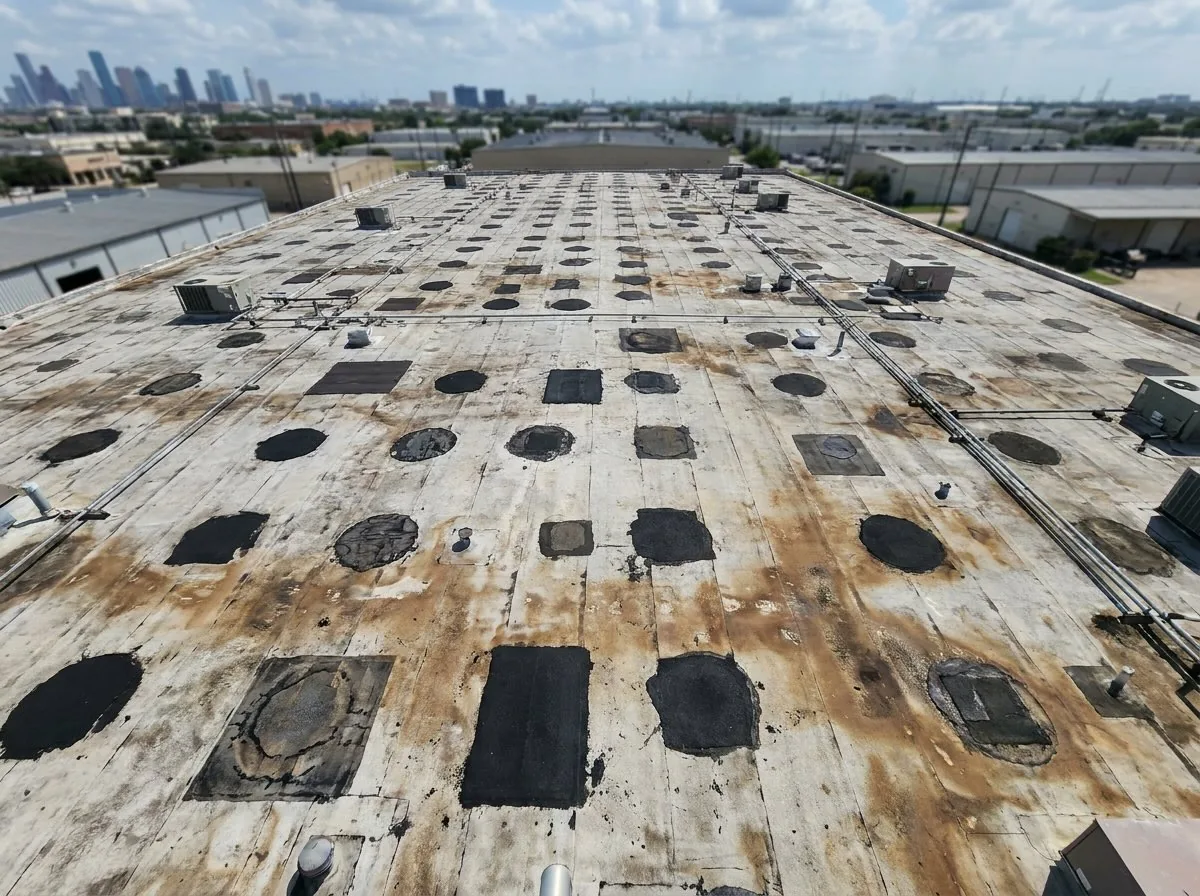
Most flat roof repairs in Houston fail within 12–24 months because they address surface symptoms rather than the underlying cause: moisture that has already penetrated the insulation layer beneath the membrane. Once water reaches the substrate, patching the surface does nothing for the saturated deck below. The honest diagnostic question isn’t “can this be patched?” It’s “has moisture already compromised more than 25% of the roof system?” If it has, the cost of repeated patching will exceed full membrane replacement within two years.
There’s a building owner in Spring Branch who called M&M after his third flat roof repair in four years. Three different contractors. Three different sections of the roof. The leaks kept moving.
He wasn’t unlucky. He was experiencing the most predictable pattern in Houston flat roofing, and nobody had explained it to him honestly yet.
This article does that. It explains why patches fail in Houston’s climate, how to tell if your flat roof can actually be saved, and what the honest cost math looks like when you stop comparing “repair” to “replacement” as individual line items and start comparing them as competing multi-year investments.
Why Flat Roofs Are Different — And Why Houston Makes It Harder
Sloped roofs are designed to shed water. Gravity does most of the work. Flat roofs (technically “low-slope” systems) can’t rely on pitch. They depend entirely on membrane integrity and drainage to keep water out. When either fails, water doesn’t run off. It sits.
In most climates, this is manageable. In Houston, it compounds fast.
Four specific factors make flat roofs in Houston more vulnerable than in most of the country.
Standing water. Houston averages 49–50 inches of rainfall per year, well above the national average of 38 inches. [1] A flat roof with even a minor drainage issue holds water after every significant rain event. Standing water tests every seam and penetration continuously.
UV intensity. Houston’s 204+ sunny days per year expose TPO and EPDM membranes to UV radiation that would take 25+ years to accumulate in northern markets. Plasticizers in the membrane break down, the surface chalks or crazes, and seams become brittle, often well before the rated lifespan.
Humidity. Houston’s average relative humidity runs 74–81%, depending on the season. [2] Any breach in the membrane is immediately exploited. Moisture doesn’t just enter when it rains. It migrates through the tiniest opening whenever the outside air is more humid than the building’s interior. Once it reaches insulation, it stays.
Thermal cycling. Houston’s temperature swings, from 90°F summer days to cold fronts that can drop 30°F overnight, stress heat-welded TPO seams and flashing bonds through repeated expansion and contraction cycles. A seam that held through summer may fail the first time it gets cold.
The result: flat roofs in Houston degrade faster than manufacturer lifespan ratings suggest. TPO rated for 20–30 years in moderate climates shows 15–20 year real performance in Gulf Coast conditions. Every small breach spreads faster here because humidity and standing water exploit weak points that might go unnoticed for years in drier regions. Learn more about flat roof systems and materials.
The 3 Reasons Flat Roof Patches Fail
Reason 1: The Leak Location Is Never Where the Problem Started
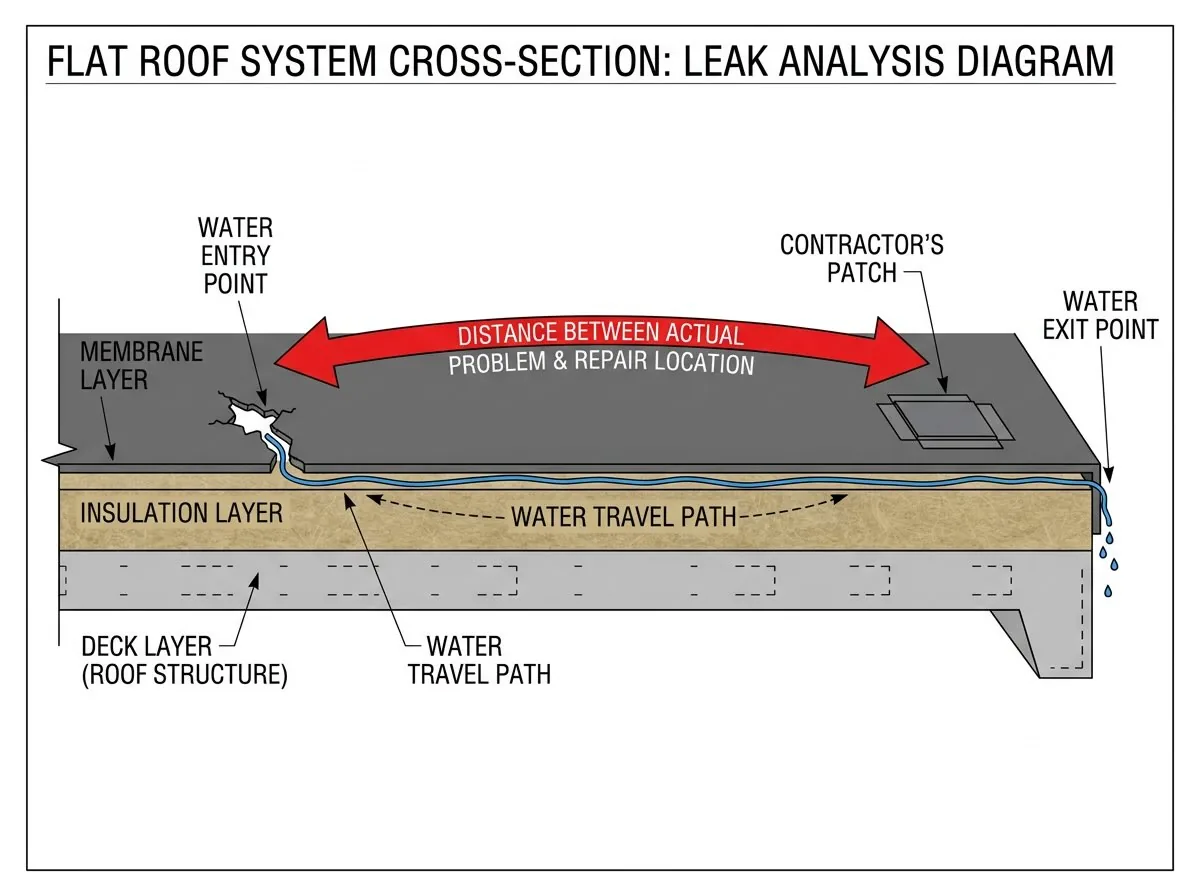
Water travels. Under a flat roof membrane, it enters at one point and travels, sometimes 10, sometimes 20 feet, before it finds a deck penetration or low spot to exit through. What the building owner sees is a drip from the ceiling at Point B. What the contractor patches is Point B.
The entry point is at Point A.
In Houston’s heavy rain events, water enters through a seam failure or penetration gap and travels laterally under the membrane, following the path of least resistance across the insulation layer. The patch at Point B holds. Six months later, Point C, the next low spot or penetration in the water’s travel path, fails. Then Point D.
This is why so many Houston flat roof owners describe the leaks as “moving around the roof.” They’re not. The entry point hasn’t changed. The water is just finding new exit routes as each patch blocks the previous one. A proper repair starts with moisture mapping: tracing where water entered the system, not just where it appeared.
Reason 2: If Moisture Reached the Insulation, the Surface Patch Does Nothing
Most flat roof systems have three functional layers: the membrane on top, rigid insulation in the middle, and the roof deck at the bottom. The membrane is the waterproofing layer. The insulation provides thermal resistance. The deck is structured.
When moisture penetrates the membrane and reaches the insulation, two things happen immediately.
First, the insulation loses R-value. Wet insulation doesn’t insulate. A building owner whose flat roof has been “repaired” multiple times is often paying significantly more in cooling costs because the insulation layer has been partially saturated for months or years. They just don’t know it. For more on how insulation degradation affects energy costs, see energy-efficient roofing systems.
Second, the wet insulation holds moisture against the roof deck. The deck begins to rot or delaminate. A surface patch does nothing for this process. The membrane looks sealed. Underneath, the substrate continues to deteriorate.
M&M uses infrared scanning and core sampling to check insulation saturation before recommending any repair. When wet insulation is found, we show the building owner exactly what we found and explain what it means for their options.
Reason 3: Houston’s UV and Heat Are Degrading the Entire Membrane, Not Just the Patched Section
A patch fixes one location. Membrane degradation isn’t localized. It’s a system-wide aging process.
When Houston’s UV exposure and thermal cycling stress a membrane, every seam, every penetration, every area of surface exposure is aging simultaneously. A patch applied at 12 o’clock doesn’t slow the degradation at 3 o’clock or 9 o’clock. The patched section holds. The membrane ages around it.
Six months later, the next weakest section fails. The leaks “keep moving” because there are progressively more weak points as the membrane ages.
This is where the 25% rule becomes the honest decision point. When more than 25% of the membrane surface is compromised, either visibly or through moisture mapping, the roof has entered whack-a-mole territory. Patching one section will be followed by another failure within months. At that point, the cumulative patch cost over the next 24 months will approach what a full membrane replacement would have cost today.
The Math We Show Houston Building Owners Before They Write Another Check
This is the conversation M&M has been having with Houston building owners for 40+ years. It’s not a sales pitch. It’s the math most contractors don’t show because they’d rather sell the next patch than explain why it won’t hold.
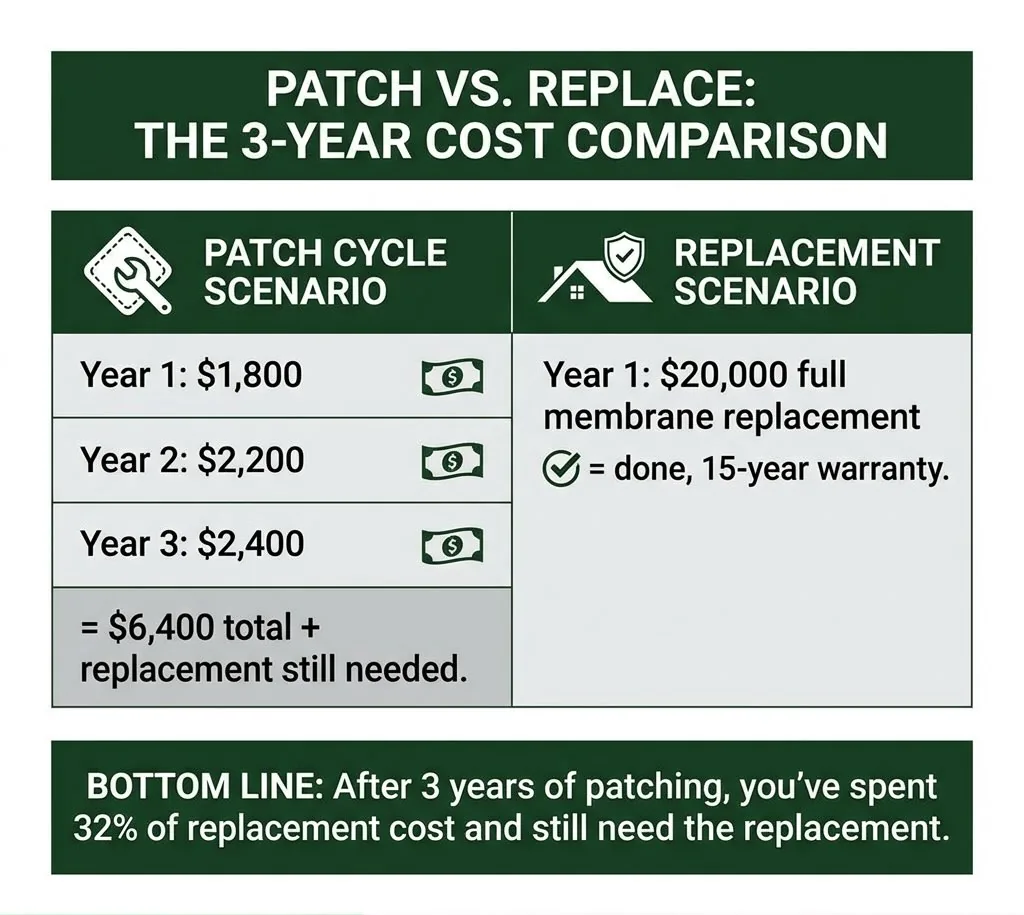
Here’s what the pattern actually looks like. A flat roof owner calls M&M after spending $1,200, then $1,800, then $2,400 on three patches over 36 months. Total: $5,400. Their TPO roof is 14 years old, covering 4,000 square feet.
A full membrane replacement on that footprint runs $18,000–$22,000, depending on material, deck condition, and whether old membrane needs to be removed. [3]
Here’s the math they haven’t done: if the patch cycle continues at roughly $2,000–$2,500 per year, and the roof has three to four years of patchable life remaining before a major failure forces replacement, they’ll spend another $6,000–$8,000 in patches over the next three years. And still face a full membrane replacement at the end of it. On a roof that’s now 17–18 years old, possibly with a compromised deck that adds to replacement cost.
The three-year cost of continuing to patch: $6,000–$8,000. That’s 30–40% of full replacement cost without adding a single day of extended useful roof life.
| Scenario | Year 1 | Year 2 | Year 3 | 3-Year Total |
|---|---|---|---|---|
| Continue patching (4,000 sq ft, 14-yr-old TPO) | $2,200 | $2,400 | $2,600 + replacement still needed | $7,200+ and replacement deferred, not avoided |
| Full TPO membrane replacement now | $18,000–$22,000 | $0 | $0 | $18,000–$22,000 — 15–20 yr lifespan, lifetime labor warranty |
Patch costs are illustrative averages for Houston commercial flat roof repairs 2024–2025. Replacement costs based on $4.50–$5.50/sq ft for a 4,000 sq ft TPO system. Deck condition, membrane removal, and drainage improvements add cost. See repair or replace: how to decide for the full decision framework.
The second piece is the one most building owners don’t account for: energy cost. When M&M finds wet insulation on a flat roof that’s been “repaired” multiple times, we regularly document insulation saturation across 30–50% of the roof surface. On a 4,000 square foot Houston commercial building, that level of insulation degradation can represent thousands of dollars per year in increased cooling costs. The patch held the surface, but the building has been leaking energy for months.
Three years of patching buys no additional roof lifespan. It buys time before an unavoidable replacement on a degraded substrate. That’s the math. Get a free inspection and we’ll run it for your specific roof →
How to Tell If Your Houston Flat Roof Can Be Saved
Not every flat roof needs replacement. Patches are the right call for the right roof. Here’s the decision framework M&M uses, with an honest answer for each tier.
Tier 1: Good Patch Candidate
Your roof is likely worth patching if it’s under 12–15 years old with fewer than two prior patches, moisture mapping shows no insulation saturation, damage is isolated to a single seam failure or penetration, and the estimated compromised area is under 15% of the total membrane. If your roof is in Tier 1, M&M will tell you to patch it. We don’t manufacture urgency where it doesn’t exist.
Tier 2: Needs Honest Assessment Before Spending Money
Before writing another check for a repair on a Tier 2 roof, get the diagnostic first. Signs you’re in Tier 2: 12–18 years old, two to four prior patches, some moisture in insulation that appears isolated, 25–40% of membrane showing visible wear or seam stress, and prior patches that haven’t held beyond 18 months.
At this stage, M&M recommends a core sample and infrared assessment before recommending patch or replace. The diagnostic is free. Finding out your insulation is saturated before you write a $2,500 repair check is the only way to know if that check makes sense.
Tier 3: Past the Point of Return
Replacement is the honest answer when the roof is 18+ years old, has four or more prior patches, moisture mapping shows widespread insulation saturation, 40%+ of the membrane is compromised, or the deck is showing signs of rot or delamination at any probe point.
Tier 3 roofs aren’t the result of neglect. They’re the result of maintenance performed without the diagnostic information that would have changed the recommendation years earlier. Most building owners don’t know they’re in Tier 3 until M&M shows them the core sample.
What M&M Does Differently on Houston Flat Roof Assessments
M&M has been repairing and replacing flat roofs in Houston for over 40 years, across commercial properties in Spring Branch, Pasadena, Baytown, the Energy Corridor, and throughout the greater Houston metro. [4] In that time, one pattern became consistent enough that M&M now treats it as standard protocol: before recommending any flat roof repair, find out whether the problem is actually patchable.
Here’s what a M&M flat roof assessment includes.
Moisture mapping. The assessment starts with moisture mapping, not a visual inspection of the leak site. Infrared scanning identifies temperature differentials that reveal trapped moisture in the insulation layer. Where necessary, core sampling confirms what the IR scan shows. We show the building owner exactly what we found, in plain terms.
Membrane age and system assessment. TPO, EPDM, and modified bitumen all have different failure patterns and remaining lifespan indicators. A 14-year-old TPO membrane in Houston has different options than a 10-year-old one. M&M identifies the system, its installation quality, and its realistic remaining life before recommending anything.
Honest written cost comparison. We put the patch-vs-replace math on paper, specific to the building owner’s roof. Square footage, system type, current condition, estimated patch life remaining, and full replacement cost. If patching delivers better three-year value, we say so.
No pressure on the honest answer. M&M’s lifetime labor warranty on new roof installations means M&M is structurally incentivized to only recommend replacements that will actually hold. That warranty doesn’t get honored twice if the replacement fails. So the recommendation only goes toward replacement when it’s genuinely the right answer. If your roof is a Tier 1 patch candidate, M&M will tell you, give you the repair scope, and leave.
The assessment is free. Schedule your free flat roof inspection → M&M will show you what you actually have, not what a contractor hoping to sell the next patch wants you to believe.
Frequently Asked Questions
How much does flat roof repair cost in Houston?
Targeted flat roof repairs in Houston typically run $500–$2,500 for isolated leak repairs or single penetration failures. Major repairs involving multiple leak sources or partial membrane replacement run $2,000–$6,000 or more. If moisture has reached the insulation layer, repair costs escalate significantly, and patching often stops making financial sense. M&M provides a free assessment and written estimate before any work begins.
How long do flat roof repairs last in Houston?
A properly diagnosed and executed patch on a fundamentally sound membrane can last five to ten years. A patch applied to a system with widespread membrane degradation or insulation saturation typically lasts 12–24 months before the next section fails. The variable isn’t patch quality. It’s whether the underlying system is still a viable candidate for localized repair.
Is it better to repair or replace a flat roof in Houston?
It depends on roof age, extent of membrane degradation, and whether moisture has reached the insulation layer. Roofs under 12–15 years with isolated damage and no insulation saturation are typically good patch candidates. Roofs 15+ years with recurring leaks and moisture in the insulation are almost always better candidates for full membrane replacement. Continued patching approaches 30–40% of the replacement cost within two years without adding any roof lifespan.
What’s the best flat roof material for Houston’s climate?
TPO (Thermoplastic Polyolefin) is the most commonly installed and generally best-suited for Houston. It’s heat-reflective, UV-resistant, and its heat-welded seams resist humidity better than adhesive-bonded alternatives like standard EPDM. Modified bitumen is an older technology and typically shows shorter service life in Gulf Coast conditions. M&M installs all major flat roof systems and recommends based on building type, budget, and condition. See the full breakdown at M&M’s flat roof systems guide.
Can I just coat my flat roof instead of replacing it?
Roof coatings are a legitimate solution for the right candidate: a structurally sound membrane with no insulation saturation that’s showing surface wear or minor seam stress. Applied to a compromised membrane with wet insulation beneath it, coatings peel within one to two seasons. M&M includes a coating-candidacy assessment in every flat roof inspection and will tell you honestly whether your roof qualifies before you spend money on it.
The Bottom Line for Houston Building Owners
Flat roofs in Houston fail faster than most climates because of the compound pressure of heat, UV, humidity, and standing water. Patches make sense when the system is fundamentally sound. They become expensive band-aids when the underlying membrane and insulation are already compromised. The only honest way to know which situation you’re in is a diagnostic, not another patch-and-pray.
M&M has been doing this in Houston for more than 40 years. The answer isn’t always replacement. But it’s never “keep patching without checking what’s underneath.” Get your free flat roof inspection — we’ll tell you what you actually have →
References
[1] US Climate Data — Houston, Texas Annual Precipitation
[2] US Climate Data — Houston Average Humidity by Month