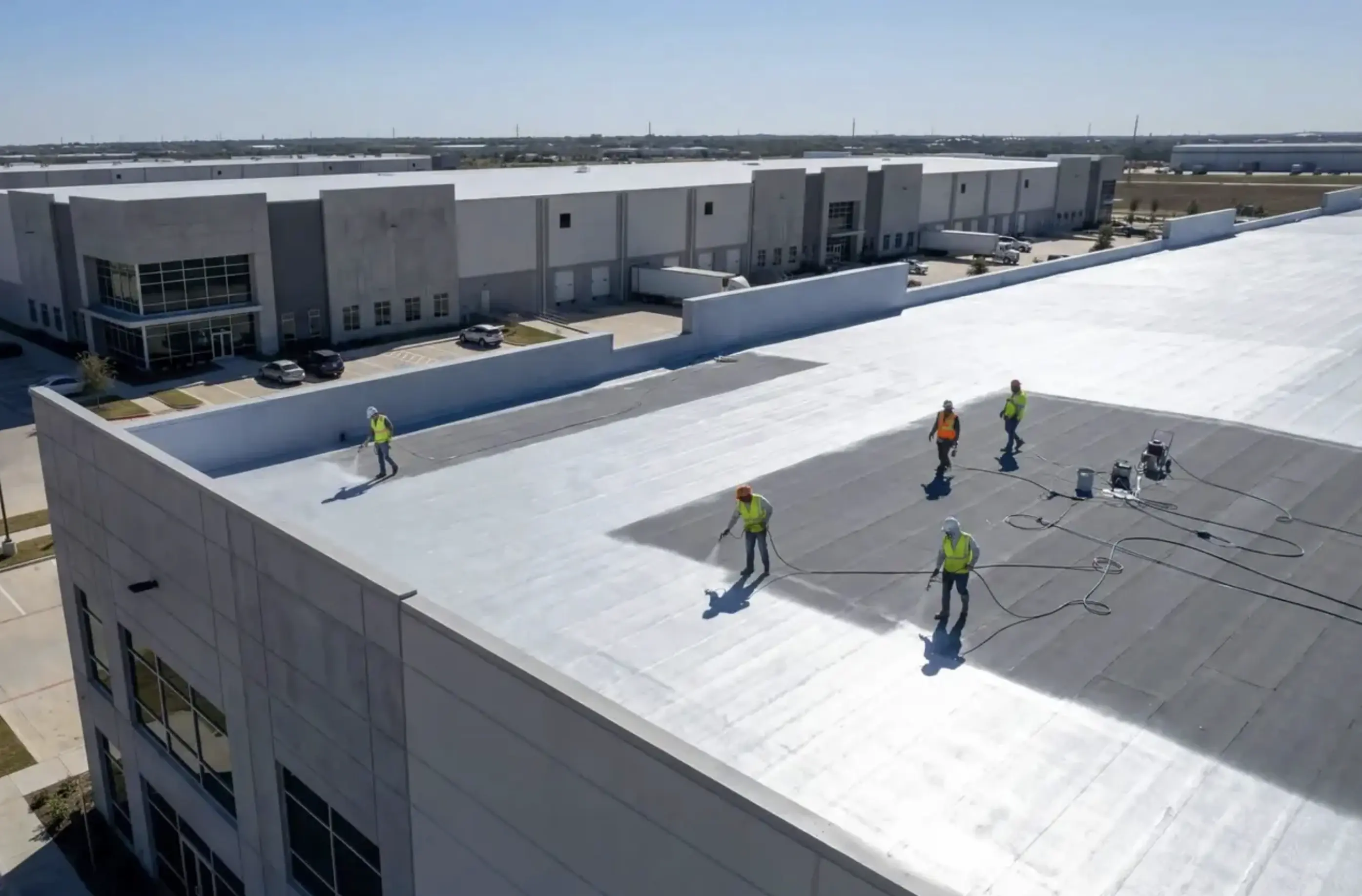




The general industry threshold is the 50% Rule: if repairs will cost more than 25–50% of a full replacement, replacement is the smarter long-term investment. Key decision factors include the roof’s age relative to its expected lifespan, the percentage of membrane affected, whether the decking is compromised, and the building’s repair history. M&M Roofing provides free commercial roof inspections and honest repair-vs-replace assessments backed by 40+ years of Gulf Coast roofing experience.
A leaking commercial roof puts inventory, equipment, and tenants at risk. For the facilities director or property manager, it also puts your credibility on the line. The real question isn’t “is it leaking?” It’s “do I spend $5,000 now or $150,000 later, and what happens if I choose wrong?”
That’s the decision facilities directors and property managers botch most often. They accept a contractor’s recommendation without understanding the criteria behind it. A repair-only contractor recommends repair. A replacement contractor recommends replacement. Without a framework to evaluate those bids independently, you’re guessing on a six-figure decision.
This guide walks you through five hard factors that determine repair vs. replace, real 2026 Gulf Coast costs, what a legitimate inspection actually includes, and how to spot a contractor who won’t spin a repair into a replacement.
The 5 Factors That Determine Repair vs. Replace
No single factor makes the call. The decision comes from looking at all five together.
Factor 1: Roof Age vs. Expected Lifespan
Every commercial roofing system has a design lifespan. The National Roofing Contractors Association publishes these benchmarks [1]:
| System | Expected Lifespan |
|---|---|
| TPO | 20–30 years |
| EPDM | 20–25 years |
| Modified Bitumen | 15–20 years |
| Built-Up Roofing (BUR) | 15–30 years |
| Standing Seam Metal | 40–70 years |
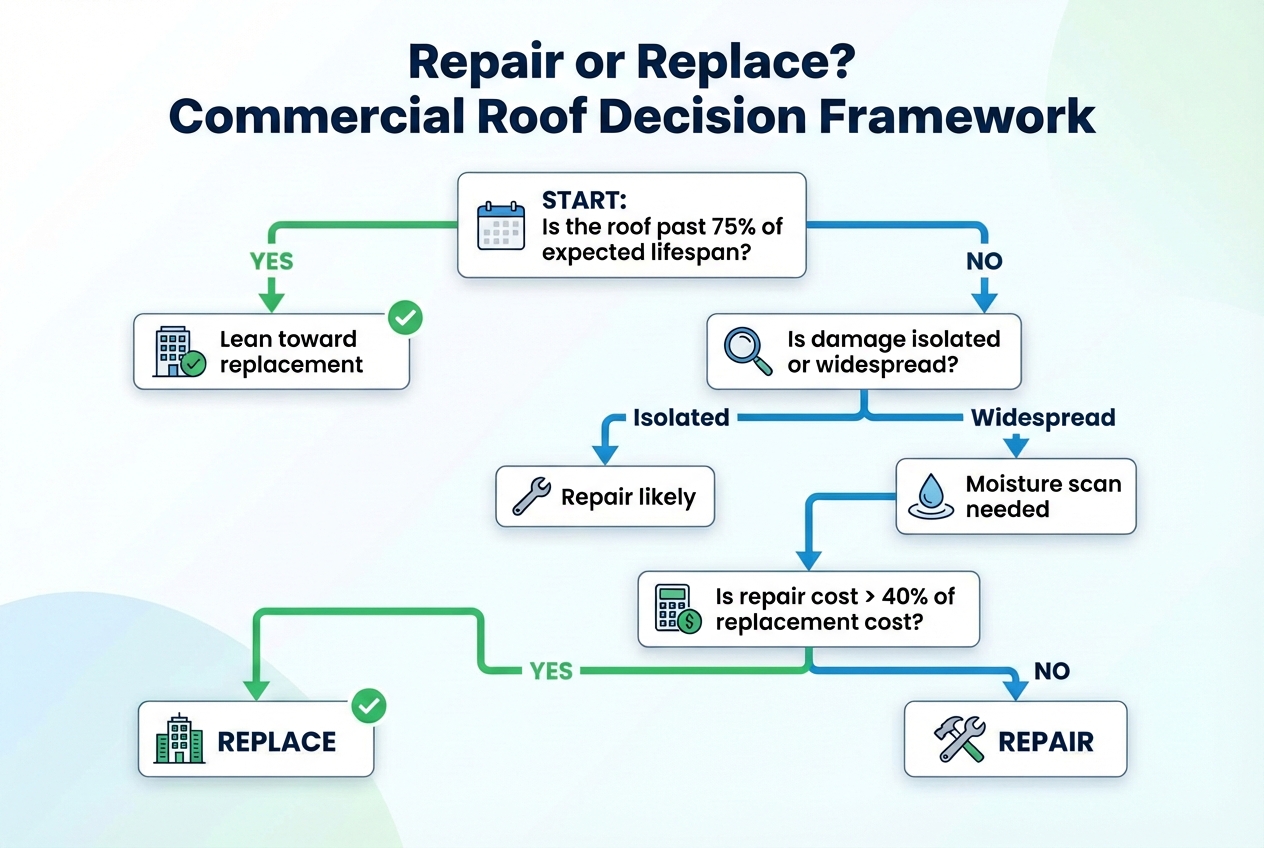
Hit 75–80% of expected lifespan? Repairs start returning less and less value. You’re patching a system that’s already aging out. Money spent now buys only a few extra years.
A practical example: a 22-year-old EPDM roof with an active leak. That system is expected to last 20–25 years. A repair might keep it functional for 2–3 more years. But a replacement now delivers a new membrane, a new warranty, and no emergency call at 2 a.m. in year 24 when the next seam fails.
Factor 2: The 50% Rule
The commercial roofing industry’s standard threshold: if repair costs exceed 25–50% of the cost of a full replacement, replacement is the better long-term investment.
The math: A new TPO membrane on a 20,000 sq. ft. warehouse runs $120,000–$160,000. If repairs will cost $60,000 or more, you’re paying half the price of a new roof to buy an aging system for only a few extra years. Replacement gives you a new warranty, a reset on lifespan, lower energy bills, and no emergency call at 2 a.m. in year 24.
This threshold should be calculated against your specific building’s replacement cost, not industry averages. Get a written replacement estimate first. Then evaluate the repair bid against that number.
Factor 3: Percentage of Membrane Affected
An isolated puncture is a very different problem from systemic membrane failure. A targeted repair stops today’s leak. Widespread damage requires a different answer.
M&M uses moisture scanning and core sampling to map the extent of water penetration into the insulation. When moisture has infiltrated more than 25–30% of the membrane area, repair doesn’t fix the root problem. The wet insulation below has already lost its insulating properties [3], and water continues to migrate no matter how well you patch the surface.
If the moisture scan shows contained, localized damage, repair is straightforward. If it shows widespread saturation, you’re looking at a systemic failure.
Factor 4: Deck and Structural Condition
The membrane sits on top of the deck. If the deck is compromised, membrane repair alone doesn’t solve the problem.
Rotted wood nailers, corroded steel deck, and deteriorated concrete all require structural remediation before any new membrane work can hold. Deck repair adds significant cost and almost always shifts the math toward full replacement. Any credible commercial roof inspection includes a deck condition assessment at suspect areas, not just a surface-level membrane check.
Factor 5: The Repair History
A roof patched three to five times in three years is sending a message: the membrane is done. It can’t hold up anymore.
Ask your contractor to pull the building’s repair history and calculate the average annual repair cost over the past five years. If that annual spend is approaching 10–15% of the total replacement cost, the math strongly favors replacement. You’re paying recurring costs on a depreciating asset instead of resetting to a new system with a full warranty [2].
Not sure whether your commercial roof needs repair or replacement? M&M’s free inspection gives you a documented assessment with no sales pressure. Schedule today.
Common Types of Commercial Roof Repairs (and What They Cost)
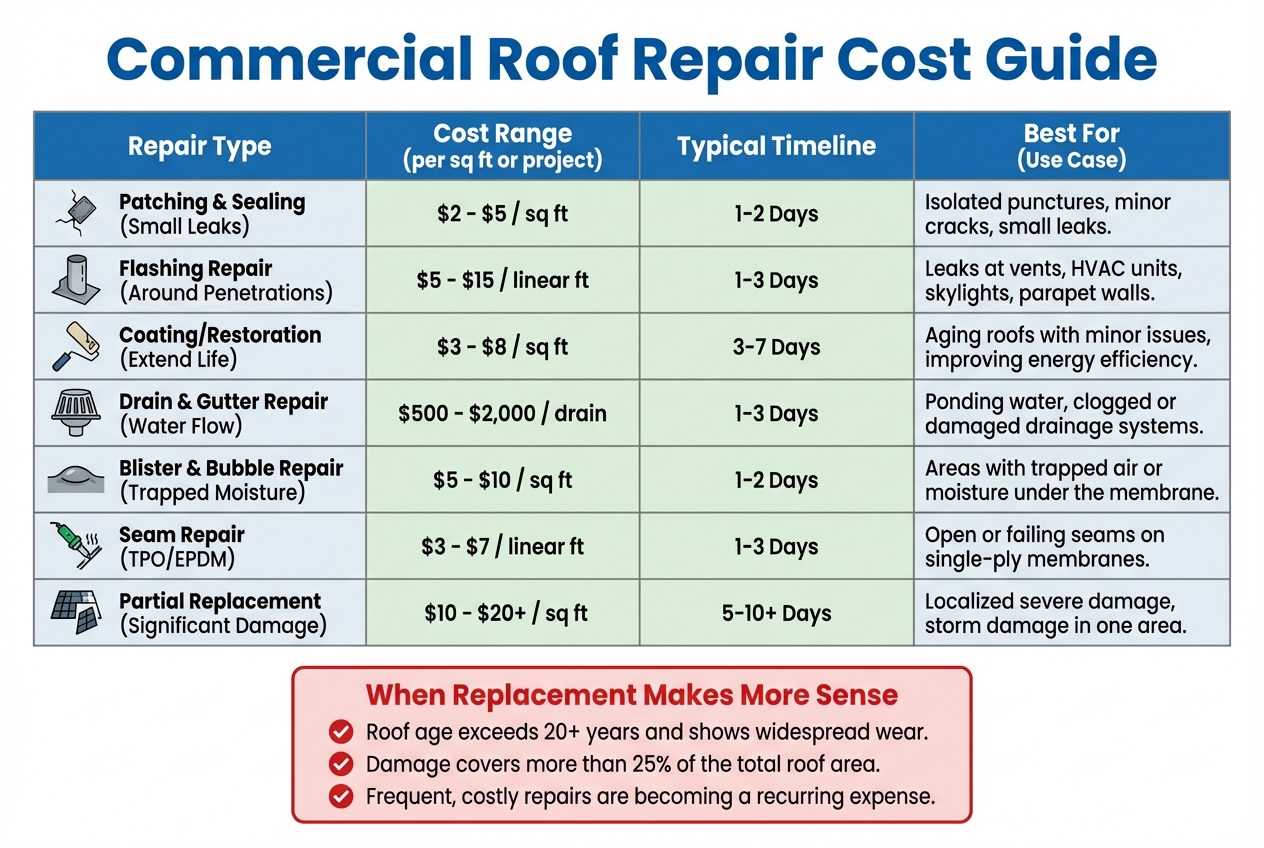
Most roofing contractors won’t publish costs. Here are real Gulf Coast market rates for 2026:
| Repair Type | Typical Cost Range | When It’s Appropriate |
|---|---|---|
| Isolated membrane patch | $500–$2,500 | Single-point damage; roof otherwise in good condition |
| Seam re-bonding / seam tape repair | $1,000–$4,000 | Failed seams in TPO or EPDM; common in Gulf Coast heat |
| Flashing repair or replacement | $1,500–$5,000 | Flashing failure at penetrations, edges, or parapets |
| Drain repair or replacement | $500–$2,000 per drain | Clogged, slow, or failing roof drains |
| Roof coating application | $2.00–$5.00/sq. ft. | Aging but structurally sound membrane; adds 5–10 years |
| Emergency leak repair | $1,500–$8,000 | Active intrusion; stops damage immediately, followed by permanent repair assessment |
| Partial section replacement | $8,000–$30,000+ | Localized severe damage where a larger section must be replaced |
These reflect typical Gulf Coast commercial repair costs. Final pricing depends on roof access, membrane type, extent of damage, and materials. M&M provides itemized written estimates with no hidden fees.
When Repair Is the Right Call
Repair makes sense when the numbers back it up. Watch for these signs:
- Roof is less than 15 years old (TPO or EPDM) or under 10 years old (modified bitumen)
- Damage is isolated to a specific area or penetration
- Moisture scan shows no widespread wet insulation
- Deck is confirmed sound and dry
- Annual repair cost history is under 5–8% of replacement cost
- Property is being sold or leased in the near term, and full replacement doesn’t pencil out
When Replacement Is the Right Call
Replace when the numbers point there. The indicators:
- Roof is at or past 75–80% of its expected lifespan
- Multiple concurrent leak points or a chronic repair history
- Widespread wet insulation confirmed by moisture scan
- Deck damage or structural compromise discovered during inspection
- Energy costs are climbing (aging roofs lose insulation value over time)
- Repair bids are approaching 40–50% of replacement cost
- Major building expansion or renovation is planned
M&M Roofing handles both: repair when that’s the right call, replacement when it’s not. Get your free commercial roof assessment.
What a Commercial Roof Assessment Should Include
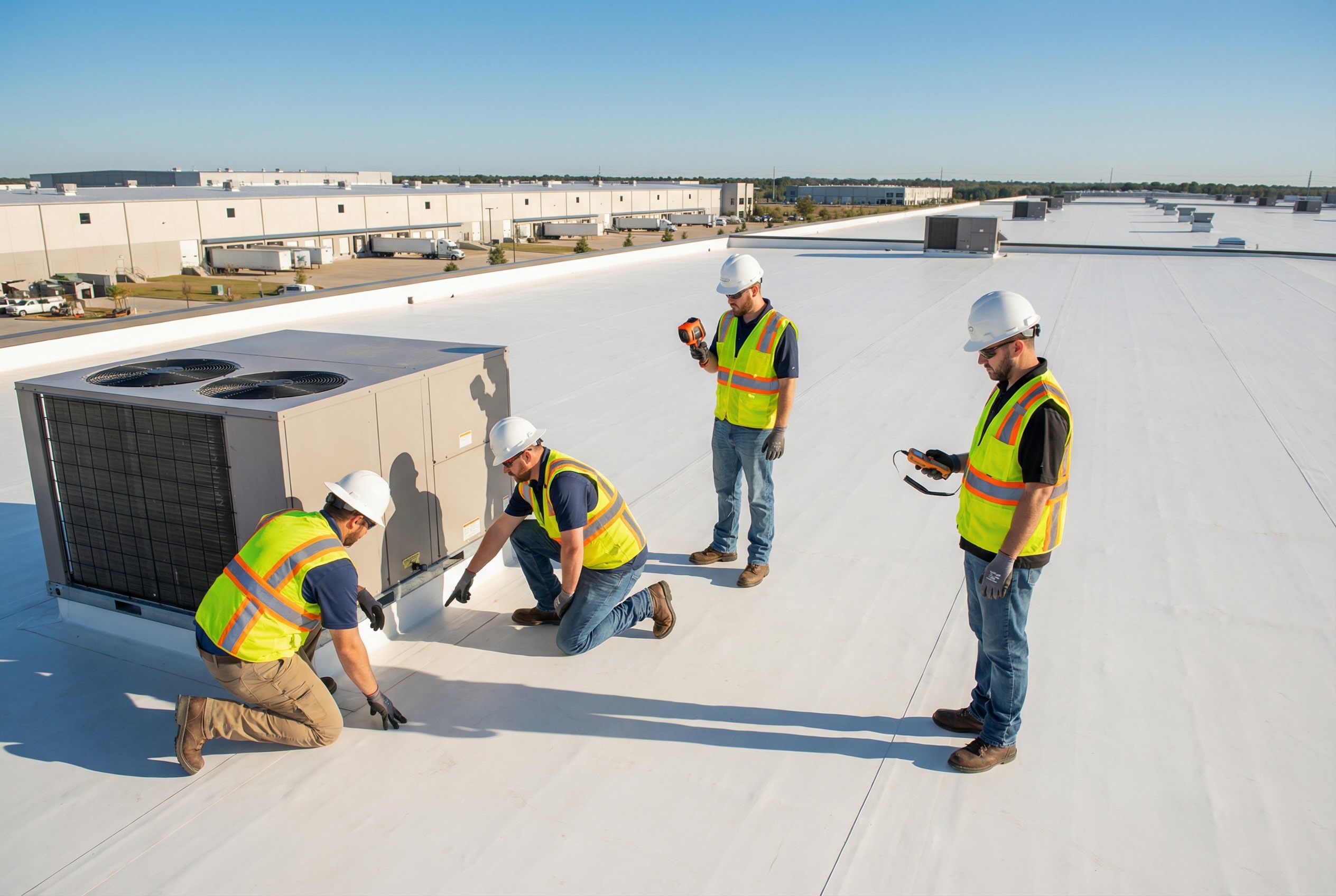
Sometimes, a facilities manager needs a documented assessment that he can defend to ownership or a board. Here’s what a legitimate commercial inspection covers, and what to demand from any contractor before you authorize repair work.
- Visual inspection. Full membrane walk documenting seams, flashings, penetrations, parapets, and drainage. Photographed throughout.
- Moisture scan or infrared survey. Non-invasive detection of wet insulation beneath the membrane. This is the most critical tool for understanding how far moisture has spread. Visual inspection alone cannot detect subsurface saturation.
- Core sampling. Physical samples at suspect areas to confirm insulation condition and deck integrity below the surface.
- Drain inspection. Flow testing and condition assessment of all roof drains and scuppers.
- Structural check. Deck condition assessment at areas of pooling or chronic leaks, wherever accessible.
- Repair history review. If records are available, review past repair documentation to assess cumulative investment and failure patterns.
- Written report. Documented findings, photo evidence, and a clear repair-vs-replace recommendation with supporting rationale you can take to your principal or board.
M&M provides all of the above at no charge. The written report includes photos, moisture scan results, and a specific recommendation backed by the 5-factor framework above. That documentation makes the decision defensible, regardless of which direction it goes.
Commercial Roof Repair for Gulf Coast Properties: What’s Different
Gulf Coast commercial properties face conditions that accelerate roofing system degradation in ways that matter for every repair and replacement decision.
Extreme heat and UV. Texas and Louisiana summers routinely exceed 100°F. TPO and EPDM membranes expand and contract dramatically with daily temperature cycles, stressing seams and penetration flashings far faster than in moderate climates. A seam that would hold for 25 years in Denver might start failing at year 15 in Houston.
Hurricane and high-wind events. Commercial flat roofs are vulnerable to wind uplift. After events like Harvey, Laura, and Ida, roofing contractors flood the Gulf Coast market. Many are unlicensed and have no prior knowledge of your building’s repair history. A long-term contractor who has been tracking your roof pays dividends here.
Humidity and moisture intrusion. Gulf Coast humidity sits at 75%+ year-round. One breach in the membrane, and water soaks into the insulation fast. That wet insulation deteriorates, loses its insulating ability, and grows mold. The gap between a fixable leak and a catastrophic failure is razor-thin. In Denver, you might have months. In Houston, you have weeks.
Ponding water. Low-slope commercial roofs in Houston, Beaumont, Lake Charles, and Lafayette are at chronic risk of ponding from heavy rainfall. Standing water accelerates membrane aging and seam failure. Drainage design is as important as the membrane itself on Gulf Coast commercial properties.
Post-storm contractor surge. After every major storm, unlicensed contractors target commercial property managers with lowball repair quotes. Always verify a contractor’s Texas or Louisiana licensing before signing anything. In Louisiana, projects over $7,500 require a State Licensing Board for Contractors license. Verify it at lslbc.louisiana.gov before signing anything.
M&M has been assessing, repairing, and replacing commercial flat roofs across Houston, Beaumont, Lake Charles, and Lafayette since 1983. The team understands specifically how Gulf Coast conditions degrade TPO, EPDM, and modified bitumen systems over time, and spec repairs accordingly.
How to Choose a Commercial Roof Repair Contractor
5 Questions to Ask Before Signing a Commercial Roof Repair Contract
- “Do you specialize in commercial flat roofing?” Not all roofing contractors have experience with commercial flat roofs. Ask specifically about TPO, EPDM, and modified bitumen. A residential contractor doing commercial work is a different risk profile.
- “Are you manufacturer-certified for my roof system?” Manufacturer certifications matter for warranty protection. An uncertified contractor’s repair can void your existing manufacturer’s warranty. Get the certification number and verify it directly with the manufacturer.
- “Do you inspect before you quote?” Any credible commercial contractor inspects before estimating. A quote without a physical inspection is a red flag. If a contractor quotes from photos or a brief walkover, decline.
- “What is your labor warranty on repairs?” Get the warranty in writing. Two years is a reasonable minimum for commercial repair work. M&M backs all repairs with a written labor warranty. See how M&M’s warranties work.
- “Can you provide references from commercial clients in this area?” Ask for local commercial references, such as property managers, facilities directors, or building owners. Not just homeowners. Volume of commercial work in your specific geography matters.
Red Flags in Commercial Roofing Bids
- Quote provided without a physical inspection
- Request for full payment before work begins
- Unable to provide a manufacturer certification or contractor license number
- Arrived unsolicited after a storm
- Bid is significantly lower than all other estimates (shortcuts on materials or labor are the usual explanation)
- No written warranty on repair work
M&M Roofing is manufacturer-certified, fully licensed in Texas and Louisiana, and backs all commercial work with a written labor warranty. Schedule your free commercial roof assessment today.
Frequently Asked Questions About Commercial Roof Repair
How much does commercial roof repair cost?
Commercial roof repair costs range from $500–$2,500 for an isolated membrane patch to $8,000–$30,000+ for a partial section replacement. Emergency leak repair typically runs $1,500–$8,000. Roof coating applications to extend an aging membrane cost $2.00–$5.00 per square foot. Factors include membrane type, damage extent, roof access, and materials. M&M provides free, detailed written estimates for all commercial repair work.
How do I know if my commercial roof needs repair or replacement?
The key indicators for replacement over repair: roof age past 75–80% of its expected lifespan, repair costs approaching 40–50% of replacement cost, widespread wet insulation confirmed by moisture scan, compromised deck, or a chronic repair history (three or more repairs in recent years). For roofs under 15 years old with isolated damage, repair is typically the right call. M&M’s free inspection delivers a documented recommendation you can take to ownership.
How long does a commercial roof repair last?
A well-done repair on a sound membrane typically lasts 3–7 years. It depends on what you’re fixing, the membrane around it, and the system type. Emergency temporary repairs may last 6–12 months. Roof coating applications can add 5–10 years to an aging but structurally sound membrane. Repairs on a roof already dying don’t work, no matter how good the contractor is.
Can I repair my commercial roof while the building is occupied?
Yes. Most commercial roof repair work can be performed with a building fully occupied. M&M coordinates schedules to minimize disruption, contains all debris and materials, and typically completes focused repairs in one to three days. For larger projects, phased scheduling reduces tenant or operational impact.
Does my commercial roof warranty cover repairs?
It depends on the warranty type. Manufacturer warranties cover material defects; they generally do not cover storm damage, traffic damage, or repairs made by an uncertified contractor. Labor warranties (from your original contractor) cover workmanship failures. If a repair is needed due to installation defects within the warranty period, both may apply. M&M helps commercial clients review warranty documentation before any repair decision to make sure existing coverage is preserved.
How often should a commercial roof be inspected?
The National Roofing Contractors Association recommends a minimum of two professional inspections per year, once in spring before storm season and once in fall after it [2]. Add inspections after any significant storm event. Biannual inspections are the single most effective way to catch repairable damage before it becomes a replacement situation.
Make the Call Before Nature Does
The repair vs. replace decision on a commercial roof is not a gut call. It is a systematic assessment of age, damage extent, repair history, and long-term cost. The five-factor framework in this guide gives facilities directors a defensible process for making that call and a clear way to explain it to ownership.
Start with a contractor who’ll tell you repair is right, even when replacement would pad their bottom line. That’s what M&M has been doing since 1983.
Schedule your free commercial roof inspection today. M&M documents everything, delivers a written report, and tells you the truth.
References
[1] National Roofing Contractors Association. “Commercial Roofing Systems.” https://www.nrca.net/
[2] National Roofing Contractors Association. “Preventive Roof Maintenance Program.” https://www.nrca.net/
[3] Oak Ridge National Laboratory. “Moisture and Its Effects on Insulation Performance.” Building Envelope Research. https://www.ornl.gov/group/building-envelope-research