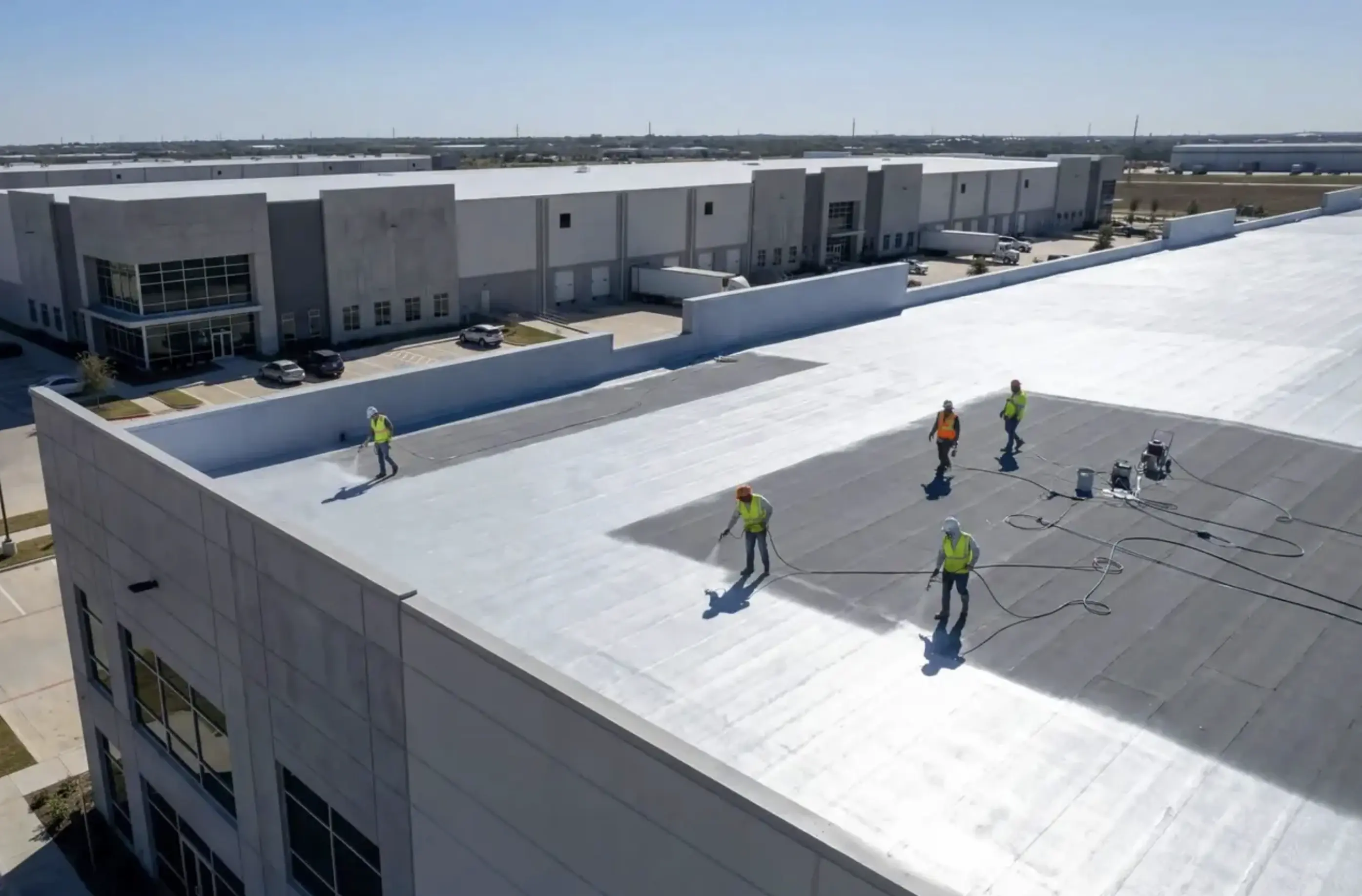




EPDM (ethylene propylene diene terpolymer) is a synthetic rubber roofing membrane used on flat and low-slope commercial and residential roofs for over 60 years. It typically costs $6–$12 per square foot installed, lasts 25–30+ years with proper maintenance, and remains one of the most cost-effective flat roofing systems available. EPDM is known for its durability, weather resistance, and affordability compared to TPO and PVC alternatives.
EPDM has been protecting flat roofs since the 1960s. That makes it the longest-proven single-ply roofing membrane on the market. Yet most property owners still confuse it with TPO, or don’t know which system their building actually has.
The most common EPDM mistake: picking it for price alone while ignoring climate, seam quality, and membrane thickness. Or assuming “rubber roof” and “TPO” are the same thing. They’re not. The differences matter, and they’ll cost you if you ignore them.
This guide walks through what EPDM is, what it costs in 2026, how it compares to alternatives, the three installation methods, and how to know if it’s the right fit for your building in Texas or Louisiana. M&M Roofing has been installing flat roofs across the Gulf Coast since 1983, and our goal is simple: give you the same information we’d want before spending $50,000+ on a roof.
What Is EPDM Roofing?
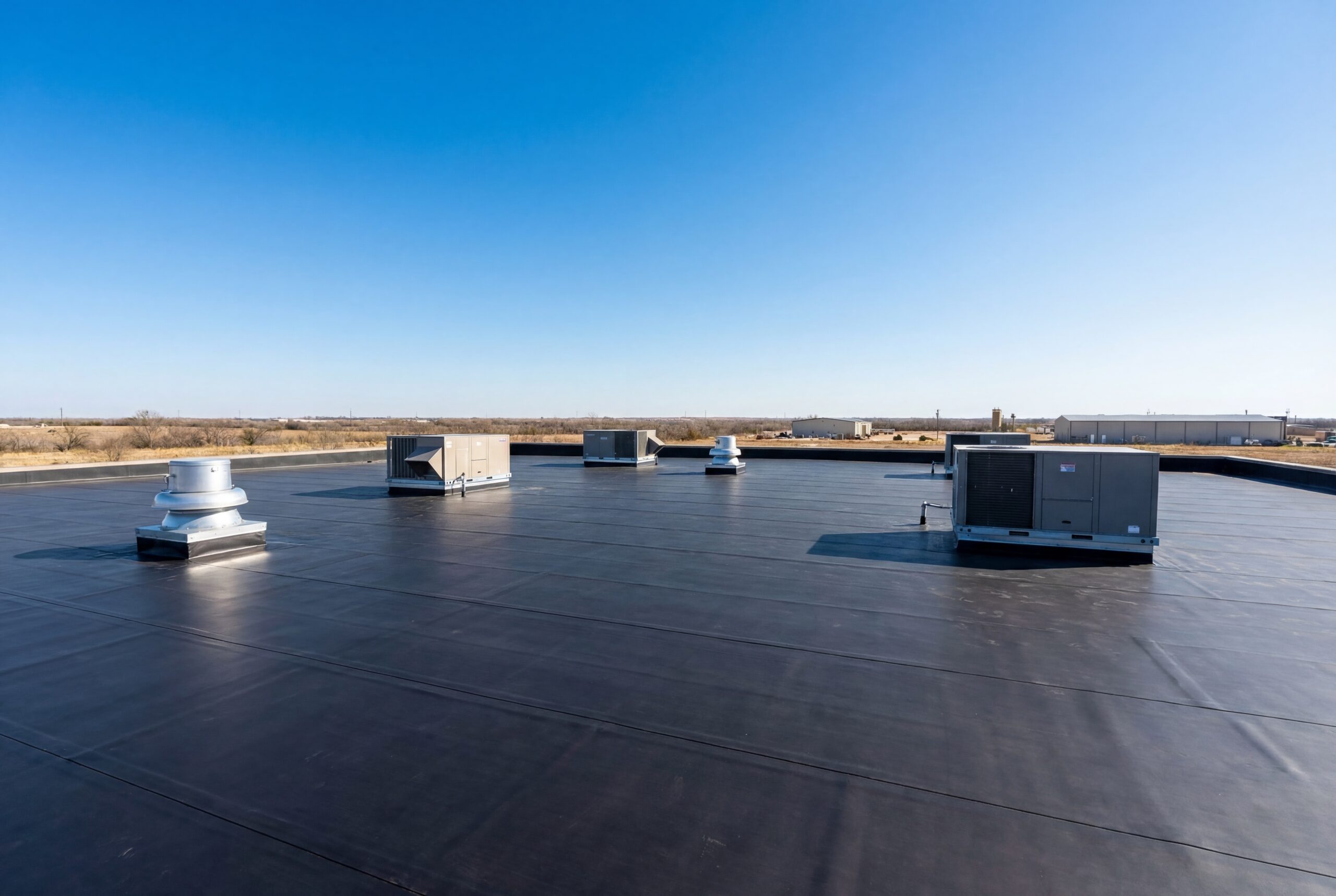
EPDM is a synthetic rubber membrane used on flat and low-slope roofs. In practical terms, it’s a large, flexible sheet made from ethylene and propylene (both derived from oil and natural gas) that gets rolled out across a roof surface and sealed at the seams.
EPDM has been in continuous use since the 1960s, giving it over 60 years of real-world field data. No other single-ply membrane comes close to that track record. When a manufacturer says an EPDM roof lasts 25–30 years, that claim is based on actual roofs inspected and tested after decades of service, not on lab projections [1].
The membrane comes in black, gray, and white, in widths from 7.5 to 50 feet, and in thicknesses of 45, 60, and 90 mil. Black is the most common. The color matters more than most people realize: black EPDM absorbs solar heat, while white EPDM reflects it. In a Texas summer, that distinction directly affects your cooling bill.
What Does EPDM Stand For?
EPDM stands for Ethylene Propylene Diene Terpolymer (sometimes written as “Monomer”). It’s classified as a thermoset material, meaning it cures during manufacturing and can’t be re-melted or heat-welded. That’s the opposite of thermoplastic membranes like TPO and PVC, which can be heated and fused at the seams.
Why does that classification matter? Because thermoset seams are sealed with adhesive or tape instead of heat welding. Adhesive seams are inherently weaker than heat-welded seams, which makes installation quality the single most important factor in EPDM performance. A well-installed EPDM roof lasts decades. A poorly sealed one starts leaking in 5–10 years.
EPDM vs. Rubber Roofing: Are They the Same?
Yes, essentially. “Rubber roofing” is a generic term that almost always refers to EPDM. When a contractor says “rubber roof,” they mean EPDM. Other elastomeric roofing materials exist, but EPDM is by far the most common. If someone tells you your building has a rubber roof, there’s a 95% chance it’s EPDM.
The confusion is understandable. EPDM is a mouthful, and “rubber roof” is easier to say. Just know they’re the same thing.
EPDM Roofing Cost: What to Expect in 2026
EPDM typically runs $6–$12 per square foot installed. Here’s what drives that range:
| Cost Component | Range per Sq. Ft. |
|---|---|
| EPDM membrane | $1.50–$3.50 |
| Insulation | $0.50–$3.00 |
| Labor | $2.50–$4.50 |
| Tear-off (if needed) | $1.00–$2.00 |
For a typical 2,000 sq. ft. residential flat roof, expect to pay $12,000–$24,000 for installation. For a 10,000 sq. ft. commercial roof, $60,000–$120,000. The final number depends on roof size, access difficulty, complexity (penetrations, HVAC units, curbs), insulation choice, membrane thickness, and warranty level.
EPDM membrane costs less than TPO or PVC, but the total installation cost is 5–10% higher because adhesive application takes longer than heat welding [1]. The material savings get partially offset by extra labor hours.
Material pricing has been volatile since 2020. The ranges above reflect early 2026, but the best way to get an accurate number is a free on-site estimate.
EPDM vs. TPO vs. PVC: Cost Comparison
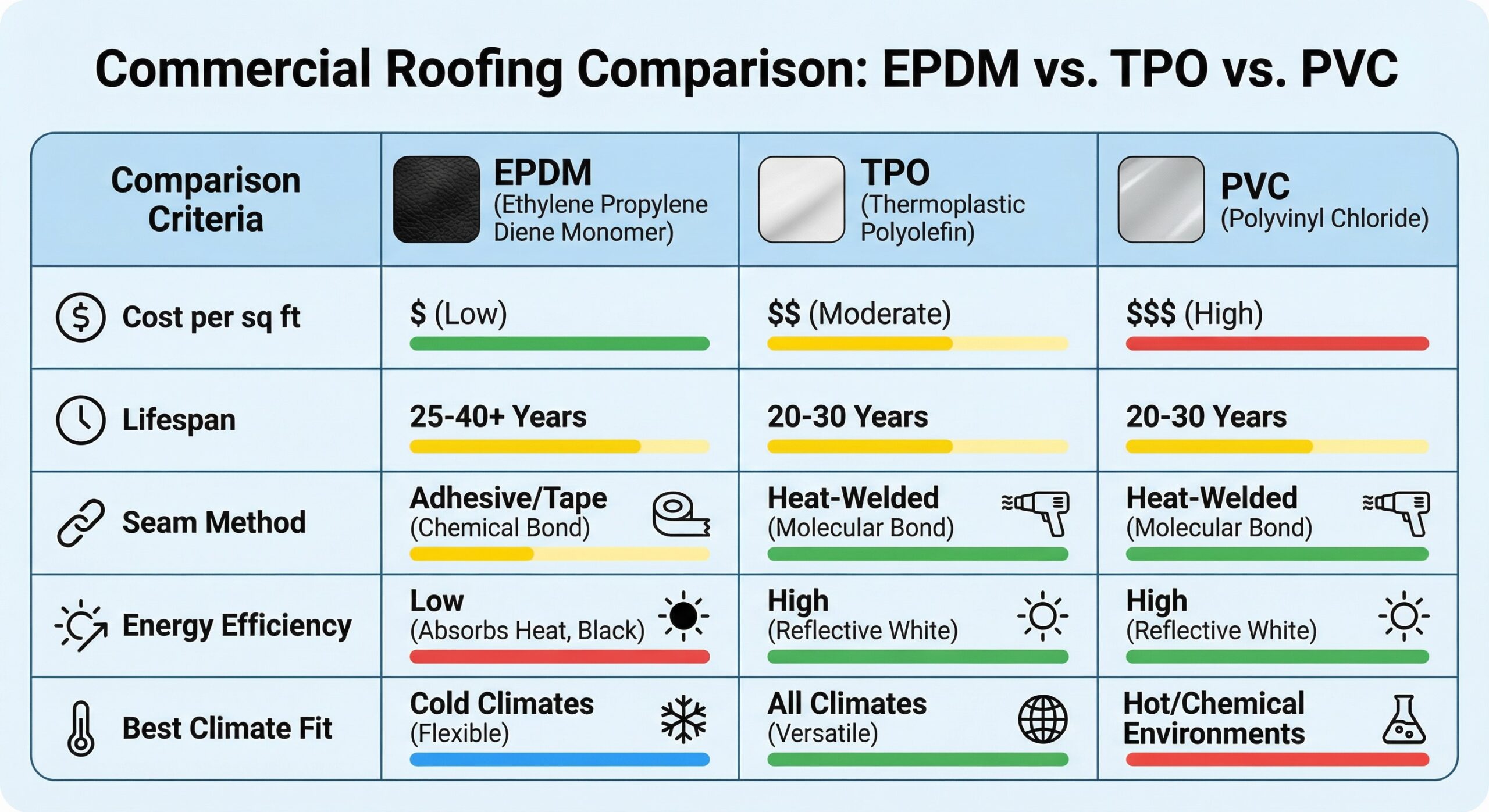
If you’re researching EPDM, you’re probably weighing it against at least one alternative. This table covers the five most common flat roofing systems:
| System | Cost/Sq. Ft. (Installed) | Lifespan | Seam Method | Energy Efficiency | Best For |
|---|---|---|---|---|---|
| EPDM | $6–$12 | 25–30+ yrs | Adhesive/tape | Moderate (black absorbs; white reflects) | Proven durability, cold climates, budget-conscious |
| TPO | $5–$12 | 20–30 yrs | Heat-welded | High (reflective white) | Hot climates, energy savings, wind resistance |
| PVC | $6–$14 | 20–30 yrs | Heat-welded | High (reflective white) | Chemical exposure, restaurants, high-wind areas |
| Modified Bitumen | $4–$8 | 15–20 yrs | Torch/adhesive | Moderate | Low-budget, simple flat roofs |
| Spray Foam | $5–$10 | 20+ yrs (renewable) | Seamless | Very high | Seamless coverage, irregular roof shapes |
EPDM and TPO are priced similarly, but they solve different problems. TPO reflects heat and has stronger seams. EPDM has a longer track record and is easier to repair. For a deeper comparison, see the complete TPO roofing guide.
Not sure which flat roofing system is right for your building? Schedule a free consultation. M&M will help you compare options.
Benefits of EPDM Roofing
- Proven track record (60+ years). EPDM has been in use since the 1960s. No other single-ply membrane can match this real-world longevity data. The EPDM Roofing Association’s 30-year study confirmed that properly installed EPDM membranes met or exceeded ASTM minimum requirements for tensile strength, tear resistance, and elongation even after three decades of field exposure [1].
- Exceptional weather resistance. EPDM withstands UV radiation, ozone, and temperature swings from −40°F to 180°F without cracking or becoming brittle. That flexibility gives it a real advantage over TPO in cold climates and during the wild temperature swings of a Texas spring.
- Cost-effective over the long term. EPDM is typically 15–25% cheaper than PVC and competitively priced with TPO. When you factor in its 25–30+ year lifespan, the cost-per-year-of-life is difficult for competing systems to match.
- Large sheet sizes mean fewer seams. EPDM rolls are available up to 50 feet wide. Fewer seams means fewer potential leak points. On a large commercial roof, this is a significant advantage.
- Easy to repair. EPDM patches and sealants are widely available and straightforward to apply. Unlike TPO or PVC, which require specialized heat-welding equipment for repairs, most EPDM repairs can be done with adhesive and patch material. No specialized crew needed for basic fixes.
- Recyclable. EPDM is recyclable at the end of life and contains no chlorine or plasticizers. Its manufacturing footprint is lower than PVC, which matters if your building has sustainability or LEED targets.
- Three installation options. Fully adhered, mechanically fastened, or ballasted. EPDM offers greater installation flexibility than any other single-ply system, making it adaptable to different building structures and budgets.
Drawbacks of EPDM Roofing (Honest Assessment)
M&M installs EPDM regularly, and it’s a strong system. But every roofing material has tradeoffs. Here’s what to weigh:
- Black EPDM absorbs heat. The most common version (black) absorbs solar heat instead of reflecting it. In Texas and Louisiana, where cooling costs already run 30–50% above national averages, this is a real consideration. White EPDM reflects heat but costs more and is less commonly stocked. For buildings where energy efficiency is the top priority, TPO may be the better choice.
- Adhesive seams are weaker than heat-welded seams. EPDM seams are sealed with liquid adhesive or seam tape, not heat-welded like TPO and PVC. Adhesive-based seams degrade over time and are more vulnerable to wind-driven rain. Seam failure is the #1 cause of EPDM leaks. This makes installation quality absolutely critical.
- Puncture vulnerability. EPDM is softer than TPO or PVC and more susceptible to puncture damage from foot traffic, falling debris, or hail. In storm-prone areas like Houston and Lake Charles, a 60–90 mil thickness is strongly recommended over the thinner 45 mil option.
- Shrinkage over time. EPDM membranes can shrink as they age, pulling seams apart and creating stress at flashings and perimeter edges. Regular inspections catch this early. Left uncaught, membrane shrinkage pulls seams open, and the next heavy rain floods the space below.
- Slippery when wet. EPDM becomes extremely slick in rain, a real safety risk if your HVAC contractor or maintenance crew needs roof access regularly. Walkway pads help, but they’re an added cost.
- Not for steep slopes. EPDM works on flat and low-slope roofs (less than 2:12 pitch). For steeper roofing applications, look at other roofing materials.
Wondering if EPDM or TPO is the better choice for your Texas building? Schedule a free consultation with M&M. We’ll give you an honest recommendation.
EPDM Roofing Installation: The 3 Methods Explained
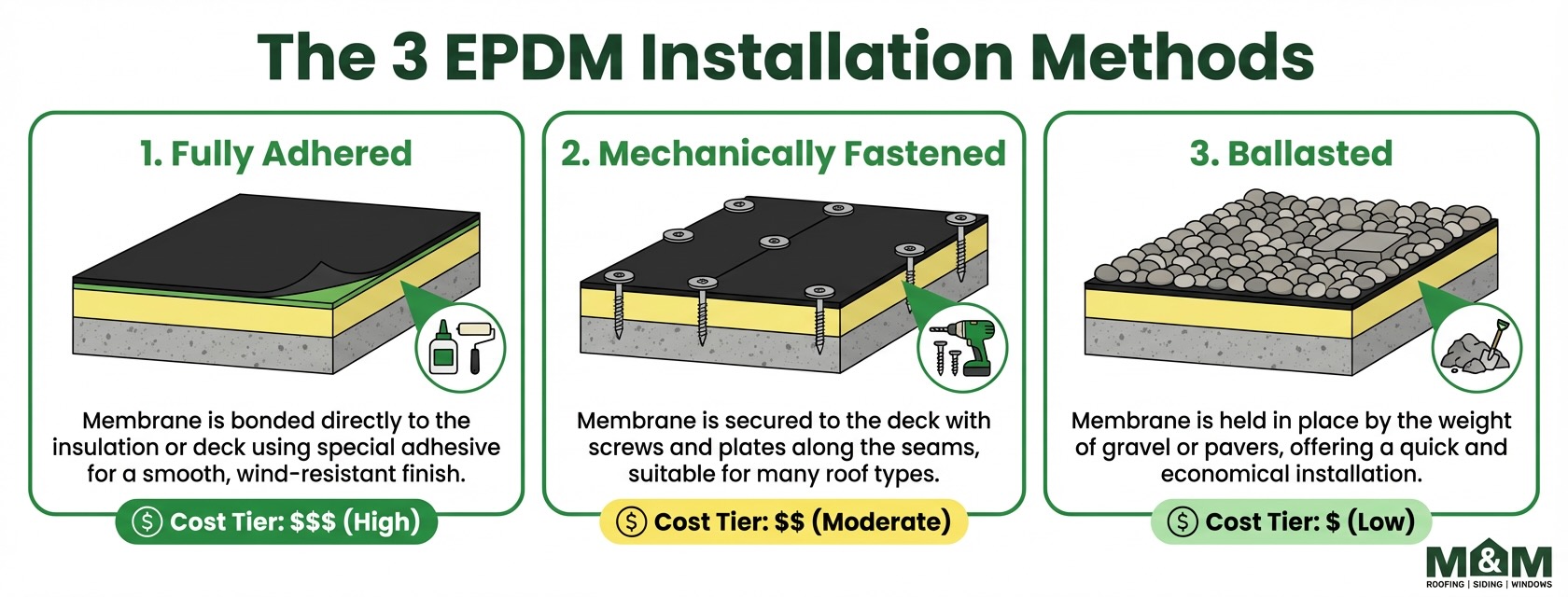
EPDM can be installed in three ways. The right method depends on your building’s structure, your climate, and your budget.
Fully Adhered Installation
The membrane is bonded directly to the roof deck (or insulation/cover board) with contact adhesive. This provides the strongest wind uplift resistance and the cleanest appearance. No roof penetrations. It’s the most expensive method, but it delivers the best long-term performance. For hurricane-prone areas like Houston, Beaumont, and Lake Charles, fully adhered is the recommended approach.
Mechanically Fastened Installation
The membrane is secured with screws and plates along seams and across the field. Typically, 20–30% faster to install than fully adhered, with no adhesive cure time to wait on. Good balance of cost and performance. This is the most common method for commercial buildings where wind uplift requirements don’t mandate full adhesion.
Ballasted Installation
Loose stones, concrete pavers, or gravel hold the membrane in place. No adhesive or fasteners. Cheapest option upfront. But 10–15 lbs per sq. ft. of ballast weight requires structural engineering approval, a hidden cost many property owners miss. Not recommended in high-wind areas. In M&M’s Texas and Louisiana markets, ballasted EPDM is the least common because of hurricane risk.
The bottom line on installation: an EPDM roof is only as good as the contractor who installs it. Seam quality is everything. With 40+ years and 100,000+ projects, M&M’s installers know which method is right for your building and climate.
M&M’s certified installers have completed over 100,000 roofing projects since 1983. Get your free flat roof estimate.
How Long Does an EPDM Roof Last?
A properly installed EPDM roof lasts 25–30 years on average. Some high-quality installations have exceeded 40–50 years. The ERA’s 30-year study tested membrane samples from roofs with three decades of field exposure and found that nearly all met or exceeded ASTM requirements for tensile strength, tear resistance, and elongation [1]. For 90-mil membranes, the data projected service lives approaching 50 years [2].
That’s the upside of EPDM’s long history. Unlike TPO (introduced in the 1990s), EPDM has 60+ years of real-world data — not lab estimates — to back its lifespan claims.
Five factors determine where your EPDM roof falls in that range:
- Membrane thickness. 60 and 90 mil membranes outlast 45 mil, especially in high-UV environments like Texas. M&M recommends 60 mil minimum for commercial applications in this region.
- Installation quality. Seam integrity is the #1 factor. Period.
- Climate. UV exposure degrades EPDM over time (relevant in Central Texas). Humidity promotes mold under poorly ventilated systems (relevant on the Gulf Coast).
- Maintenance frequency. Biannual inspections extend roof life significantly by catching small issues early.
- Foot traffic. Heavy-traffic areas need thicker membrane or walkway pads to prevent punctures.
While EPDM manufacturers offer 10–20 year material warranties, M&M backs new installations with a lifetime labor warranty. If a seam fails due to workmanship, you’re covered for the life of the roof. That distinction matters because seam quality is what separates a 15-year EPDM roof from a 40-year one.
EPDM Roofing Maintenance and Repair
EPDM is relatively low-maintenance, but “low” doesn’t mean “no.” Here’s what a solid maintenance plan looks like:
Biannual inspections, spring and fall. Check seams and flashings for separation or lifting. Look for punctures, tears, or membrane shrinkage. Clear debris from drains and scuppers. Inspect for ponding water.
After every major storm. Inspect for punctures from debris, displaced ballast (if applicable), or seam lifting from wind. Don’t wait for a visible leak inside the building. By the time you see a water stain on the ceiling, the insulation, deck, and framing below are already soaked. Those repairs cost thousands more than a timely roof inspection.
Trim overhanging branches. Falling branches are one of the most common causes of EPDM punctures. Preventable damage is the cheapest damage.
Keep drains clear. Ponding water is EPDM’s enemy. Standing water that doesn’t drain within 48 hours accelerates membrane degradation and can compromise the insulation below. Proper drainage prevents this.
Common EPDM Repairs
- Seam failures: Re-sealed with EPDM primer and seam tape or adhesive. This is the most common repair on aging EPDM systems.
- Punctures: Patched with EPDM patch material and adhesive. Straightforward for small areas.
- Flashing deterioration: Flashings around penetrations (pipes, vents, HVAC curbs) are resealed or replaced.
- Membrane shrinkage: If minor, seams can be re-tensioned and re-sealed. If severe, partial or full replacement may be needed.
When to Repair vs. Replace an EPDM Roof
Repair if: damage is localized, the roof is under 20 years old, less than 25% of insulation is saturated, and seams are mostly intact. A good repair can extend the roof’s life by 10–15 years.
Replace if: you’re seeing widespread seam failure, the roof is 25+ years old, more than 25% of insulation is saturated, ponding water is chronic, or you’ve patched the same areas multiple times.
M&M uses infrared scanning to map moisture in the insulation below the membrane. If saturation is under 25%, a targeted repair can extend the roof’s life 10–15 years. Above 25%, replacement is the better investment. Schedule a free inspection. Same-day service for requests before noon, and we’ll give you an honest call.
Is EPDM the Right Choice for Texas and Louisiana?
This is where M&M’s regional experience matters most.
Houston, Beaumont, Lake Charles (Gulf Coast): Hurricanes and heavy rain demand strong wind uplift resistance. Fully adhered EPDM performs well here, but ballasted systems carry too much risk in hurricane zones. EPDM’s adhesive seams are more vulnerable to wind-driven rain than TPO’s heat-welded seams. For coastal properties, that tradeoff between stronger seams and a longer track record is worth a 30-minute free consultation to sort out. M&M recommends 60 mil minimum and fully adhered installation for all Gulf Coast EPDM projects.
Austin, San Antonio (Central Texas): Extreme heat and UV are EPDM’s biggest challenges. Black EPDM absorbs significant solar heat, driving up cooling costs during six months of 90–100°F+ summers. White EPDM or a reflective elastomeric coating can offset this, but TPO may be the better energy-efficiency choice for Central Texas buildings. According to the DOE, cool roofs can reduce cooling costs by 10–25% [3], and white TPO delivers that performance without requiring an additional coating.
Across all markets: Humidity promotes mold and moisture under EPDM if ventilation is inadequate. Proper insulation and vapor barriers are non-negotiable in Gulf Coast installations. On the other hand, EPDM’s flexibility during temperature swings is a genuine advantage during Texas’s unpredictable spring weather.
Bottom line: EPDM is a solid choice for commercial roofs in Texas and Louisiana when installed by an experienced contractor who accounts for the local climate. For buildings where cooling costs are the top priority, TPO may be the better option. For buildings where proven longevity and budget are top priorities, EPDM is hard to beat.
M&M has been installing flat roofs across Houston, Austin, San Antonio, Beaumont, and Lake Charles since 1983. We know when EPDM is the right call and when TPO is the better fit. We’ll recommend the system that fits your building and budget, even when that means suggesting TPO instead of EPDM.
EPDM Roofing for Residential vs. Commercial Buildings
EPDM is primarily a commercial roofing system, but it’s widely used on residential flat-roof sections too.
Residential uses: flat-roof additions, garage roofs, sunrooms, modern flat-roof homes, and patio covers. Residential projects are smaller (typically 500–3,000 sq. ft.), which means a higher cost per square foot due to less economy of scale. A thinner membrane (45 mil) is sometimes acceptable for residential applications, though 60 mil is the better long-term investment. Aesthetics can be a factor since the black membrane might be visible on low-pitch sections.
Commercial uses: warehouses, office buildings, strip centers, churches, schools, and multi-family properties. Commercial projects require a thicker membrane (60–90 mil), involve larger coverage areas with more seams, and need careful flashing around HVAC penetrations. Ponding water is more common on large flat commercial roofs, making drainage design critical.
M&M handles both commercial and residential roofing projects. One contractor for the full scope.
Frequently Asked Questions About EPDM Roofing
What is EPDM roofing?
EPDM (ethylene propylene diene terpolymer) is a synthetic rubber membrane used on flat and low-slope roofs. It’s been the most widely used single-ply roofing membrane for over 50 years, known for its durability, weather resistance, and affordability. EPDM membranes are manufactured to ASTM D4637 standards [2].
What does EPDM stand for in roofing?
EPDM stands for Ethylene Propylene Diene Terpolymer (sometimes “Monomer”). It’s a thermoset rubber compound, meaning it cures during manufacturing and cannot be re-melted. That’s why EPDM seams are sealed with adhesive or tape instead of heat welding.
How much does an EPDM roof cost?
EPDM roofing typically costs $6–$12 per square foot installed, depending on membrane thickness, insulation choice, installation method, and roof complexity. A typical 2,000 sq. ft. residential flat roof runs $12,000–$24,000. A 10,000 sq. ft. commercial roof runs $60,000–$120,000.
How long does an EPDM roof last?
A properly installed EPDM roof lasts 25–30 years on average, with some high-quality installations exceeding 40–50 years. The ERA’s 30-year study confirmed that tested membranes met or exceeded ASTM requirements even after decades of field exposure [1]. Lifespan depends on membrane thickness, installation quality, climate, and maintenance frequency.
Is EPDM better than TPO?
Neither is universally “better.” EPDM has a longer proven track record (60+ years vs. TPO’s ~30 years), is easier to repair, and performs well in cold climates. TPO has stronger heat-welded seams, better energy efficiency (reflective white surface), and is generally preferred in hot climates. For Texas buildings, M&M can help you choose based on your specific needs.
Can EPDM roofing be installed on a residential home?
Yes. EPDM is widely used on residential flat-roof sections, including additions, garage roofs, sunrooms, and modern flat-roof homes. It offers the same durability and weather resistance as commercial applications at a residential scale.
What is the difference between EPDM and rubber roofing?
“Rubber roofing” is a generic term that almost always refers to EPDM. When contractors say “rubber roof,” they mean EPDM, a synthetic rubber membrane. Other elastomeric roofing materials exist, but EPDM is by far the most common.
Is EPDM Roofing Right for You?
EPDM has earned its reputation as the workhorse of flat roofing. With 60+ years of proven performance, competitive pricing, and straightforward repair options, it remains one of the best choices for commercial and residential flat roofs.
The catch? EPDM is only as good as its installation. Seam quality, membrane thickness, and climate-appropriate installation method are what separate a 15-year EPDM roof from a 40-year one. That’s not a talking point—it’s what M&M has observed across 100,000+ projects since 1983.
Ready to lock in the cost of your EPDM roof? Get a free, no-obligation estimate. Same-day inspections for requests before noon, so you’re not guessing on a $50,000+ investment.
References
[1] EPDM Roofing Association. “Long-Term Service Life Study of EPDM.” https://epdmroofs.org
[2] ASTM International. “ASTM D4637/D4637M: Standard Specification for EPDM Sheet Used in Single-Ply Roof Membrane.” https://www.astm.org/Standards/D4637.htm
[3] U.S. Department of Energy. “Cool Roofs.” Energy Saver. https://www.energy.gov/energysaver/cool-roofs