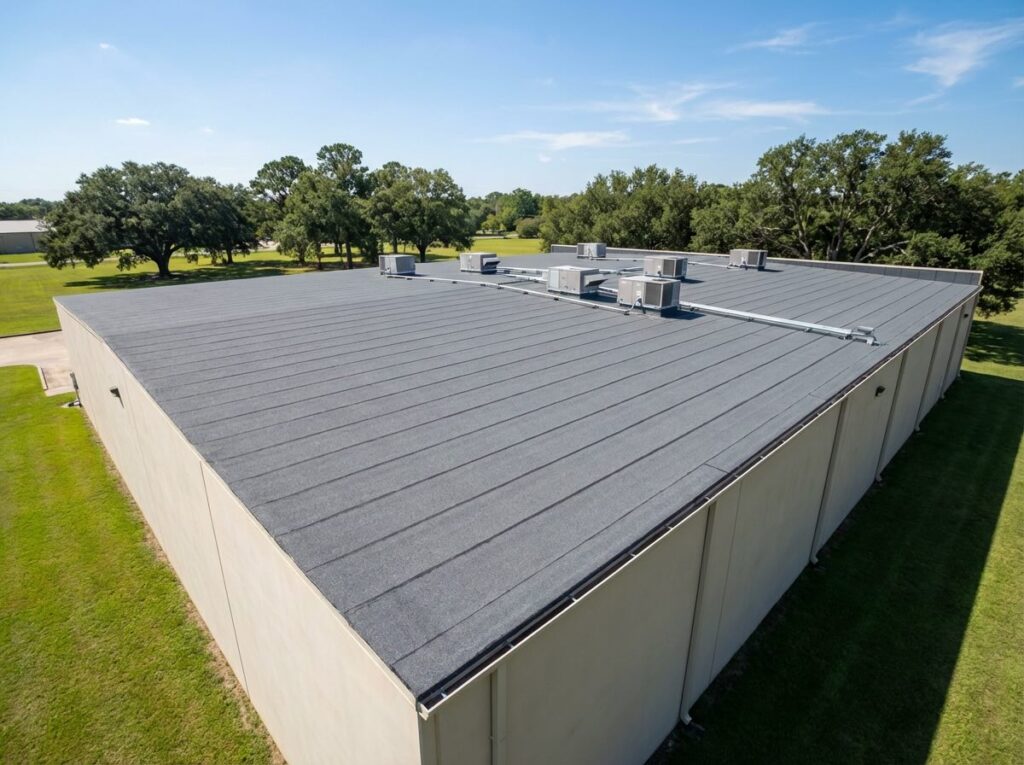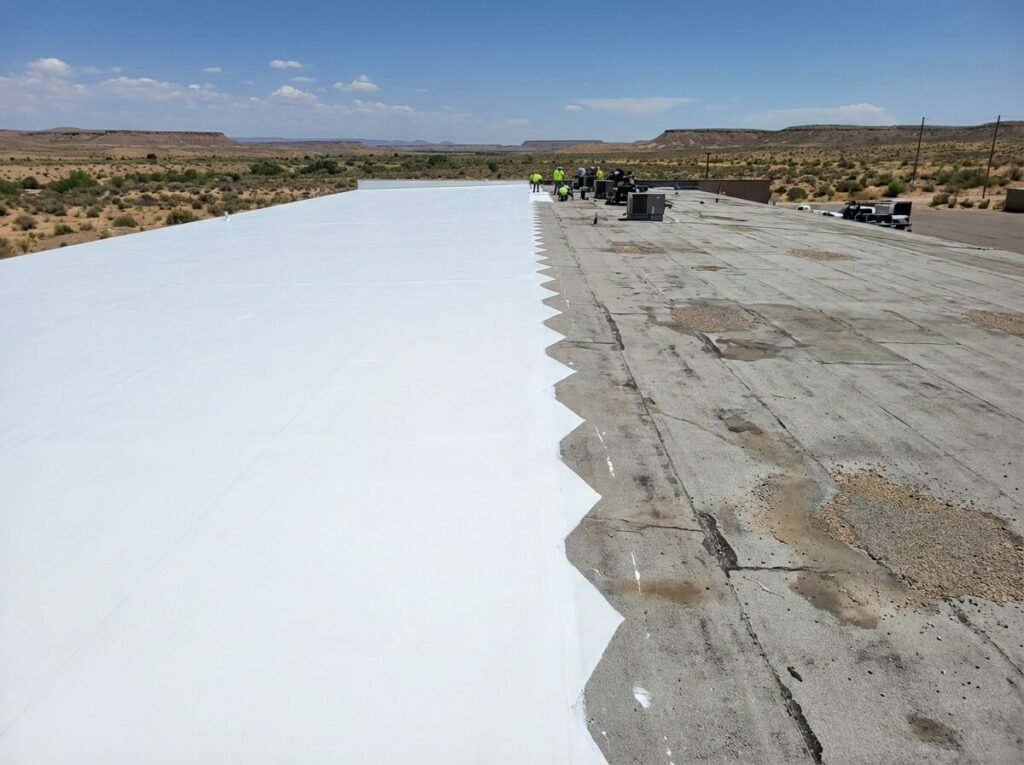
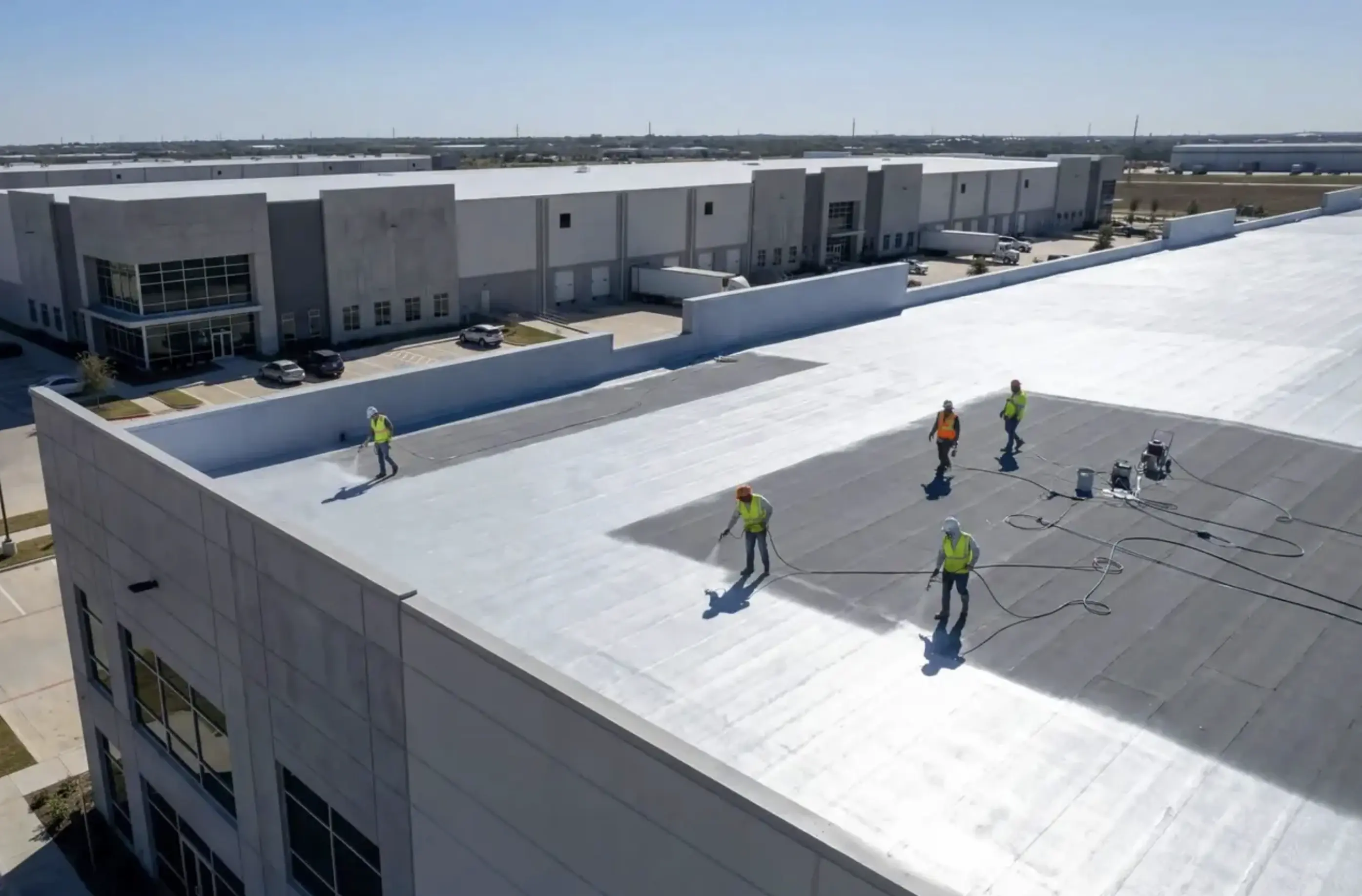





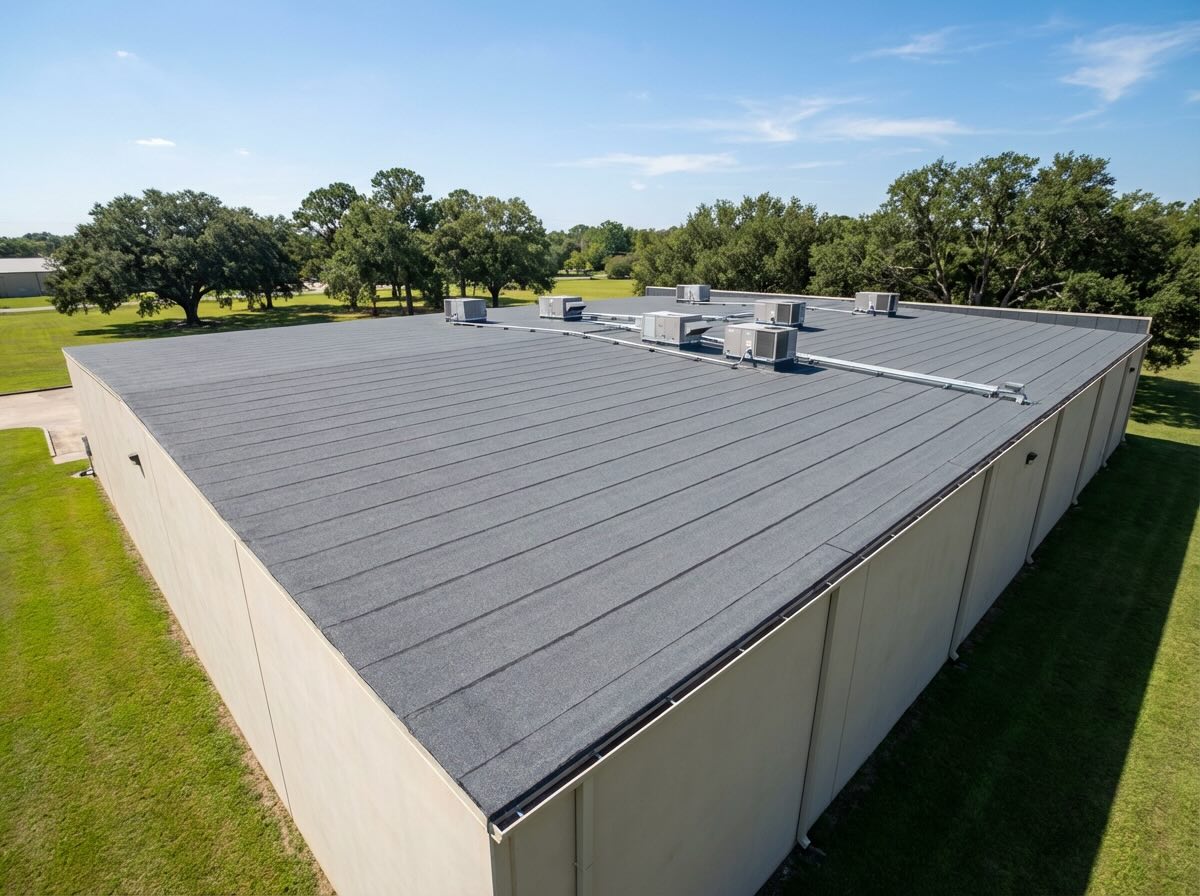
Modified bitumen (mod-bit) roofing is a multi-ply asphalt-based membrane system designed for flat and low-slope commercial roofs. It combines the durability of built-up roofing with a flexible polymer modifier, either SBS (rubber-based) or APP (plastic-based), for superior performance. It costs $4–$10 per square foot installed and lasts 15–25 years, depending on the system, ply count, and installation method. It remains one of the most proven commercial flat roofing systems available, particularly well-suited for Gulf Coast climates where storm resistance and waterproofing are the top priorities.
Most building owners hear “torch-down” on a bid and nod along without understanding what it means. This guide explains what modified bitumen actually is, which type performs better in Texas and Louisiana heat, what installation methods really mean (including the honest answer on fire risk), what the job costs at commercial scale, and how to compare mod-bit against TPO and EPDM before signing.
Modified bitumen has protected commercial flat roofs since the 1970s. Most building owners have heard the name or seen it on a bid without understanding it. That knowledge gap costs money. The wrong spec, wrong ply count, or wrong installation method for the climate can shorten a roof’s life by years and leave a building exposed to the exact problems it was designed to prevent.
What Is Modified Bitumen Roofing? (And How It Differs from BUR)
Modified bitumen evolved from built-up roofing (BUR), the dominant commercial flat roof system throughout the twentieth century.
BUR worked by alternating layers of hot asphalt and reinforcing felt, applied on-site one layer at a time. It was effective but slow, labor-intensive, and heavily dependent on crew skill. Modified bitumen improved on BUR in one critical way: the polymer modifier.
Adding a rubber-based (SBS) or plastic-based (APP) polymer to the asphalt changes the material’s performance. It becomes more flexible, more resistant to temperature extremes, and more durable under UV exposure. Rather than being built layer by layer on the roof, the modified material is manufactured into reinforced rolls at a factory, then brought to the job site and applied to the deck.
The result is a more consistent, faster-to-install system that still delivers the multi-layer waterproofing redundancy that made BUR the commercial standard for decades. Where a single-ply membrane like TPO is exactly one layer thick, a 2-ply or 3-ply mod-bit system gives the roof multiple lines of defense against water intrusion.
That redundancy is why modified bitumen remains one of the most widely specified commercial flat roofing systems, particularly in markets like Texas and Louisiana, where severe weather puts roofs under real stress.
For a broader overview of flat and low-slope commercial roofing systems, M&M Roofing’s flat roofs guide covers the full landscape.
SBS vs. APP Modified Bitumen — Which Is Right for Your Climate?
This is the question most building owners never ask, and the one that matters most for long-term performance. SBS and APP are not interchangeable. They behave differently under heat, cold, and UV exposure, and the right choice depends directly on where the building sits.
SBS Modified Bitumen (Rubber-Based)
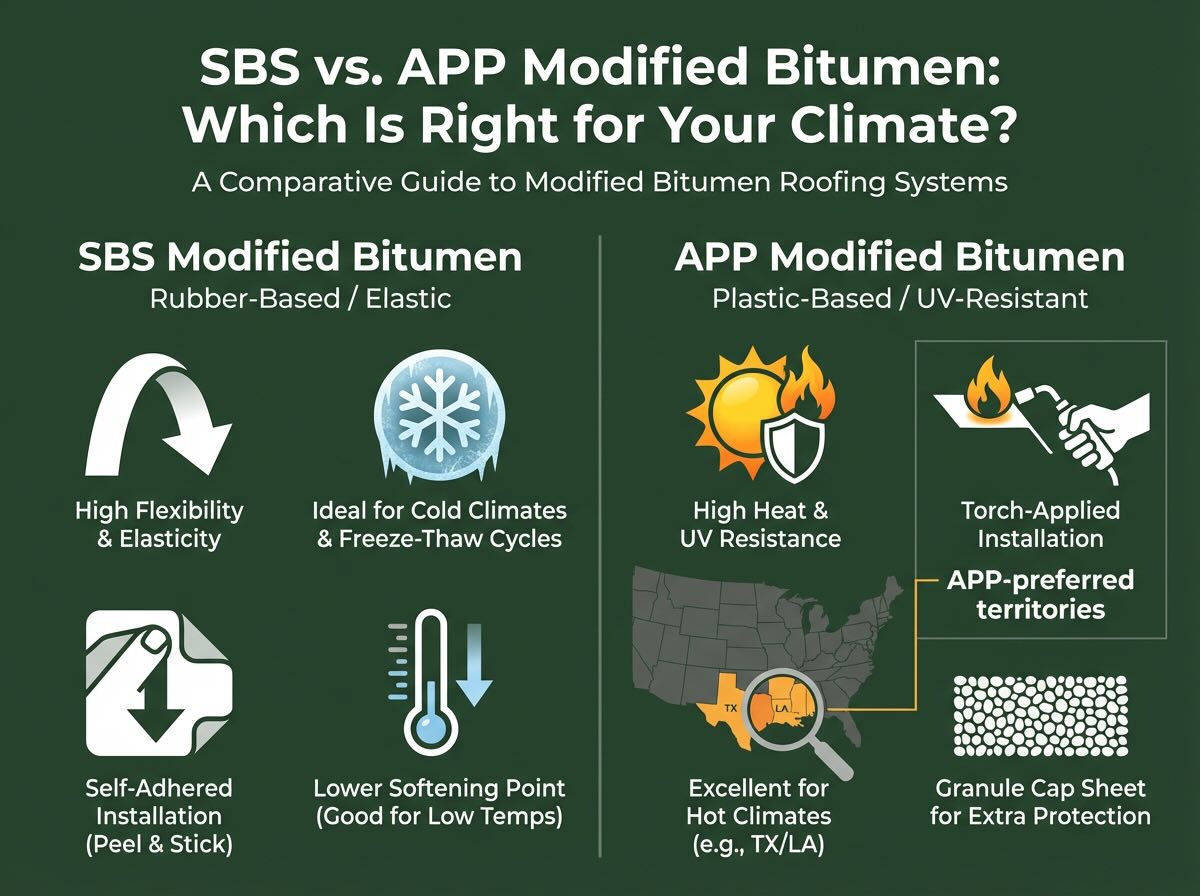
SBS stands for Styrene-Butadiene-Styrene, a synthetic rubber compound blended into the asphalt during manufacturing. That rubber content gives SBS membranes their defining characteristic: elasticity. They stretch and return to shape under thermal stress, making them highly forgiving through repeated expansion and contraction cycles.
SBS is most commonly installed by self-adhered (peel-and-stick) methods or cold adhesive. Torch application does not apply to SBS.
The strength of SBS is flexibility. The limitation is heat tolerance. SBS has a lower softening point than APP. In climates with extreme sustained heat, an underspecified or improperly installed SBS membrane can become susceptible to heat-related issues at the surface.
TX/LA context: SBS self-adhered systems work well for occupied commercial buildings in Houston and Gulf Coast markets where torch fire risk near tenants or combustible elements is a genuine concern. Specification matters more in hot climates, so working with a contractor experienced in Gulf Coast conditions is critical.
Lifespan: 15–25 years with proper maintenance.
APP Modified Bitumen (Plastic-Based)
APP stands for Atactic Polypropylene, a plastic polymer that behaves differently from SBS. APP membranes are stiffer at ambient temperature, flow when heated with a torch, and bond by cooling into a hard, waterproof layer. They have a higher softening point than SBS and outstanding UV resistance once cured.
APP is almost always torch-applied. The top cap sheet is typically granule-surfaced for UV protection and surface durability.
For hot, sunny climates, APP is the better-performing modifier. The higher softening point means the membrane is less vulnerable to heat-induced stress in 100°F-plus Texas summers. The UV resistance means the cap sheet holds up through years of intense sun without accelerated degradation.
TX/LA recommendation: APP is the preferred choice for most commercial buildings in Texas and Louisiana. Its thermal stability and UV resistance match the climate demands better than SBS. A reflective or light-colored APP granule cap sheet adds energy efficiency on top of durability.
Lifespan: 15–20 years with proper maintenance; reflective cap sheet extends life and cuts cooling costs.
Not sure which modifier is right for your building? M&M Roofing’s commercial team will assess the roof and recommend the right system at no charge. →
The 4 Installation Methods — What “Torch-Down” Actually Means
“Torch-down” is the term most building owners know. Few know it’s only one of four installation methods for modified bitumen, and that the best method depends on the building, the modifier type, and the project circumstances.
Torch-Applied (Hot Torch)
A propane torch heats the underside of the membrane roll as the crew unrolls it across the substrate. The bitumen melts and bonds directly to the surface below. Seams are heat-welded for a continuous, watertight bond.
This is the standard commercial application method for APP membranes. When executed by a trained crew, torch application produces a high-quality, fully-adhered bond with excellent wind uplift resistance.
The fire risk is real and deserves direct acknowledgment. An open propane flame on a roof requires a trained crew, proper fire watch protocol, and clear awareness of combustible materials nearby. Responsible contractors manage this with practiced technique, designated fire watch personnel during and after application, and a documented safety plan. For occupied buildings with combustible elements in the structure or nearby, self-adhered or cold-process methods eliminate the concern entirely.
TX/LA note: Torch-applied APP is the most common commercial mod-bit method in Texas. Experienced crews manage fire risk effectively. It is the right choice for most commercial buildings when the crew knows what they’re doing.
Self-Adhered (Peel-and-Stick)
The membrane has a factory-applied adhesive backing. The crew peels the release liner and presses the membrane directly onto the prepared substrate. No heat required.
Self-adhered systems are ideal for occupied buildings, wood decks, and any installation where fire risk must be eliminated. Application is faster than torch work and produces no fumes or combustion risk.
The limitation is substrate sensitivity. The adhesive needs a clean, dry, properly primed surface to bond fully. Cold or damp conditions at installation time can reduce adhesion quality. Self-adhered systems applied during a rare Houston winter need temperature monitoring.
Cold-Process Adhesive
A solvent-based or water-based adhesive is spread on the substrate. The membrane is rolled into it and pressed down. No heat, no flame.
Cold-process is useful for reroofing over existing systems where torch heat poses a risk, and for applications in environments where open flame is prohibited. The tradeoff is longer cure time, more labor to apply uniformly, and the need for an adhesive formulated for Texas summer heat extremes. Not all cold-process adhesives perform equally in 100°F-plus conditions.
Hot-Mopped (Hot Asphalt)
Molten asphalt is mopped onto the deck, and the membrane is rolled into it. This is the traditional BUR method applied to mod-bit. It is more common in multi-ply systems combining a mod-bit cap sheet with traditional BUR base plies. It appears less frequently on new Texas and Louisiana commercial installs, but still shows up on reroofing projects over older BUR systems.
How Many Plies Does a Commercial Modified Bitumen Roof Need?
Ply count is one of the most important variables in a commercial mod-bit bid. It directly affects performance, longevity, and cost. Low-ball bids often cut it.
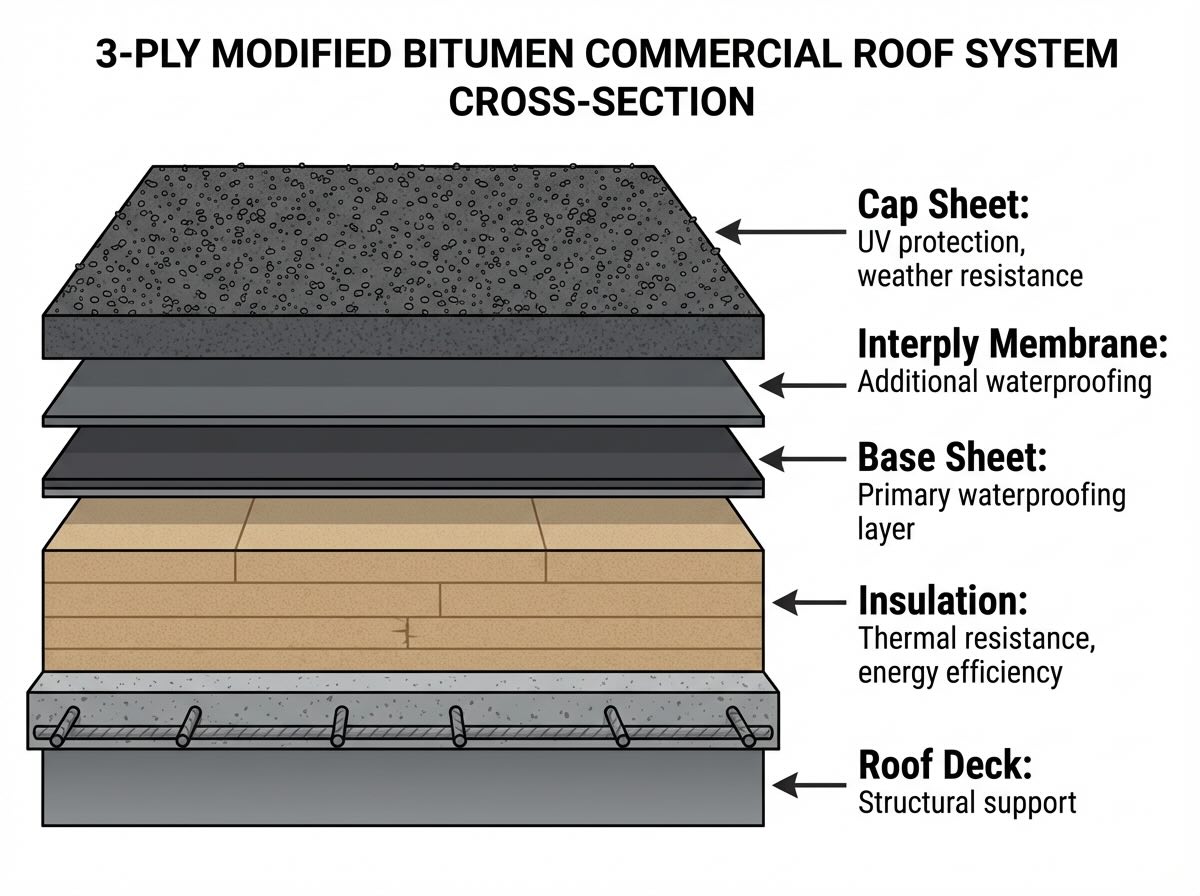
A modified bitumen system typically consists of three layers.
Base sheet: Mechanically fastened or adhered directly to the deck. It provides the foundation layer, initial waterproofing, and the critical wind uplift resistance. Fastening pattern matters more than most building owners realize, particularly in hurricane zones.
Interply (3-ply systems only): An additional reinforcing membrane between the base and cap. It adds waterproofing redundancy, impact resistance, and structural integrity.
Cap sheet: The exposed, weather-facing layer. Typically, granule-surfaced APP or smooth SBS. This is where UV protection, reflectivity, and weather resistance come from. The cap sheet quality determines how long the system looks and performs.
A 2-ply system (base plus cap) is the commercial minimum and adequate for most low-traffic applications with proper drainage and maintenance. A 3-ply system is the right call for:
- High-traffic roofs with HVAC access and maintenance crews
- Larger commercial buildings over 15,000 square feet
- Buildings in hurricane and high-wind zones (Houston, Beaumont, Lake Charles, Lafayette)
- Projects seeking 20-plus year system warranties
M&M Roofing has completed more than 100,000 roofing projects across Texas and Louisiana. The team has seen what happens when a Gulf Coast commercial building gets spec’d with the wrong ply count. The crew specs what the building actually needs, not the cheapest system that wins the bid.
The cost difference between 2-ply and 3-ply is roughly $2–$3 per square foot. On a 10,000 square foot roof, that is $20,000–$30,000. It is also the difference between a roof that lasts 15 years and one that lasts 22.
Modified Bitumen Roofing Cost in Texas and Louisiana (2026)
Modified bitumen roofing in Texas and Louisiana typically runs $4–$10 per square foot installed. The range is wide because ply count, installation method, deck condition, and cap sheet type each move the number meaningfully.
The table below scales costs to two common commercial building sizes.
| System | Cost Per Sq Ft | 5,000 Sq Ft Estimate | 15,000 Sq Ft Estimate | Lifespan |
|---|---|---|---|---|
| 2-ply APP torch-down | $4–$7 | $20,000–$35,000 | $60,000–$105,000 | 15–20 yrs |
| 2-ply SBS self-adhered | $5–$8 | $25,000–$40,000 | $75,000–$120,000 | 15–25 yrs |
| 3-ply system (commercial grade) | $7–$10 | $35,000–$50,000 | $105,000–$150,000 | 20–25 yrs |
| TPO (for comparison) | $5–$12 | $25,000–$60,000 | $75,000–$180,000 | 20–30 yrs |
Prices reflect current Texas and Louisiana market rates. Costs vary by ply count, installation method, deck condition, insulation requirements, and number of penetrations.
What pushes a project toward the higher end of the range:
- Ply count: 3-ply adds $2–$3 per square foot over 2-ply
- Installation method: Cold-process adds labor time; torch-applied is typically the most cost-efficient
- Cap sheet type: Reflective or white granule cap sheet adds cost upfront and reduces energy bills over time
- Deck condition: Tear-off and prep adds $1.50–$3.00 per square foot if old roofing must come off first
- Insulation: Local energy codes may require above-deck insulation, adding $1.50–$2.50 per square foot
- Penetrations: Each HVAC unit, drain, vent, and pipe penetration adds labor for proper flashing detail
M&M Roofing offers financing options for larger commercial projects, including no-money-down programs. For building owners weighing a $60,000–$150,000 roofing investment, that flexibility matters.
Modified Bitumen in Texas and Louisiana — What the Climate Demands
National roofing specs treat all commercial buildings the same. A Gulf Coast warehouse and a Minneapolis office building share nothing in common from a roofing standpoint, and a spec that ignores the difference will underperform.
Doug Moncure started M&M Roofing in 1983. Four decades of commercial work across Texas and Louisiana means four decades of watching how every flat roof system performs against the actual weather these buildings face.
Houston, Beaumont, and the Gulf Coast
The Gulf Coast delivers three stressors that define roof system selection: hurricane-force wind, sustained heavy rain, and ponding water on flat roofs.
Multi-ply modified bitumen is among the most storm-resilient commercial flat roof systems available for coastal markets. The redundant layers provide a level of protection that single-ply membranes cannot match. FEMA’s guidance on low-slope commercial roof systems confirms that built-up and modified bitumen assemblies demonstrate strong wind performance when properly installed and tested to FM or UL uplift standards [1].
A fully adhered installation, whether torch-applied or cold-process, provides superior wind uplift resistance compared to mechanically fastened systems. In coastal wind zones from Galveston to Lake Charles, fully adhered is the right specification.
Drainage design matters too. Flat Gulf Coast roofs accumulate standing water after heavy rains. Modified bitumen handles ponding better than single-ply TPO, but standing water left unaddressed accelerates membrane deterioration in any system. Proper drain placement and tapered insulation slopes should be part of the spec, not afterthoughts.
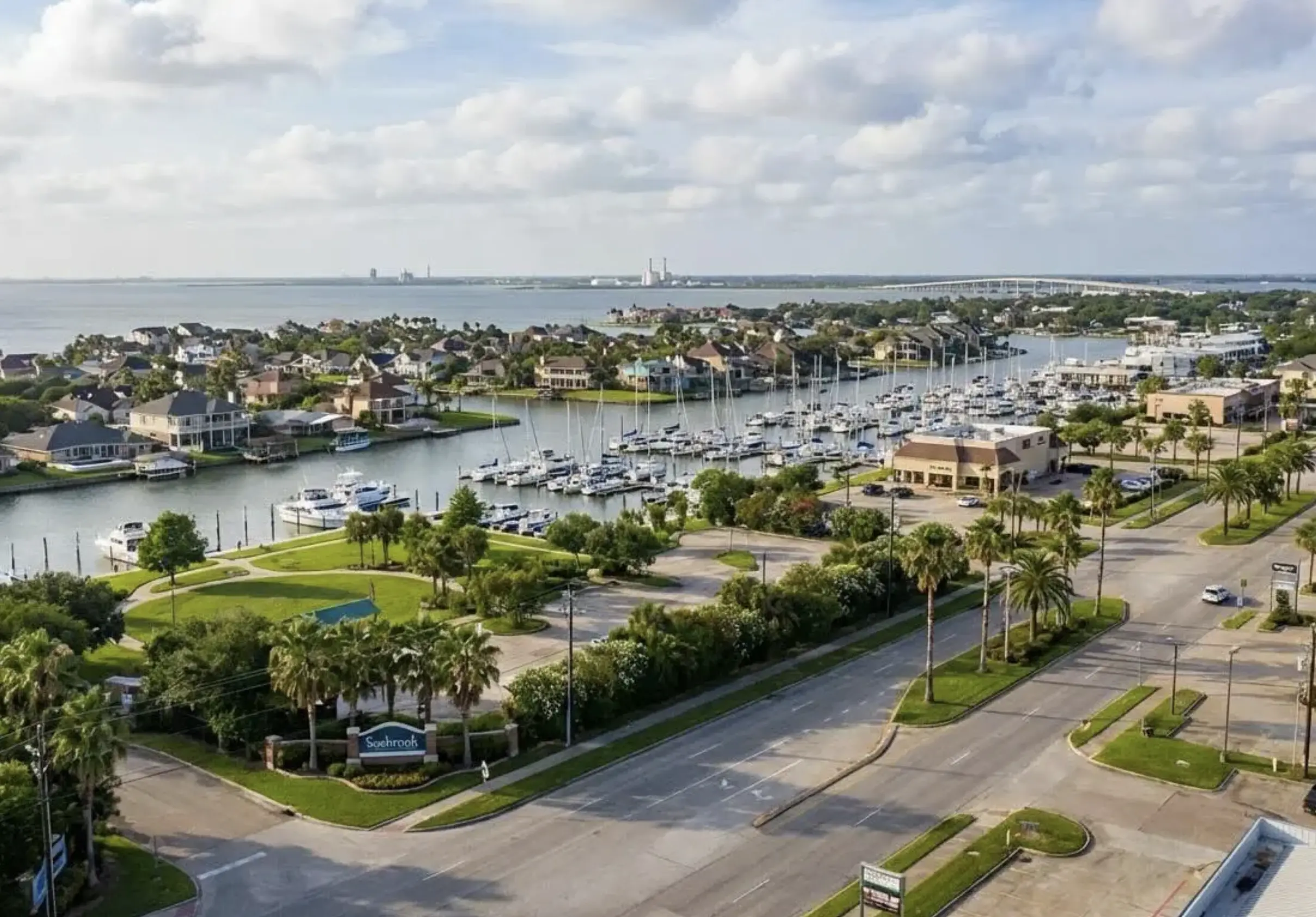
Salt air along the coast adds a layer of consideration for buildings near Seabrook, Clear Lake, Galveston, and coastal Louisiana. A granule-surfaced cap sheet with algae and UV inhibitors provides meaningful protection against the corrosive and biological effects of a coastal environment.
Austin, San Antonio, and Inland Texas
Inland Texas trades hurricanes for heat. Austin averages over 300 sunny days a year. Roof surface temperatures on an uncoated dark membrane in July can reach 170°F-plus. Thermal cycling, where the membrane expands during the day’s heat and contracts at night, stresses seams and fasteners repeatedly over the roof’s life.
APP modified bitumen is the right modifier for this market. Its higher softening point handles Texas heat without the heat-related vulnerability that underspecified SBS can show in extreme conditions. The granule-surfaced cap sheet provides UV protection that keeps the membrane from baking and aging prematurely.
A reflective or white APP cap sheet delivers a meaningful energy benefit. DOE research on cool roofs confirms that white or reflective roofing can reduce surface temperatures by up to 50°F compared to dark membranes [2], reducing thermal stress on the building and the cooling load on HVAC systems running six or more months a year.
Hail Markets Throughout Texas
Texas is hail country. Austin, San Antonio, and markets across central and north Texas see significant hail seasons. NOAA data shows Texas has experienced more billion-dollar severe storms and hail events than any other state [3].
Multi-ply modified bitumen systems, particularly 3-ply configurations, absorb hail impact energy significantly better than single-ply TPO or EPDM. Multiple layers mean a hailstone that compromises the cap sheet does not automatically create a leak. That redundancy is a genuine performance advantage in hail-prone markets, not a marketing claim.
Lake Charles, Lafayette, and Louisiana Markets
Louisiana expansion markets face the same hurricane zone requirements as Houston and Beaumont, compounded by high annual rainfall and humidity. 3-ply systems with fully adhered installation are the appropriate spec. Local building codes in these markets may specify wind uplift requirements per FM or ANSI/SPRI standards, and contractors should be able to demonstrate compliance in writing.
Modified Bitumen vs. TPO vs. EPDM — How to Choose
Most commercial building owners evaluating a flat roof replacement are comparing at least two or three systems. Here is an honest breakdown of where modified bitumen wins, where it loses, and when to choose something else.
| Modified Bitumen | TPO | EPDM | |
|---|---|---|---|
| Cost (installed) | $4–$10/sq ft | $5–$12/sq ft | $4–$8/sq ft |
| Lifespan | 15–25 years | 20–30 years | 25–35 years |
| Storm/hail resistance | Excellent (multi-ply) | Good (single-ply) | Good (single-ply) |
| TX/LA heat performance | Good (APP with reflective cap) | Excellent (reflective white) | Fair (black absorbs heat) |
| Hurricane wind zones | Excellent (multi-ply, adhered) | Good (fully adhered) | Variable (glued seams) |
| Repairability | Excellent (patch with compatible membrane) | Good (requires heat welder) | Good (tape or adhesive) |
| Energy efficiency | Good (with reflective cap) | Excellent (white membrane) | Poor (black, heat-absorbing) |
| Best candidate | Storm-zone commercial; hail risk; multi-layer redundancy | Most TX/LA commercial buildings wanting max energy efficiency and longevity | Budget-constrained; cold climates; EPDM overlay restoration |
For most Texas and Louisiana commercial buildings, prioritizing energy efficiency and maximum lifespan, TPO is often the first recommendation. Modified bitumen is the right choice when hail resistance, multi-layer storm redundancy, or ease of field repair are the top priorities, and for Gulf Coast buildings where multi-ply protection against hurricane damage outweighs single-ply cost savings.
For more on TPO as an alternative, M&M Roofing’s TPO guide covers that system in depth. For EPDM and other single-ply options, the rubber roofing guide provides a full comparison.
How Long Does a Modified Bitumen Roof Last?
The direct answer: 15–25 years, depending on system type, ply count, installation quality, and maintenance.
A 2-ply APP torch-applied system, properly installed and maintained, typically performs 15–20 years in Texas conditions. A 3-ply commercial-grade system with a quality granule cap sheet, in a well-drained application, can reach 20–25 years. Poorly maintained mod-bit, with drainage issues left unaddressed and no regular inspection, can fail in 10–12 years.
Maintenance extends lifespan. Annual inspections that catch flashing failures, seam lifts, and ponding areas early are the difference between a roof that performs its full rated life and one that fails halfway through it.
At the 12–15 year mark, one option is worth considering: an elastomeric or silicone coating applied over an aging but structurally sound modified bitumen roof can extend service life by 5–10 years before a full replacement is required. That restoration path can represent significant cost savings before committing to a full tear-off. M&M Roofing’s guide to commercial roof coatings covers that option in detail.
What to Expect During Commercial Modified Bitumen Installation
Understanding the process helps a building owner evaluate whether a contractor is doing it right.
Step 1: Inspection and tear-off assessment
Before any material goes down, the crew assesses the existing roof. The key decision is overlay versus tear-off. If the existing membrane is sound and within code allowances for roof layers, overlaying saves time and cost. If moisture testing reveals wet insulation or the deck has structural issues, tear-off and replacement of the affected substrate is required. Skipping this step to save money creates the next leak.
Step 2: Deck preparation and repair
Any damaged decking is repaired or replaced. The substrate must be clean, dry, and structurally sound before membrane work begins. This is where experienced crews separate from crews that move too fast.
Step 3: Base sheet installation
The base sheet is mechanically fastened to the deck. Fastening pattern is not cosmetic, it is structural. In wind uplift zones, fastener spacing is specified to meet FM or UL ratings for the local wind design pressure. A contractor who cannot explain the fastening pattern for the base sheet in a hurricane zone is worth questioning.
Step 4: Interply (3-ply systems)
The middle reinforcing ply is applied by the specified method: torch, self-adhered, or cold process, before the cap sheet goes down.
Step 5: Cap sheet application
The visible, weather-facing layer. Penetrations, seams, parapet terminations, and drains receive extra attention here. Most leaks on modified bitumen roofs originate from the detail work, not in the field of the membrane. HVAC curbs, drain sumps, pipe penetrations, and parapet edges are where installation quality determines whether the roof performs or fails. A crew that rushes through details is a crew to watch carefully.
Step 6: Flashing and penetration detailing
Every element that penetrates or terminates the membrane requires properly installed flashing. This is the most skill-intensive part of the job and the part most commonly shortcut by low-bid contractors.
Step 7: Final inspection and walkthrough
The crew inspects the finished system and walks the owner through what was done. After every commercial installation, Doug Moncure makes a personal follow-up call to confirm the work met spec. That level of accountability is not standard in commercial roofing, where large contractors hand projects off to project managers and move on.
M&M Roofing’s full range of commercial roofing services, including modified bitumen installation and replacement, is detailed at mmroofsiding.com/services/commercial-roofing/.
Modified Bitumen Right For You?
Modified bitumen is one of the most battle-tested commercial flat roofing systems available. In Gulf Coast markets where multi-layer storm redundancy and field repairability matter, it earns that reputation.
The right system spec (SBS versus APP, 2-ply versus 3-ply, torch versus self-adhered) depends on the building, the climate, and the owner’s priorities. Getting those specs in writing before signing anything is not optional.
Schedule a free commercial roof assessment with M&M Roofing. → The team will evaluate the building, recommend the right system spec, and provide a written recommendation with no obligation.
Frequently Asked Questions
What is modified bitumen roofing?
Modified bitumen roofing is a multi-ply asphalt-based flat roofing system that blends asphalt with a polymer modifier, either SBS (synthetic rubber) or APP (polypropylene plastic), applied in reinforced membrane rolls. It evolved from traditional built-up roofing and is one of the most widely used commercial flat roofing systems, known for durability, repairability, and storm resistance.
How much does a modified bitumen roof cost?
In Texas and Louisiana, modified bitumen roofing costs $4–$10 per square foot installed. A 2-ply torch-applied APP system for a 10,000 square foot commercial roof typically runs $40,000–$70,000. A 3-ply commercial-grade system runs $70,000–$100,000. Costs vary based on ply count, installation method, substrate condition, and insulation requirements.
How long does a modified bitumen roof last?
A properly installed modified bitumen roof lasts 15–25 years. 2-ply APP torch-applied systems typically perform 15–20 years. 3-ply systems with quality cap sheets can reach 20–25 years. Poor maintenance can shorten lifespan to 10–12 years, while an elastomeric coating applied mid-life can extend service life by 5–10 years before full replacement.
What is the difference between SBS and APP modified bitumen?
SBS (Styrene-Butadiene-Styrene) modified bitumen uses a rubber-based modifier, making it highly elastic and flexible. It is best for self-adhered installations and climates with high thermal cycling. APP (Atactic Polypropylene) uses a plastic modifier with a higher softening point and superior UV resistance. It is torch-applied and the preferred choice for hot, sunny climates like Texas and Louisiana.
Is modified bitumen or TPO better for commercial buildings in Texas?
TPO generally offers better energy efficiency and a longer lifespan for most Texas commercial buildings. Modified bitumen is the better choice when hail resistance, multi-layer storm redundancy, or ease of field repair are the top priorities, particularly for Gulf Coast buildings in Houston, Beaumont, and Lake Charles, where severe weather is frequent.
Is torch-down roofing dangerous?
Torch-applied modified bitumen involves an open propane flame and carries real fire risk if improperly managed. Professional installers mitigate this through trained crews, fire watch protocols, and strict safety procedures. For occupied buildings or fire-sensitive structures, self-adhered SBS membranes or cold-process installation eliminate fire risk entirely while maintaining comparable performance.
References
[1] FEMA — Low-Slope Roof Systems Fact Sheet
[2] U.S. Department of Energy — Cool Roofs
[3] NOAA NCEI — Texas Billion-Dollar Weather and Climate Disasters