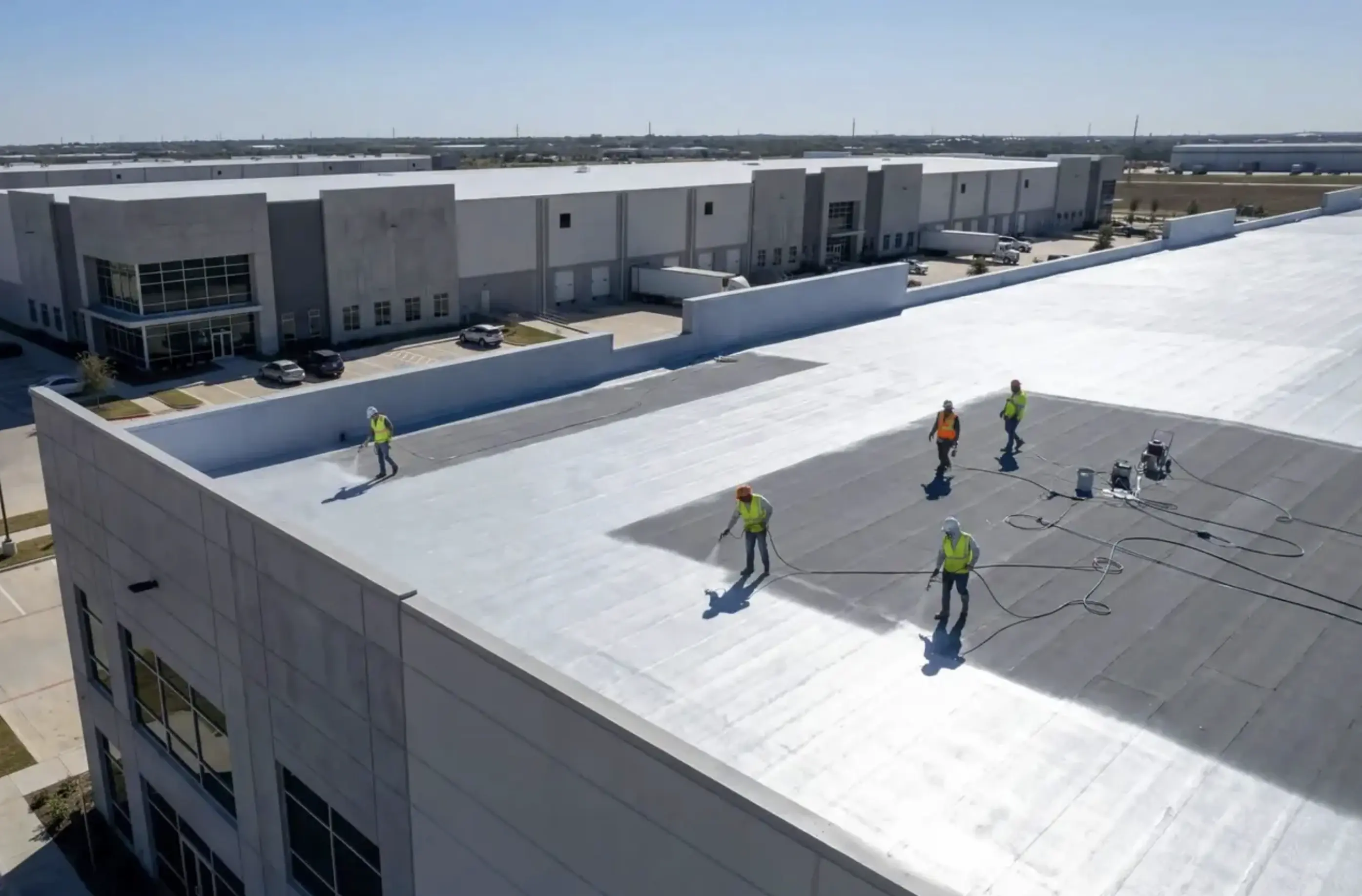





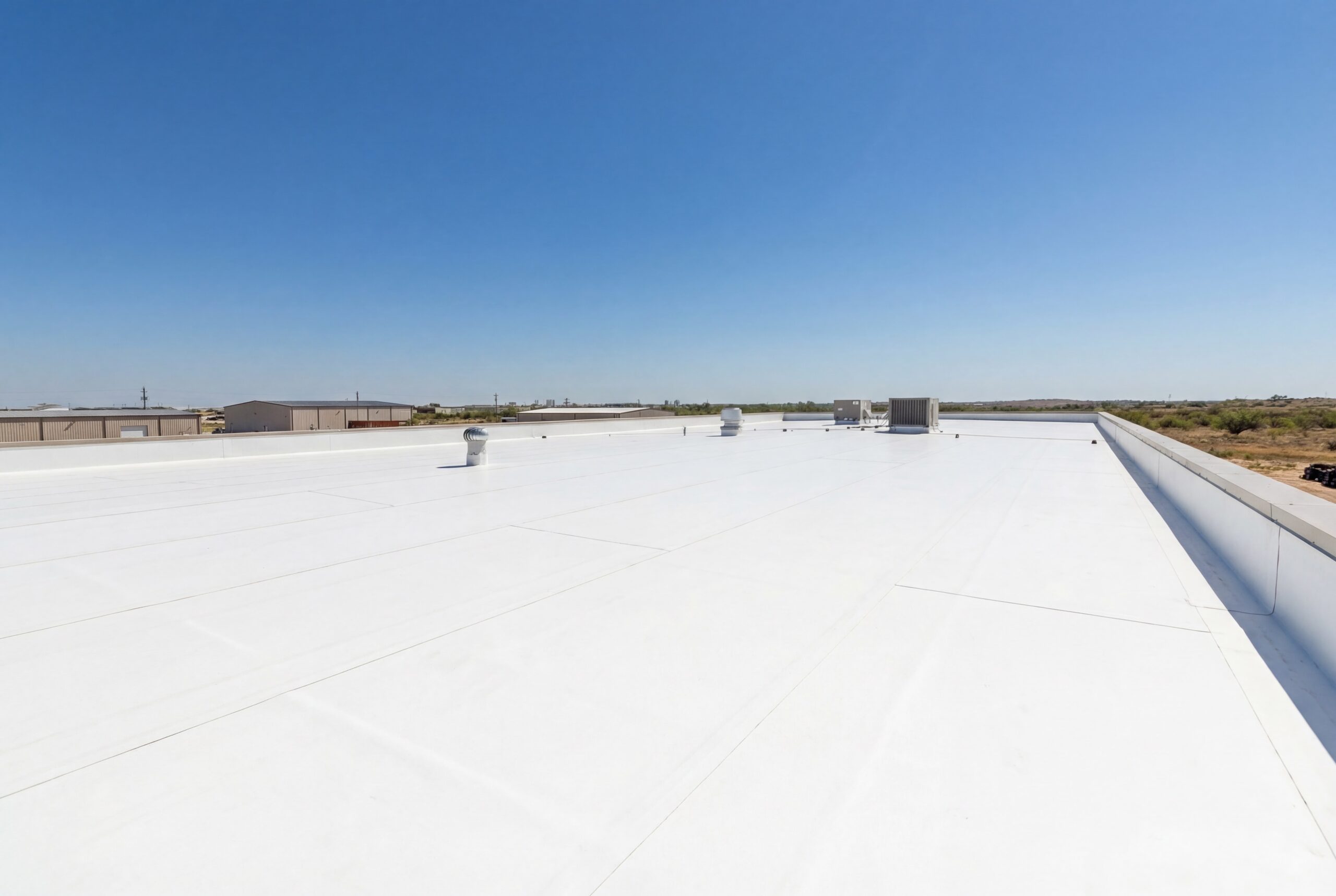
TPO (Thermoplastic Polyolefin) roofing is a single-ply reflective membrane designed for flat and low-slope roofs. It typically costs $5–$12 per square foot installed, lasts 20–30 years with proper maintenance, and accounts for roughly 40% of the U.S. commercial roofing market. That makes it the most widely used single-ply commercial roofing system in the country.
You’ve probably gotten a bid for a flat roof and seen “TPO” listed as the recommended system. Maybe your property manager mentioned it. Maybe a contractor threw the term around, assuming you already knew what it meant.
TPO dominates commercial roofing for good reasons: it’s reflective, cost-effective, and durable when installed correctly. But installation quality is what most people overlook.
M&M Roofing has been installing and maintaining roofs across Texas and Louisiana since 1983. Over 100,000 projects. And the single biggest factor in whether a TPO roof lasts 25 years or fails in 8 isn’t the membrane itself; it’s the quality of the seam welding and the crew that put it on.
This guide breaks down everything you need to know about TPO roofing: what it is, what it costs, how it compares to alternatives, and whether it’s the right fit for your building in Texas or Louisiana. No jargon. No sales pitch. Just the facts you’d want if you were making this decision yourself.
What Is TPO Roofing?
TPO stands for Thermoplastic Polyolefin. In plain English, it’s a single-ply membrane (a large, flexible sheet) made from a blend of polypropylene and ethylene-propylene rubber. It comes in multiple thicknesses: 45, 60, and 90 mil. Thicker membranes resist heat and UV damage longer, which matters in hot climates.
That signature white finish isn’t just aesthetic. It reflects UV radiation and solar heat, which is why TPO has become the go-to system for commercial buildings in hot climates like ours.
TPO was introduced in the early 1990s and quickly gained market share. Today, it leads the single-ply commercial roofing market. The reason is simple: it offers reflective performance comparable to PVC at a significantly lower price point.
What Does TPO Stand For?
Thermoplastic Polyolefin. The “thermoplastic” part is what matters most from a practical standpoint. It means the material can be heated and re-welded—the opposite of thermoset materials like EPDM, which rely on adhesive or tape to seal seams.
Why does that matter? Because heat-welded seams are 3–4 times stronger than glued seams [1]. When a Gulf Coast hurricane hits your building with 100+ mph winds, seam strength isn’t a technical detail. It’s the difference between a roof that holds and one that doesn’t.
How TPO Roofing Is Made (The 7-Layer System)
A TPO roof isn’t just a membrane sitting on a building. It’s a system, and every layer plays a role.
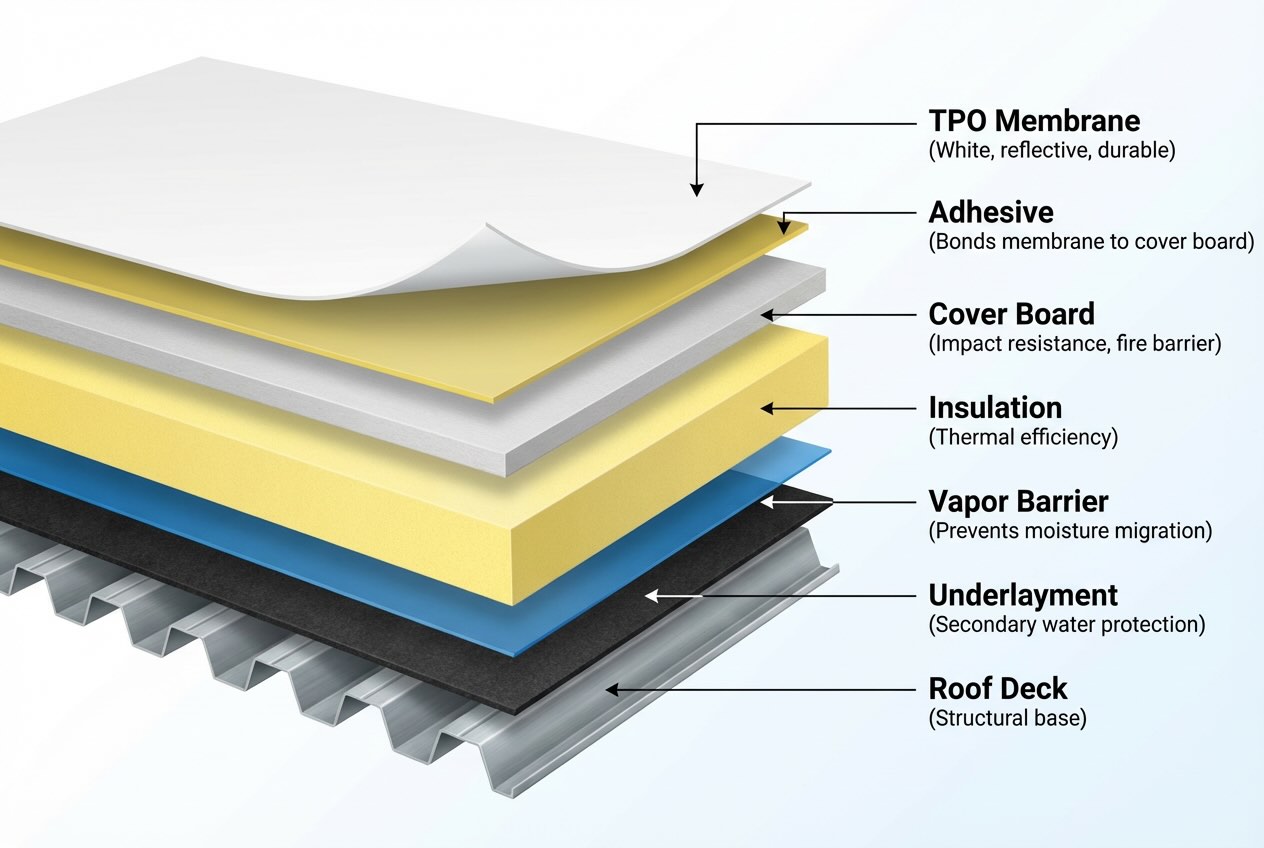
From top to bottom:
- TPO membrane: The weatherproofing layer. White, reflective, heat-welded at seams.
- Bonding adhesive: Secures the membrane to the layer below (in fully adhered systems).
- Cover board: A rigid board that protects insulation and provides a smooth surface for the membrane.
- Insulation: Controls energy transfer. Options include Polyiso (highest R-value per inch), EPS (budget-friendly), and XPS (moisture-resistant). Your insulation choice directly affects both energy performance and cost.
- Vapor barrier: Prevents moisture from migrating upward into the insulation.
- Underlayment: An additional protection layer between the vapor barrier and the deck.
- Roof deck: The structural base. Typically steel, concrete, or wood.
The membrane gets all the attention, but the insulation layer is where energy savings actually happen. A TPO membrane reflects heat away from the surface. Good insulation keeps that heat from reaching your interior. You need both.
TPO Roofing Cost: What to Expect in 2026
Let’s talk numbers. TPO typically runs $5–$12 per square foot installed for commercial projects. That’s a wide range, and it’s worth understanding what drives it.
Here’s the breakdown:
| Cost Component | Range per Sq. Ft. |
|---|---|
| TPO membrane | $1.00–$2.50 |
| Insulation | $0.50–$3.00 |
| Labor | $2.50–$4.50 |
| Tear-off (if needed) | $1.00–$2.00 |
The final price depends on roof size, access difficulty, complexity (penetrations, HVAC units, curbs), insulation choice, and warranty level. A 10,000 sq. ft. warehouse with easy access costs less per square foot than a 3,000 sq. ft. building with rooftop equipment everywhere.
One note on pricing: material costs have fluctuated significantly since 2020. Supply chain disruptions, resin shortages, and labor market shifts have all pushed numbers around. The ranges above are accurate as of early 2026, but the best way to get a precise number is a free on-site estimate.
TPO vs. Other Roofing Systems: Cost Comparison
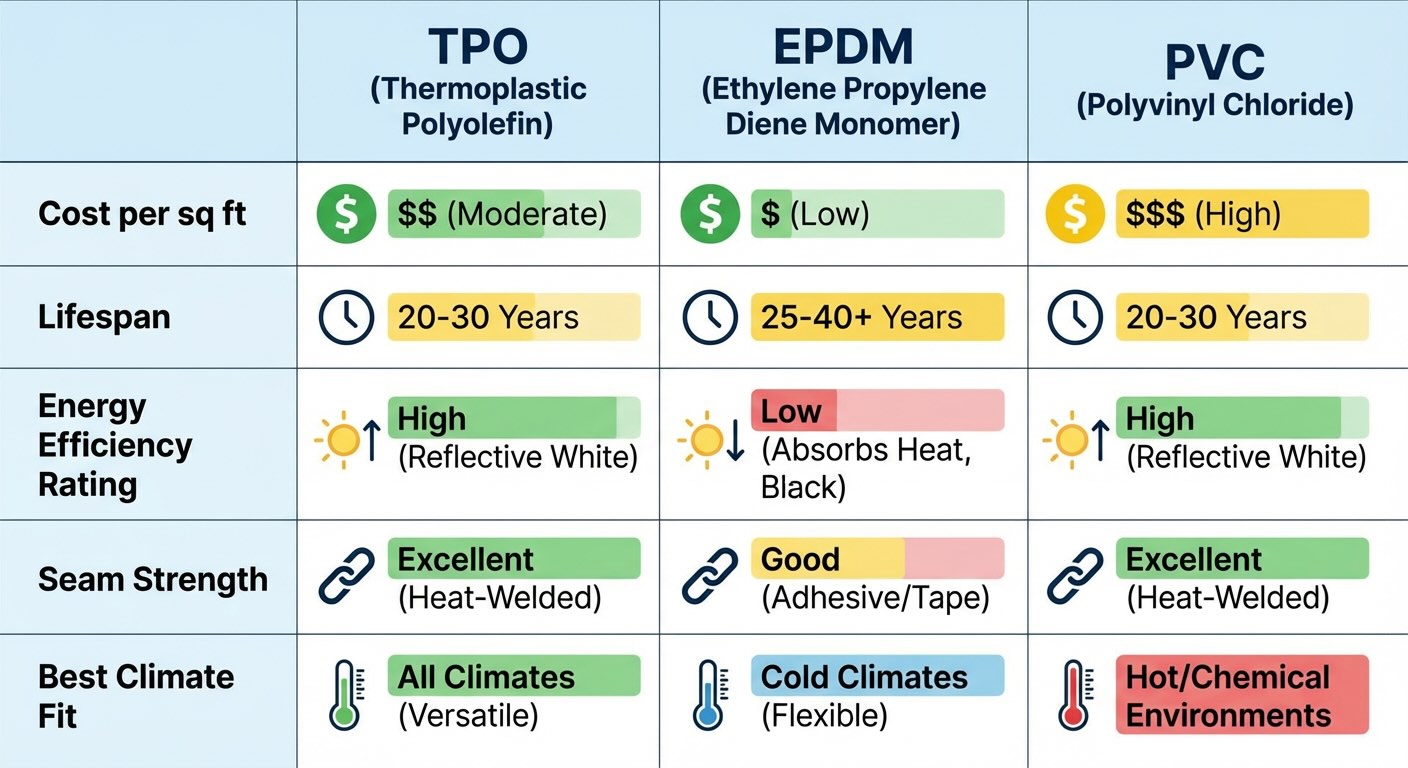
This table is something most guides don’t include. But if you’re evaluating TPO, you’re probably weighing it against at least one alternative.
| System | Cost/Sq. Ft. (Installed) | Lifespan | Energy Efficiency | Best For |
|---|---|---|---|---|
| TPO | $5–$12 | 20–30 years | High (reflective) | Budget-conscious commercial buildings |
| EPDM | $5–$10 | 25–30 years | Low (black, absorbs heat) | Cold climates, simple installations |
| PVC | $6–$14 | 20–30 years | High (reflective) | Chemical exposure areas (restaurants, labs) |
| Modified Bitumen | $4–$8 | 15–20 years | Moderate | Low-budget flat roofs |
| Spray Foam | $5–$10 | 20+ years (renewable) | Very high | Seamless coverage, irregular shapes |
TPO hits the sweet spot for most commercial building owners: it’s 25–35% cheaper than PVC while offering comparable reflective performance. EPDM costs about the same but absorbs heat, which is a real liability in Texas. Modified bitumen is cheaper upfront but shorter-lived.
Pros and Cons of TPO Roofing
M&M has installed thousands of TPO roofs. The team has also repaired hundreds that were poorly installed or underspecified. Here’s an honest assessment.
Advantages of TPO
- Energy efficiency. TPO’s white reflective surface is ENERGY STAR rated. According to the U.S. Department of Energy, cool roofs like TPO can reduce cooling costs by 10–25% [1]. In Texas, where cooling can account for 30% or more of a commercial building’s energy spend, those savings add up quickly.
- Cost-effective. TPO delivers reflective, single-ply performance at 25–35% less than PVC. For budget-conscious building owners, that margin matters.
- Strong seam integrity. Heat-welded seams are 3–4 times stronger than EPDM’s adhesive-based seams. This is the single biggest performance advantage TPO has over EPDM.
- Lightweight and flexible. TPO installs faster than multi-ply systems and doesn’t add structural load to aging buildings.
- Recyclable. TPO contains no chlorine or plasticizers, making it more environmentally friendly than PVC.
- Color options. White, gray, tan, and black are all available, though white is the standard for energy performance.
- Class A fire rating. Meets the highest fire resistance classification for roofing, required in many commercial jurisdictions.
Disadvantages of TPO
- Newer technology. TPO has been around since the 1990s, about 30 years less track record than EPDM. Early formulations had quality issues, though manufacturers have largely resolved those.
- Puncture vulnerability. Foot traffic, debris, and dropped tools can puncture the membrane. Without walk pads, routine HVAC maintenance can cause sudden, expensive leaks.
- Heat stress concerns. Sustained temperatures above 160°F on the membrane surface (common on Central Texas rooftops in July and August) can stress thinner TPO membranes, accelerating their degradation. Cheaper 45 mil membranes are especially vulnerable.
- Manufacturer variability. Unlike EPDM (which is fairly standardized), TPO formulations vary between manufacturers. Not all TPO is created equal. Stick with established brands: GAF, Carlisle, Firestone, Johns Manville.
- Specialized installation. Heat-welding equipment requires trained operators. An inexperienced crew with a welding gun can void your warranty and leave you with a roof that leaks within months.
- Not for steep slopes. TPO is designed for flat and low-slope roofs (up to about 2:12 pitch). For steeper applications, look at other roofing materials.
Not sure if TPO is right for your building? Schedule a free consultation. We’ll help you compare options.
TPO Roofing Installation: How It Works
There are two main ways to attach a TPO membrane: mechanically fastened and fully adhered. Each has tradeoffs.
Mechanically fastened systems use screws and plates to secure the membrane to the deck through the insulation. It’s faster and cheaper, and it provides strong wind uplift resistance. The downside: the fastener points create thermal bridges, slightly reducing energy performance.
Fully adhered systems use bonding adhesive to glue the membrane to the substrate. The result is a cleaner look with better energy performance (no thermal bridging). The trade-off: it’s temperature-sensitive during installation (the adhesive doesn’t bond well in cold or extremely hot conditions) and costs more.
Both methods require heat-welding of seams. This is the critical step. A technician uses a hot-air welding machine to fuse overlapping membrane sheets into a single, watertight surface. Done right, the welded seam is stronger than the membrane itself. Done wrong, it’s the first thing to fail.
A typical TPO installation takes 3–7 days for a standard commercial roof. Larger or more complex projects (buildings over 30,000 sq. ft., heavy rooftop equipment, multiple penetrations) may extend to two weeks.
Here’s what every building owner needs to hear: TPO roofing is only as good as its installation. The membrane is manufactured in accordance with ASTM D6878 [2]. But no standard can account for a crew that rushes seam welds or skips proper substrate prep. With 40+ years and 100,000+ projects, M&M’s certified installers know how to get seam welding right the first time.
How Long Does a TPO Roof Last?
A properly installed TPO roof lasts 20–30 years. Some last longer. Some don’t make it to 15.
The difference comes down to five factors:
- Membrane thickness. 60 and 90 mil membranes outlast 45 mil, especially in high-UV environments like Texas. M&M recommends a minimum of 60 mil for any commercial application in this region.
- Installation quality. Poor seam welds are the #1 cause of premature TPO failure. Period.
- Insulation and drainage. Ponding water (standing water that pools for more than 48 hours after rain) accelerates decay and attracts mold, shortening roof life by years. Proper slope and drainage design prevent this.
- Maintenance. Regular inspections catch small problems before they become expensive ones.
- Climate. Extreme UV, sustained heat, and hurricane-force winds all stress the system. Texas and Louisiana buildings need TPO configurations that account for our specific conditions.
Most manufacturers offer 10-, 15-, and 20-year warranties on the membrane itself. But here’s something worth knowing: M&M backs new installations with a lifetime labor warranty. If a seam fails due to workmanship, you’re covered — not just for a decade, but for the life of the roof.
That distinction matters. The membrane is only half the equation. Labor quality is the other half. And most manufacturers don’t warranty someone else’s labor.
TPO Roofing Maintenance and Repair
TPO is relatively low-maintenance, but “low” doesn’t mean “no.” Here’s what a solid maintenance plan looks like:
Biannual inspections, spring and fall. Check seams and flashings for separation or lifting. Look for punctures, tears, or membrane shrinkage. Clear debris from drains and scuppers. Inspect for ponding water.
After major storms. Any time your area takes hail, wind gusts over 60 mph, or sustained rainfall over 2 inches, get up there and look. Or better yet, have a professional do it. Damage you can’t see from the ground floor can quietly escalate from a $500 repair to $50,000+ in water damage and mold remediation.
Common repair scenarios:
- Seam failures (typically from poor original welding or age)
- Punctures from foot traffic or fallen debris
- Flashing deterioration around HVAC units, pipes, and curbs
- Membrane shrinkage pulling away from the edges
When to Repair vs. Replace a TPO Roof
Here’s a framework that works:
Repair if: the roof is under 15 years old, damage is localized, and less than 25% of the insulation is saturated. A good repair or restoration can extend the roof’s life by 10–15 years.
Replace if: the roof is 20+ years old, you’re seeing widespread seam failure, more than 25% of the insulation is wet, or you’ve patched the same areas multiple times.
That 25% saturation threshold is the key number. We use infrared scanning to map moisture in the insulation below the membrane. If less than 25% is saturated, we can typically restore the roof with a coating system over the existing TPO. If it’s more than 25%, the insulation is compromised. A full tear-off and replacement is the right call.
M&M prioritizes honest assessment over quick sales. If replacement is needed, we say so, even though a patch would be cheaper in the short term. That’s why we offer free inspections with same-day service for requests before noon, written findings, and no obligation.
Concerned about your TPO roof? Schedule a free inspection. Same-day service for requests before noon.
Is TPO Roofing Right for Texas and Louisiana?
This is where M&M’s regional experience matters most.
Houston, Beaumont, Lake Charles, Lafayette (Gulf Coast): Hurricanes, heavy rain, and humidity are your primary threats. TPO’s heat-welded seams resist wind uplift significantly better than EPDM’s glued seams. M&M has documented this advantage across hundreds of post-hurricane inspections. For coastal properties, M&M recommends 60 mil minimum. Ponding water from heavy rain events is an ongoing concern, so proper drainage design is non-negotiable.
Austin, San Antonio (Central Texas): Extreme heat and UV degradation are the main challenges. Summer rooftop surface temperatures regularly exceed 160°F. TPO’s reflective surface helps. According to the DOE, cool roofs can reduce cooling costs by 10–25% [1]. But thinner membranes can still stress under sustained heat. For commercial buildings in Central Texas, M&M recommends 80–90 mil TPO. Hailstorms are also a factor here; discuss impact resistance ratings with your contractor.
Across all markets: Texas and Louisiana building owners face cooling costs 30–50% higher than the national average due to extended summer seasons. TPO’s reflectivity is a major advantage in this region. But the membrane alone isn’t the whole solution. Proper attic ventilation, adequate insulation R-value, and correct drainage design all work together with TPO to deliver real energy savings.
M&M has been installing and maintaining roofs across Houston, Austin, San Antonio, Beaumont, and Lake Charles since 1983. We know how Gulf Coast weather treats every type of roofing system, and we recommend TPO configurations accordingly.
TPO Roofing for Residential vs. Commercial Buildings
TPO is primarily a commercial roofing system. But it’s increasingly showing up on residential projects, and for good reason.
If your home has a flat or low-slope section (a garage roof, patio cover, addition, or modern flat roof), TPO is a strong option. It offers the same reflective performance and heat-welded seam strength, typically at 500–3,000 sq. ft., compared with 10,000+ sq. ft. for commercial buildings.
The key differences between commercial and residential TPO projects:
- Scale. Residential projects are smaller, which means a higher cost per square foot (less economy of scale).
- Membrane thickness. Residential applications sometimes use thinner membranes (45–60 mil), though 60 mil minimum is the right call in Texas.
- Aesthetics. Commercial buildings rarely care what the roof looks like from above. Residential owners sometimes do, especially on visible flat sections. TPO’s gray and tan color options help here.
M&M handles both commercial and residential roofing projects. If your home has a flat-roof section that keeps giving you trouble, TPO might be the long-term solution.
Frequently Asked Questions About TPO Roofing
What is TPO roofing?
TPO (Thermoplastic Polyolefin) is a single-ply reflective roofing membrane designed for flat and low-slope roofs. It’s made from a blend of polypropylene and ethylene-propylene rubber, and it’s the most widely used commercial roofing system in the U.S. TPO membranes are heat-welded at the seams, creating a continuous, watertight surface.
What does TPO stand for in roofing?
TPO stands for Thermoplastic Polyolefin. “Thermoplastic” means the material can be heated and re-welded, which is how TPO seams are sealed during installation. That’s why those seams are significantly stronger than adhesive-based alternatives.
How much does TPO roofing cost?
TPO roofing typically costs $5–$12 per square foot installed, depending on roof size, membrane thickness, insulation choice, and local labor rates. For a 20,000 sq. ft. commercial building, that translates to roughly $100,000–$240,000. Material costs have been volatile since 2020, so get a current estimate for accurate pricing.
How long does a TPO roof last?
A properly installed TPO roof lasts 20–30 years. Lifespan depends on membrane thickness (45, 60, or 90 mil), installation quality, climate conditions, and maintenance frequency. In high-UV environments like Texas, thicker membranes (60–90 mil) consistently outlast thinner options.
Is TPO roofing good for hot climates like Texas?
Yes. TPO’s white reflective surface makes it one of the best roofing options for hot climates. It reflects UV radiation and can reduce cooling costs by 10–25% according to the U.S. Department of Energy [1]. However, in areas with sustained extreme heat, a thicker membrane (60–90 mil) is recommended to prevent heat-related stress and degradation.
Can TPO roofing be used on residential buildings?
Yes. While TPO is primarily commercial, it’s increasingly used on residential flat-roof sections like garage roofs, patio covers, additions, and modern flat-roof homes. It delivers the same energy efficiency and durability benefits at a smaller scale.
What’s the difference between TPO and EPDM roofing?
TPO is white and reflective (reduces cooling costs), uses heat-welded seams (3–4x stronger), and costs about the same as EPDM. EPDM is black, uses adhesive or tape seams, and has a longer track record (since the 1960s). TPO is generally better for hot climates; EPDM is often preferred in cold climates where heat absorption is actually desirable.
Is TPO Right For Your Building?
TPO is the leading single-ply roofing system for a reason. It’s cost-effective, energy-efficient, and durable when installed correctly.
But “done right” is the key phrase.
The quality of your TPO roof comes down to three things: membrane thickness appropriate for your climate, proper system design (insulation, drainage, attachment method), and the skill of the crew welding those seams. Get all three right, and you’ve got a roof that performs for decades. Miss any one of them, and you’re looking at problems years before you should be.
That’s why choosing the right contractor matters more than choosing the right membrane brand.
M&M Roofing has installed and maintained roofs across Texas and Louisiana since 1983 — over 100,000 projects and counting. Every new installation includes a lifetime labor warranty and a personal follow-up call from M&M’s owner within 30 days. If you’re not satisfied, we fix it. That’s the deal.
Ready to explore TPO roofing for your building? Get a free, no-obligation estimate. Same-day inspections for requests before noon.
References
[1] U.S. Department of Energy. “Cool Roofs.” Energy Saver. https://www.energy.gov/energysaver/cool-roofs
[2] ASTM International. “ASTM D6878/D6878M: Standard Specification for Thermoplastic Polyolefin-Based Sheet Roofing.” https://www.astm.org/d6878_d6878m-21.html