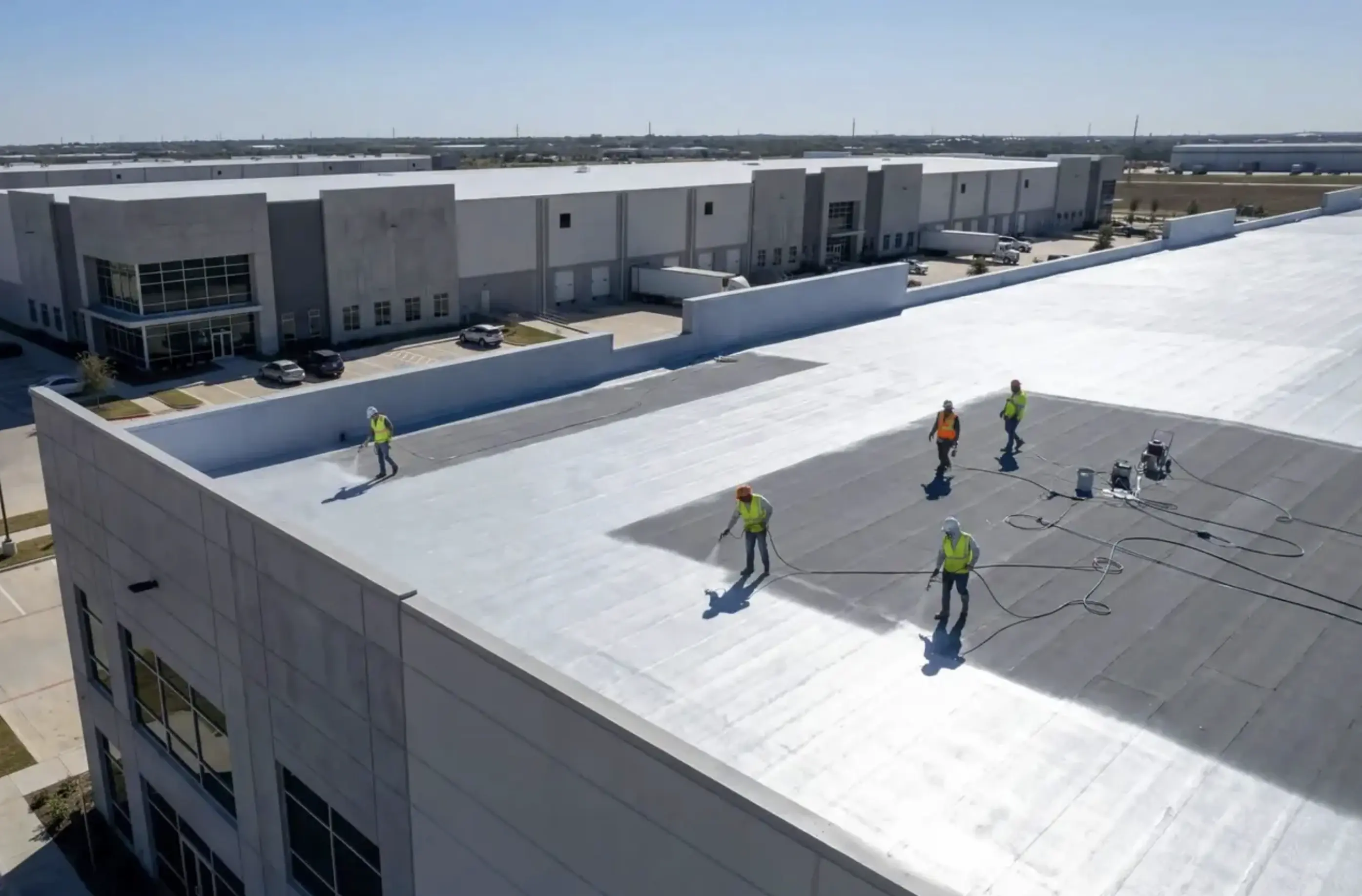



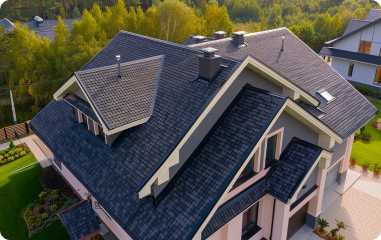

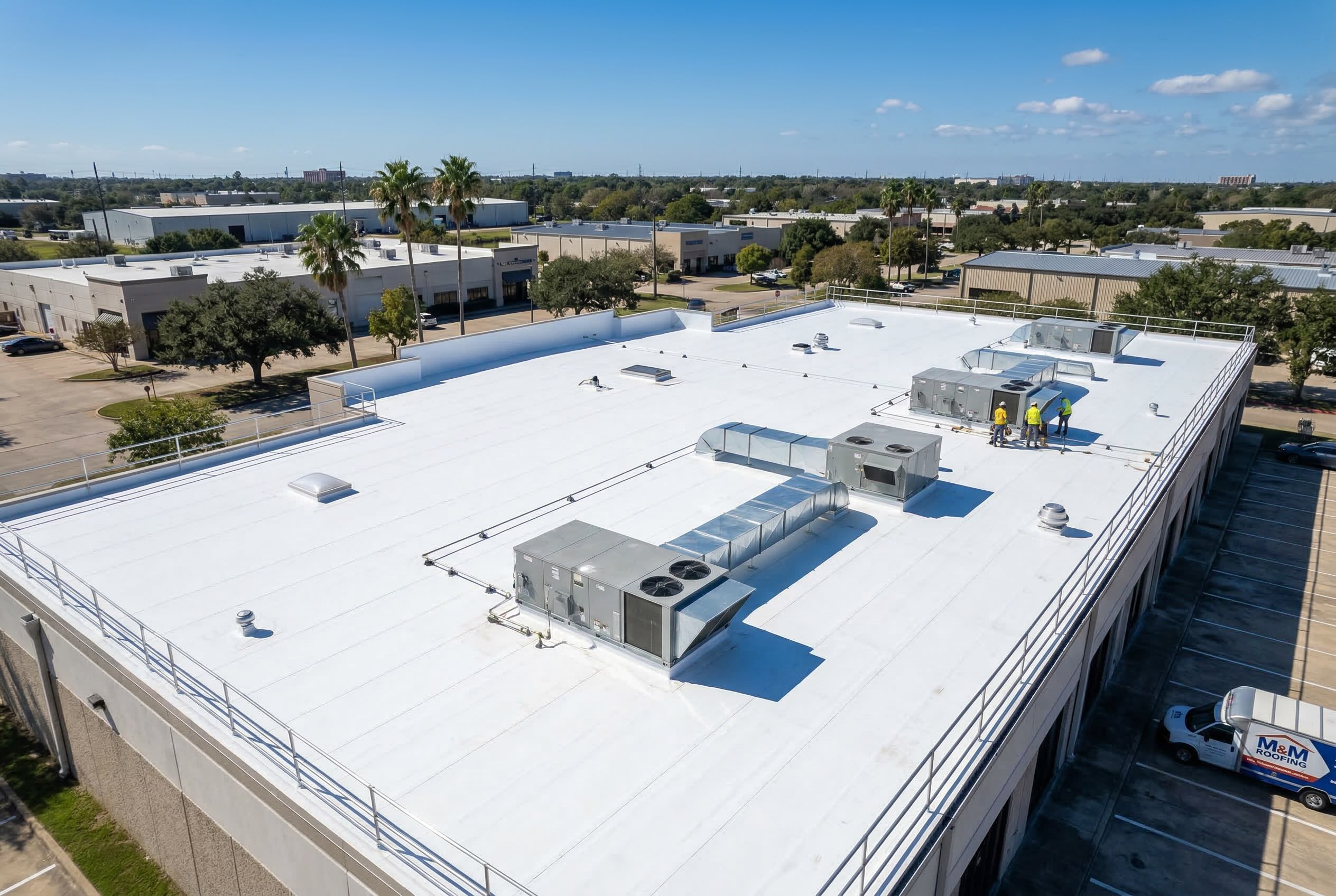
Rubber roofing refers to single-ply membrane systems used on flat and low-slope roofs. The three main types are EPDM (ethylene propylene diene monomer), TPO (thermoplastic polyolefin), and PVC (polyvinyl chloride). Each membrane delivers exceptional waterproofing and durability compared to traditional materials, making them the standard choice for commercial buildings, flat-roofed homes, and low-slope additions. Installed costs range from $4–$12 per square foot, depending on membrane type and roof complexity.
A contractor just told you your flat roof needs a “rubber roof.” You’re staring at standing water after the last rainstorm. Water pooling on your roof isn’t normal. Now someone’s quoting you EPDM or TPO, and you’re wondering which one’s worth the money. And whether you’re about to get upsold on something you don’t need.
Here’s what’s true: rubber roofing is the right call for flat and low-slope roofs. Standard asphalt shingles can’t handle standing water. They’re designed to shed it on a pitched surface. Rubber membranes seal the surface entirely and hold up for 20–30 years when installed correctly.
What’s also true: EPDM, TPO, and PVC perform very differently in heat, UV exposure, and chemical environments. In Texas and Louisiana, where summers hit triple digits, and Gulf Coast storms test every seam, the membrane you choose matters.
By the end of this guide, you’ll know which type fits your building, what it costs, and the questions to ask any contractor before signing.
What Is Rubber Roofing?
“Rubber roofing” is an informal term for single-ply membrane roofing systems. A single-ply membrane is exactly what it sounds like: a single flexible layer, 45 to 90 mils thick, installed directly over the roof deck and insulation to create a continuous waterproof surface.
Standard pitched roofs work because water runs downhill. A shingle roof on a 6:12 pitch sheds water faster than it can pool. Flat roofs don’t have that option. Any roof with a pitch under 2:12 needs a material designed to waterproof the surface itself rather than direct water off it. That’s what rubber membranes do.
The most common applications in the M&M Roofing service area: commercial buildings, warehouses, retail centers, flat-roofed garages, low-slope home additions, and residential homes with flat or near-flat roof sections. If your roof is flat or nearly flat, one of these three membrane types is almost certainly the right material.
EPDM is the only true synthetic rubber in the group. TPO and PVC are technically thermoplastics. But contractors, insurers, and building owners use “rubber roofing” to cover all three, and that’s the convention this guide follows.
For a complete look at flat roof design and drainage requirements, see M&M’s guide to flat roofs.
The 3 Types of Rubber Roofing Membranes
EPDM: The Classic Rubber Membrane
EPDM (ethylene propylene diene monomer) is the original rubber roofing membrane and still the most widely installed on residential flat roofs. It’s been in use since the 1960s. The track record is there.
Key specs: Available in 45–90 mil thickness. Typically black, though white reflective versions exist. Lifespan of 20–30 years with proper maintenance. Installed cost: $4–$8 per square foot.
Best for: Residential flat roofs, budget-conscious projects, and buildings where long lifespan with low upfront cost is the priority.
One consideration for TX/LA: Black EPDM absorbs heat. In Houston in July, rooftop temperatures on black EPDM hit 170°F or higher. That heat finds its way inside and pushes your air conditioner harder. It costs money every single summer. White EPDM or a reflective coating solves it, but adds cost. For buildings where cooling costs matter, TPO is worth a closer look.
For full installation details, repair methods, and maintenance guidance, see M&M’s complete EPDM roofing guide.
TPO: The Energy-Efficient Option
TPO (thermoplastic polyolefin) became the most installed commercial roofing membrane in North America over the last decade. The white reflective surface is the main reason.
Key specs: Available in 45–80 mil thickness. Typically white or light gray. Lifespan of 15–25 years. Installed cost: $5–$10 per square foot.
Best for: Commercial buildings, hot climates where cooling costs are significant, and any application where energy savings need to offset the higher upfront cost versus EPDM.
TX/LA advantage: In Austin, San Antonio, Houston, and across coastal Louisiana, a white TPO membrane reflects UV rather than absorbing it. The Cool Roof Rating Council measured reflective membranes reducing rooftop surface temperatures by 50–60°F compared to black. In July in Houston, that’s the difference between 170°F on black EPDM and 110°F on white TPO. That cuts cooling bills measurably over a 20-year roof life.
For a full breakdown of TPO installation methods and specifications, see M&M’s complete TPO roofing guide.
PVC: The Chemical-Resistant Choice
PVC (polyvinyl chloride) is the premium option and the most chemically resistant of the three. It’s not the default for most flat roofs, but for specific applications it’s the only appropriate choice.
Key specs: Available in 40–80 mil thickness. White or light-colored. Lifespan of 20–30 years. Installed cost: $6–$12 per square foot.
Best for: Restaurants, commercial kitchens, food processing facilities, any building with grease exhaust or regular chemical exposure. Grease and cooking oils degrade EPDM and TPO membranes. PVC resists them.
When it’s worth the premium: If your building has grease exhaust vents, rooftop kitchen equipment, or chemical storage in close proximity to the roof, PVC isn’t an upgrade. It’s the right specification. Using EPDM or TPO in those conditions means premature failure.
Rubber Roofing Cost Breakdown
This is the data no competitor in this space provides. Here are installed cost ranges by membrane type and building size, reflecting Gulf Coast regional rates for Texas and Louisiana.
| Membrane Type | Material (per sq ft) | Installed (per sq ft) | 1,000 sq ft | 3,000 sq ft |
|---|---|---|---|---|
| EPDM | $1.50–$3.00 | $4–$8 | $4,000–$8,000 | $12,000–$24,000 |
| TPO | $2.00–$4.00 | $5–$10 | $5,000–$10,000 | $15,000–$30,000 |
| PVC | $3.00–$5.00 | $6–$12 | $6,000–$12,000 | $18,000–$36,000 |
Installed cost includes labor, membrane, adhesive or fasteners, edge metal, and standard flashing. Prices reflect TX/LA market rates as of 2024–2025.
Not sure what your specific roof will cost? Get a free flat roof estimate from M&M, no obligation.
What Moves the Final Number
Four variables drive most of the cost range above.
Roof size and complexity. Penetrations (HVAC units, skylights, drains, exhaust vents) each require individual flashing details. More penetrations means more labor hours.
Existing membrane removal. Removing an old membrane adds $1–$2 per square foot. Ballasted systems (covered in stone) add removal cost for the gravel itself.
Insulation upgrade. Most flat roof replacements include new or upgraded ISO board insulation. Adding tapered insulation to improve drainage is highly recommended in TX/LA. It adds cost but prevents the ponding water that degrades membranes faster than any other factor.
Warranty tier. Manufacturer warranties range from 10 to 20+ years. Higher warranty tiers require specific membrane thickness and installation methods. The labor to meet those specs costs more. A 20-year no-dollar-limit manufacturer warranty is worth the difference for commercial property owners.
EPDM vs. TPO vs. PVC: Which Is Right for You?
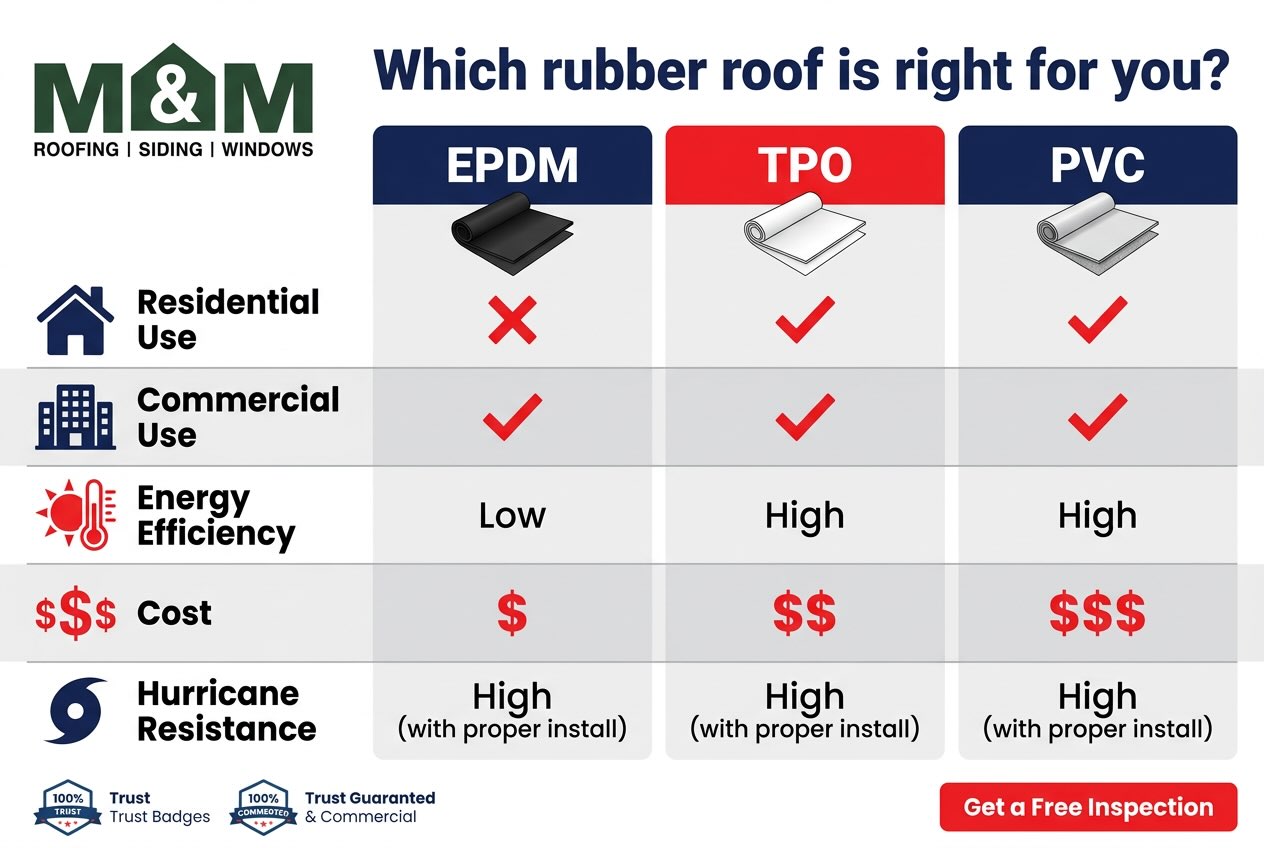
Three questions narrow the choice for most property owners.
- Is your building commercial or residential? PVC is almost exclusively commercial. EPDM and TPO cover both. For a residential flat-roofed garage or home addition, start with EPDM or TPO.
- Is energy efficiency a meaningful priority? In TX/LA summers, it almost always is. If your building is air-conditioned and cooling costs matter, white TPO or PVC outperforms black EPDM meaningfully. The reflectivity difference is significant at the surface temperature level.
- Is there grease, chemical exposure, or kitchen exhaust on or near the roof? If yes, PVC is the specification. EPDM and TPO will degrade in those conditions. This isn’t a close call.
Quick decision guide:
| Your Situation | Best Choice |
|---|---|
| Residential flat roof, budget-first | EPDM |
| Commercial building in TX/LA heat | TPO |
| Restaurant or grease exhaust present | PVC |
| Long lifespan + energy efficiency | TPO or PVC |
| Budget-conscious residential repair | EPDM |
How Rubber Roofing Is Installed
Three installation methods exist. Each has a different cost profile and wind-resistance characteristic.
Fully adhered. The membrane is bonded to the insulation substrate with adhesive across the entire surface. Most common for residential applications and hurricane-prone regions. Most secure against wind uplift because there’s no unsealed area for wind to get underneath.
Mechanically fastened. Screws and plates are driven through the membrane into the roof deck at set intervals. Faster installation, lower labor cost, standard for large commercial roofs. Less wind-resistant than fully adhered because the membrane can flutter between fasteners at high wind speeds.
Ballasted. The membrane lies loose over the insulation and is held down by river stone ballast. Lowest material and labor cost. Requires a structurally sound roof deck to handle the weight, typically 10–12 lbs per square foot. Rarely used in Gulf Coast applications where wind uplift is a real risk.
Why installation quality matters more than membrane choice: Seam failures and edge metal separation cause most rubber roof failures. The membrane itself rarely dies first. A properly installed EPDM roof lasts 30 years. An improperly installed TPO roof fails in five. With 40+ years and 100,000+ projects across Texas and Louisiana, M&M’s team has seen every failure mode under real Gulf Coast conditions. The seams and edges are where experience shows up most.
How Long Does Rubber Roofing Last?
| Membrane | Standard Lifespan | With Proper Maintenance |
|---|---|---|
| EPDM | 20–25 years | Up to 30 years |
| TPO | 15–20 years | Up to 25 years |
| PVC | 20–25 years | Up to 30 years |
Three TX/LA-specific factors that shorten lifespan when not accounted for:
Extreme UV and heat cycling. In Austin and San Antonio, summer surface temperatures on black EPDM can exceed 170°F. That thermal cycling (60°F at night, 170°F by afternoon) stresses seams and flashings over time. Proper membrane thickness (60 mil minimum in high-UV zones) and white or coated membranes reduce this stress.
Hurricane-force wind uplift. In Houston, Beaumont, Lake Charles, and Lafayette, wind events regularly test the edge metal and seam adhesion on flat roofs. Fully adhered systems and enhanced mechanical fastening patterns are the appropriate specification for these markets.
Ponding water and drainage failure. Rubber membranes tolerate standing water better than shingles, but prolonged ponding accelerates seam and membrane degradation. Proper drainage design, including tapered insulation and functioning roof drains, is what keeps a rubber roof at the high end of its lifespan range.
Rubber Roofing Maintenance and Repair
A rubber roof doesn’t need much. But it does need consistent attention on a few specific points.
Annual maintenance checklist:
- Inspect and clear all roof drains, scuppers, and gutters. Proper drainage is the highest-leverage maintenance task for any flat roof.
- Check all seams, flashings, and edge metal for separation or lifting.
- Remove debris: leaves, branches, anything that traps moisture against the membrane surface.
- Reapply sealant at penetrations and termination bars where weathering occurs first.
Maintaining gutters and downspouts on adjacent building sections matters here too. Water that backs up from a blocked gutter and sits against flat roof flashing will find a way in.
When to repair vs. replace:
Minor punctures or small seam lifts are straightforward patch repairs. EPDM in particular is easy to patch with compatible membrane tape and adhesive. Typical repair cost: $200–$800.
Widespread shrinkage, multiple seam failures across different sections, or membrane that has hardened and cracked calls for full replacement.
Aging but structurally sound membrane with no active leaks is a candidate for roof coating restoration. A quality elastomeric coating adds 10–15 years to a membrane that still has integrity, at significantly lower cost than full replacement. For guidance on repair versus full replacement on commercial roofs, see M&M’s commercial roof repair guide.
Has your rubber roof been inspected recently? Schedule a free inspection. M&M’s team will give you a straight assessment of what you’re actually dealing with.
Is Rubber Roofing Right for Texas and Louisiana?
For flat and low-slope roofs in the Gulf Coast region, rubber membrane roofing isn’t just the right choice. It’s essentially the only practical one. The question is which membrane and which installation method.
By market:
| Market | Primary Risk | Recommended Spec |
|---|---|---|
| Houston / Beaumont | Hurricane wind uplift, heavy rain | Fully adhered EPDM or TPO; 60 mil minimum; enhanced edge metal |
| Austin / San Antonio | Extreme UV, heat cycling, hail | White TPO; tapered ISO board insulation |
| Lake Charles / Lafayette | Hurricanes, wind-driven rain, humidity | Fully adhered TPO or EPDM; verify contractor licensing |
| All Gulf Coast | Ponding water, drainage failure | Tapered insulation standard; gutter and drain maintenance required |
On storm chasers in Louisiana: After Hurricane Ida, Laura, and Delta, out-of-state contractors flooded Lake Charles and Lafayette. Most quoted low prices, but they carried no manufacturer warranty, no Louisiana license, and no ability to back up the work five years later when the seams started leaking. Always verify contractor licensing through lslbc.louisiana.gov and get manufacturer warranty certification in writing. Doug Moncure built M&M in the Gulf Coast region in 1983. That’s 43 years of manufacturer certifications and the credibility to back up long-term warranties. See the Lake Charles roofing guide and Lafayette roofing guide for more on choosing a contractor you can trust.
M&M serves Houston, Katy, Pearland, Sugar Land, Austin, San Antonio, Beaumont, Lake Charles, Lafayette, and surrounding areas. For Houston-area commercial and residential projects, see M&M’s Houston roofing guide.
Frequently Asked Questions
What is the best rubber roofing material for a flat roof?
EPDM is best for residential flat roofs on a budget. White TPO wins for commercial buildings in hot climates. PVC is required for grease exhaust or chemical exposure.
How long does rubber roofing last?
EPDM and PVC: 20–30 years with proper maintenance. TPO: 15–25 years. Gulf Coast conditions shorten this timeline if you skip tapered insulation or let ponding water sit.
How much does it cost to replace a rubber roof?
$4–$12 per square foot installed. A 2,000 sq ft residential roof runs $8,000–$24,000. A 3,000 sq ft commercial roof runs $15,000–$36,000.
Is rubber roofing good for residential homes?
Yes. EPDM is cost-effective and easy to repair. Lasts 20+ years with minimal maintenance. TPO is used when energy efficiency is important.
Can rubber roofing withstand hurricanes?
Only if it’s fully adhered with enhanced edge metal. Ballasted and mechanically fastened systems carry uplift risk in hurricane zones.
What’s the difference between EPDM and TPO?
EPDM is cheaper, black, and easy to repair. TPO is white, more efficient, and lasts a bit less long. In TX/LA heat, TPO’s reflectivity saves cooling costs. See the EPDM guide and TPO guide for full details.
Which Membrane Is Right for Your Roof?
Rubber roofing is the correct choice for any flat or low-slope roof. The right membrane depends on your building type, climate priorities, and budget. For most TX/LA commercial property owners, TPO delivers the best balance of energy efficiency and lifespan. For budget-conscious residential projects, EPDM is the proven workhorse.
What most property owners get wrong is treating this as a commodity purchase. The membrane is one variable. Installation quality, drainage design, and the contractor’s ability to back up a warranty five years from now matter more.
Doug Moncure built M&M in 1983. Forty-three years. Over 100,000 completed projects across Texas and Louisiana. A team that’s seen every failure mode on Gulf Coast flat roofs and knows exactly how to prevent them. That experience is worth more than the lowest bid.
Get your free flat roof inspection with same-day availability before noon across TX and LA.
Citations:
[1] Cool Roof Rating Council — Rated Products Directory.
[2] Louisiana State Licensing Board for Contractors.
[3] National Roofing Contractors Association — Low-Slope Membrane Roofing.
M&M Roofing, Siding & Windows has served homeowners across Texas and Louisiana for more than 40 years. Backed by over 100,000 completed home improvement projects, M&M offers expert insight on roofing, siding, windows, gutters, storm damage, and exterior restoration, helping homeowners make confident, informed decisions about their property.