





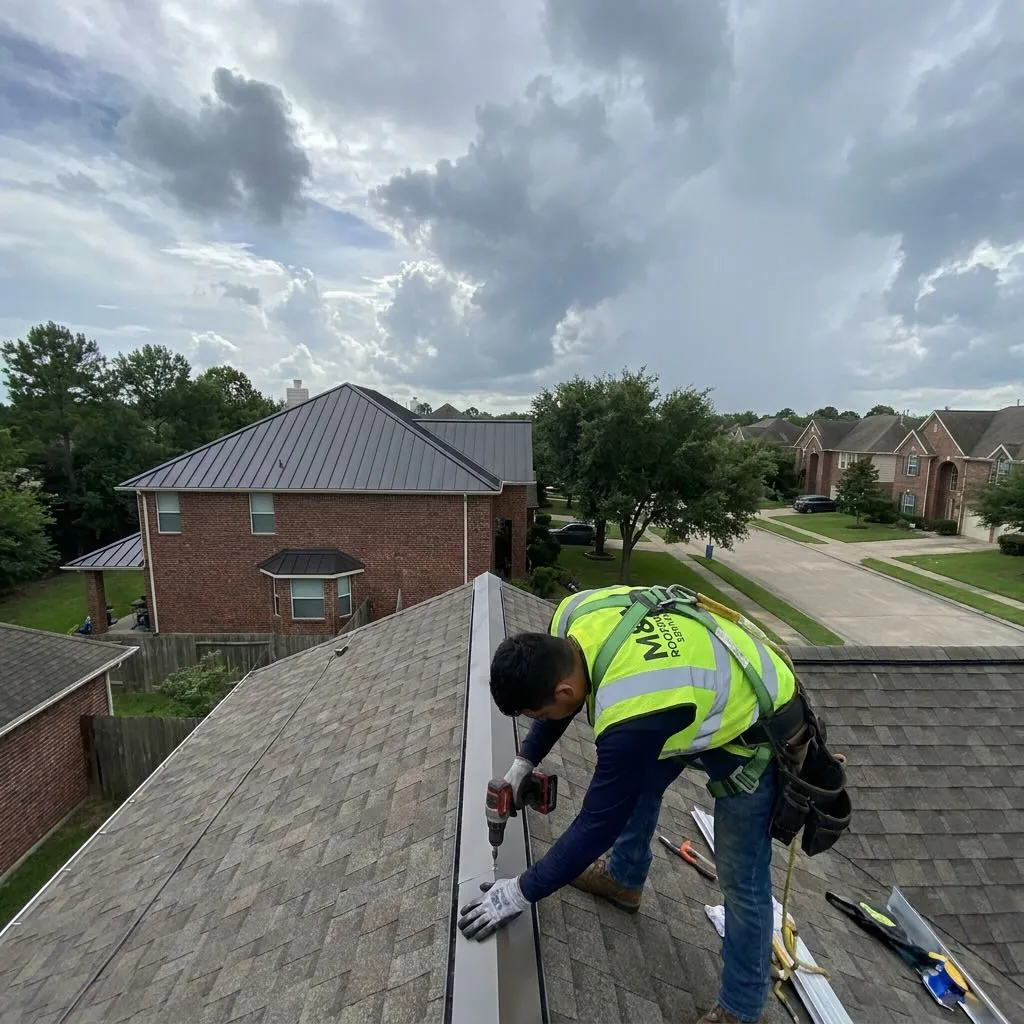
An emergency roof repair in Katy is needed when water is actively entering the home, when structural materials like decking or underlayment are directly exposed to the elements, or when wind damage has compromised a roof section to the point where the next rain event will cause interior damage. Not every roof problem requires same-day service, but those three conditions do. M&M Roofing has completed hundreds of emergency and non-emergency repairs across Katy, Cinco Ranch, and Houston’s western suburbs, and the most common call we get is from homeowners who genuinely can’t tell which situation they’re in. This article gives you the framework M&M uses to answer that question.
Last Tuesday night’s storm. You heard something hit the roof. This morning, there’s a water stain on the ceiling that wasn’t there before. You searched “emergency roof repair Katy TX,” and now you’re staring at the phone, unsure whether you need someone there in two hours or whether you have time to think about it.
M&M gets this call hundreds of times a year. Here’s how to answer it.
The single most expensive mistake Katy homeowners make isn’t calling too late. It’s a misreading of which category their situation falls into. Either they treat a genuine emergency like something that can wait, and a $600 repair becomes a $5,000 ceiling restoration. Or they panic over something that’s urgent but not same-day, and make a rushed decision under pressure.
The framework below fixes that. Walk through the signs in order. Most Katy homeowners know which category they’re in by the time they finish Section 2.
The 3 Categories of Roof Damage — And Why It Matters Which One You Have
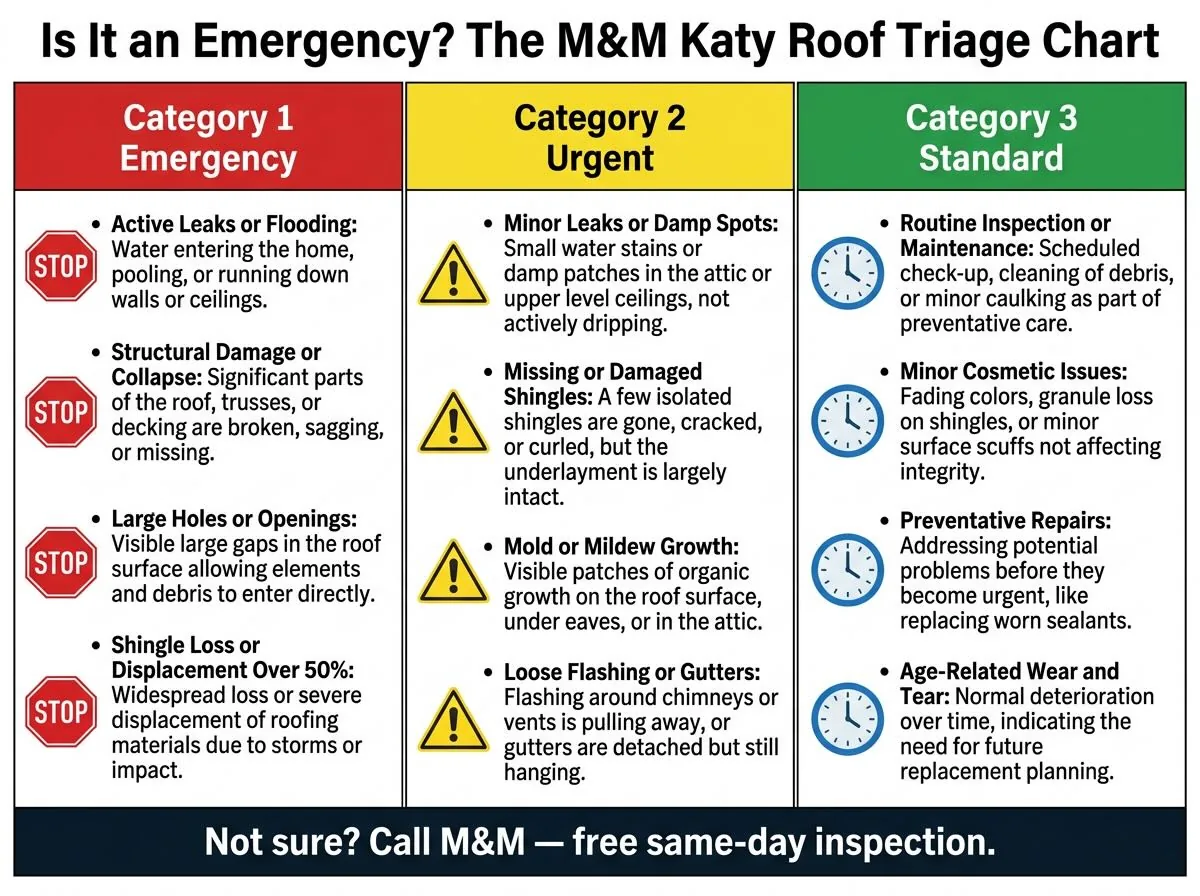
Every roof problem M&M responds to in Katy falls into one of three categories. Knowing which one you’re dealing with determines your timeline and your cost.
Category 1: Active Emergency (call today): Water is entering the home right now. Structural materials are exposed or will be exposed before the next rain. One storm away from major interior damage. Same-day service is needed.
Category 2: Urgent Non-Emergency (schedule within 3–5 days): Damage exists but isn’t yet allowing active water intrusion. Left for another two to three weeks, it becomes a Category 1. Wind-lifted but still-attached shingles, separated flashing, cracked ridge caps: these are Category 2 situations most Katy homeowners don’t recognize.
Category 3: Standard Repair (schedule within 2–4 weeks): Isolated minor damage. No immediate water risk. A few missing granules, one or two lifted shingles on an otherwise sealed roof, and minor gutter damage. Real problems that warrant attention, but not this afternoon.
Here’s the pattern M&M sees repeatedly in Katy: homeowners with Category 2 situations treating them as Category 1, calling in a panic and paying emergency rates for something that needed attention this week but not this hour. And homeowners with Category 1 situations are treating them as Category 3, waiting through a second storm because the ceiling stain from the first one dried out.
The difference between those two errors is knowing which signs belong to which category.
Signs You Have an Active Emergency (Category 1 — Call Today)
These are definitive emergency indicators. If you see any of these, call now. Don’t wait to see what happens with the next rain.
Active Water Intrusion Inside the Home
Water stains that are wet to the touch. A ceiling that’s bubbling, sagging, or soft. Water dripping from a light fixture or ceiling fan. If water is moving through the structure right now, every hour of delay increases interior damage.
In Katy’s climate, wet insulation begins developing mold within 24–72 hours. What starts as a wet ceiling patch can become an insulation replacement and drywall remediation project before the end of the week. The response window is measured in hours, not days.
Call M&M for same-day emergency service in Katy
Visible Sky or Daylight Through the Roof Deck
Any gap in the roof where daylight is visible from the attic is a Category 1 emergency. This results from wind-torn sections, tree impact, or catastrophic flashing failure at a large penetration. Don’t delay. Any rain event, even a light one, means direct water entry with nothing to stop it.
A Large Section of Shingles Missing After a Storm
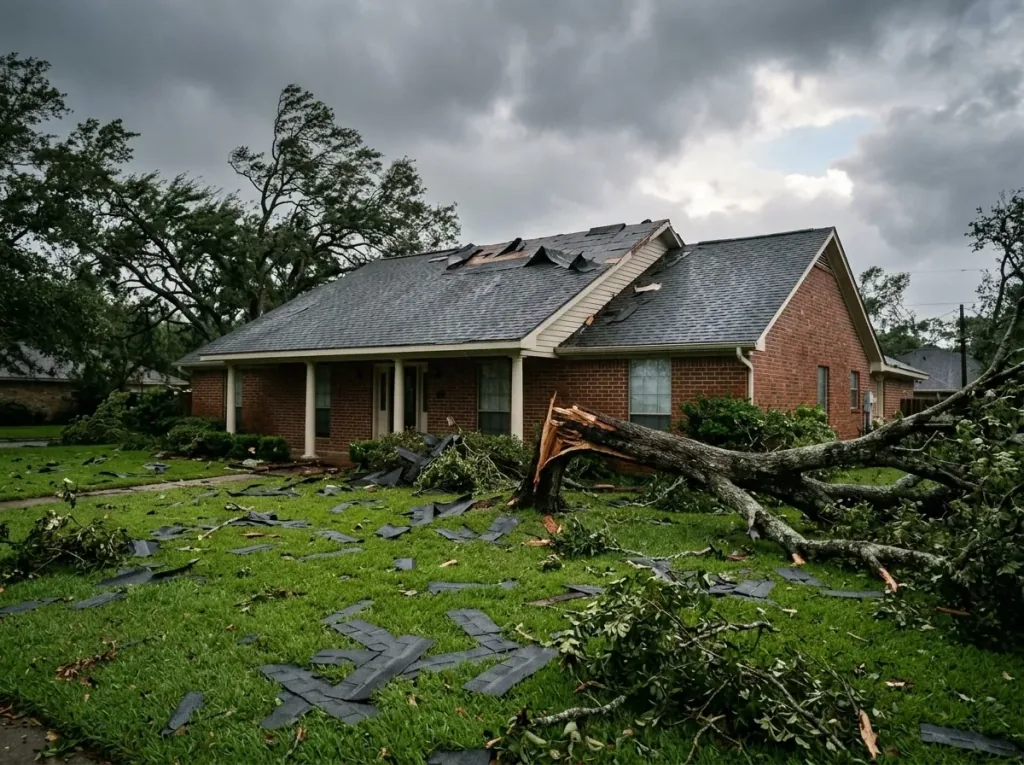
Three or more shingles missing in a contiguous area on the same slope constitute emergency exposure. This is especially true if the missing shingles are from a lower course, where the underlayment beneath isn’t designed to shed standing water independently.
The distinction matters: scattered single shingles missing across the roof is Category 2. A blown section from one area of a slope is Category 1. Spot-missing shingles look alarming from the driveway. A blown section might not be as obvious from street level. It takes a trained eye on the roof surface to distinguish between the two.
Sagging, Buckling, or Soft Spots on the Roof Surface
If you can safely view the roof surface and notice a sagging ridgeline, buckled sections, or soft areas under pressure, that’s a structural deck compromise. Not surface damage. The deck is failing, and the repair scope is entirely different from a standard shingle replacement.
Signs You Have an Urgent Non-Emergency (Category 2 — Schedule This Week)
This is the category most Katy homeowners don’t know exists. These situations aren’t actively leaking today. They will be, usually, within the next one to three rain events. The repair cost is manageable right now. It won’t be after the next storm.
Wind-Lifted Shingles That Are Still Attached
After a Katy storm, wind-lifted shingles that haven’t torn off yet look like curled or elevated edges, slightly upward from the plane of the roof. They’re still sealed for now, but the adhesive bond broke. One more wind event and they’re gone.
Katy’s Gulf-fed storm systems produce sudden gusts that regularly hit 50–60 mph. A shingle with a broken bond is one gust from becoming a Category 1 situation. Schedule within three to five days.
Ridge Cap Separation
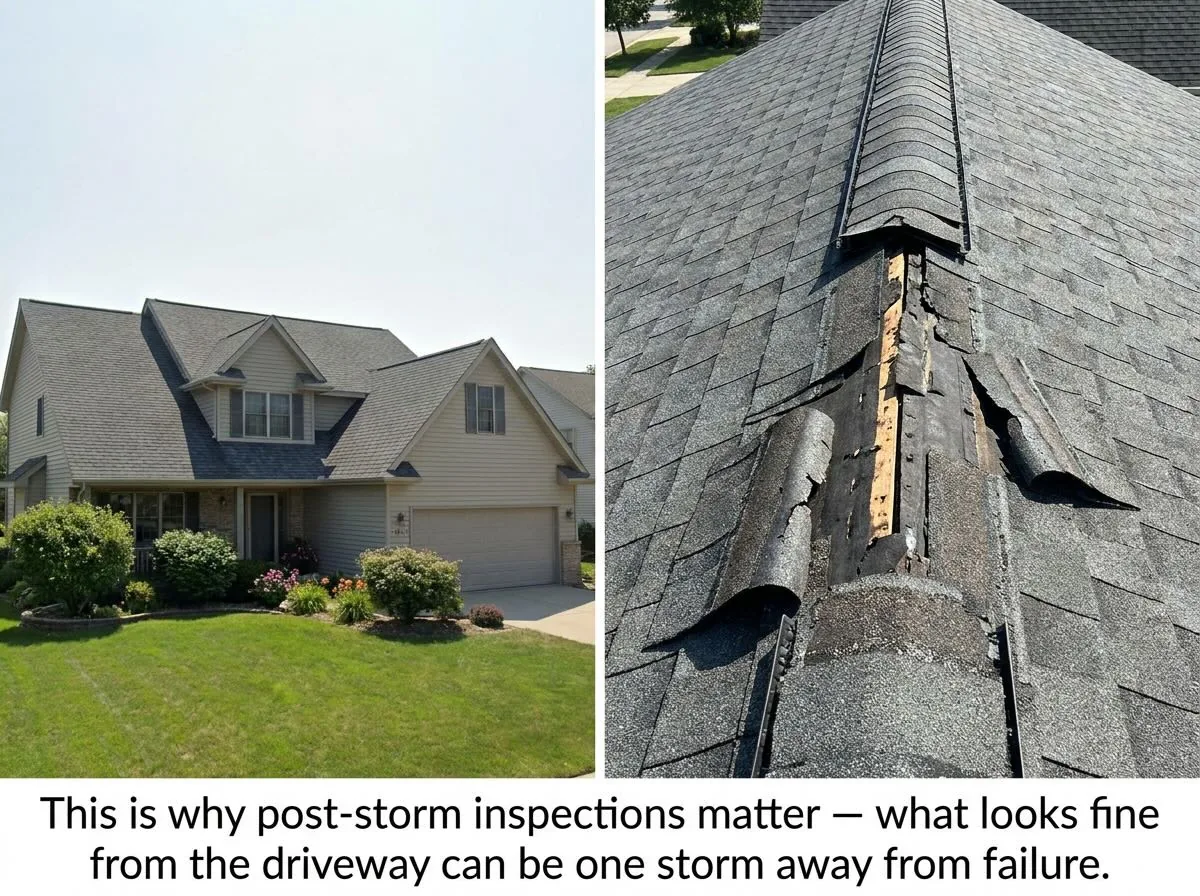
The ridge cap, the row of shingles along the peak of the roof, is the most wind-vulnerable point on any Katy roof. Partially detached ridge caps look completely fine from the driveway. From the roof level, the separation and lifting are obvious.
M&M finds partially lifted ridge caps on Katy homes after almost every significant storm event. The adhesive fails, the nails work loose, and the cap is held in place by friction alone. One more storm takes it off entirely, exposing the ridge board and creating a direct water entry point at the highest part of the roof. Schedule within a week.
Flashing Separation Around Chimney, Skylights, or HVAC Curbs
Katy’s thermal cycling, hot days followed by cool fronts, summer temperatures followed by winter northers, works metal flashing loose over the years. Separated step flashing, counter-flashing, or HVAC boot flashing isn’t actively leaking yet. The next heavy rain will find that gap.
This is especially common in Katy homes built in the 1990s and early 2000s, where original flashing is now 20–30 years old and has cycled through thousands of temperature swings. Schedule within a week. For more on what storm damage roof repair looks like across the Houston metro, see M&M’s storm damage guide.
A Ceiling Stain That Has Dried
A water stain that dried after the last storm and hasn’t grown since is a Category 2 situation, not a Category 3. A dried stain means water entered your roof system at some point and soaked into the insulation before it found the drywall. The entry point is still there. The next rain event finds it again. Get it inspected within a week.
Signs You Can Schedule in the Next Few Weeks (Category 3)
Not everything that looks alarming is an emergency. Part of M&M’s value is telling Katy homeowners the honest answer, and sometimes the honest answer is “you have time.”
These are real problems that need attention. They’re just not the same-day situations.
Isolated granule loss in gutters or on the ground after a storm, without any active penetration or visible shingle damage. Worth monitoring and scheduling an inspection, but not a weekend emergency.
One or two shingles are missing on an otherwise fully intact roof, where surrounding shingles are properly sealed, and no underlayment is exposed. The roof is managing moisture. Schedule a repair within a few weeks.
Minor caulk cracking around small penetrations where the underlying flashing is still intact and sealed. Caulk fails before flashing in most cases. This is a maintenance repair, not a structural failure.
Gutter damage without any corresponding roof surface damage. Bent or separated gutters affect drainage but don’t create immediate roof penetration risk.
One important qualifier: if you’re in Category 3 and there’s a storm in the forecast within the next 48 hours, bump it up. What’s manageable in dry conditions becomes a liability once water starts stressing those weak points.
The 2 Most Common Calls We Get Wrong in Katy (And What M&M Actually Found)
After hundreds of Katy emergency calls, two patterns repeat consistently enough that M&M treats them as standard diagnostic considerations on every Katy job.
The Emergency That Wasn’t
A homeowner in Cinco Ranch called M&M at 7 am on a Tuesday. Water was dripping from the ceiling in the master bedroom. She’d been up since 5am convinced she had a catastrophic roof failure. M&M arrived the same day.
The source wasn’t the roof. It was a clogged HVAC condensate drain line in the attic, a plastic line carrying moisture from the air handler to a drain point, now blocked with algae and backing up into the overflow pan. That pan had been slowly releasing water onto the insulation below, which found its way to the drywall in the bedroom ceiling. [1]
This happens multiple times every month in Katy homes built in the 1990s and early 2000s, where original condensate routing has become inadequate as systems age. Katy’s year-round humidity means HVAC units run almost continuously through the summer, and condensate drain lines work overtime. The clog and backup pattern is predictable in this housing stock.
M&M found the source in 20 minutes. The condensate line was cleared and rerouted, and the “roof leak” stopped. The homeowner had spent two days convinced she was facing a major roof repair.
The lesson: ceiling water stains are not automatically a roof problem. A trained eye can distinguish the source quickly. Don’t assume the diagnosis before someone gets up there and looks.
The Non-Emergency That Was
A homeowner in Cross Creek Ranch called M&M for what he described as a “minor shingle repair.” His neighbor noticed a few shingles had blown off in last month’s storm. He wasn’t in a hurry. He had it rated as a Category 3 in his head.
M&M got on the roof. Three missing shingles, confirmed. Manageable, Category 2. But the inspection also found a six-foot section of ridge cap that had been progressively lifting since a storm two months prior, now held by friction alone, adhesive strip completely separated, and nails working out of the deck.
With a storm front in the forecast two days out, M&M treated it as a Category 1 urgency and repaired it that day. Two days later, a significant storm moved through the area. The roof was fine. Without the inspection, that homeowner would have filed a “few missing shingles” repair call and gotten his ridge cap blown off during heavy rain, with full structural exposure at the peak.
After hundreds of Katy emergency calls, the most important thing M&M can tell homeowners is this: the difference between a $400 repair and a $4,000 ceiling restoration is usually how quickly someone got on the roof to look. Whether it’s M&M or someone else, just get someone on the roof.
Not sure which category you’re in? M&M will tell you — free inspection, no obligation.
What M&M’s Emergency Repair Process Looks Like in Katy
When a Katy homeowner calls M&M for an emergency repair, here’s what happens.
Same-day scheduling. Requests submitted or called in before noon are eligible for same-day inspection and, where materials allow, same-day repair. Katy falls squarely within M&M’s primary Houston-area service territory. The response time reflects that.
Triage before work begins. The first thing M&M does on every job is confirm the category. Is this an active emergency, or a Category 2 that needs attention this week? M&M doesn’t manufacture urgency where it doesn’t exist. If a roof is in Category 2, the homeowner knows that before a single nail is driven.
Emergency tarping when needed. If materials aren’t on hand for same-day permanent repair, M&M installs an emergency tarp over exposed sections while permanent materials are sourced. The tarping cost is documented and typically reimbursable through homeowners’ insurance.
Photo documentation throughout. Every finding is photographed with notes. Katy homeowners dealing with storm damage almost always have an insurance conversation alongside the repair question. M&M’s documentation is formatted to support claims and can be submitted directly to adjusters. Learn more about whether to contact insurance or your roofer first after a storm.
Written findings report. Before leaving, M&M provides a written summary of what was found, what was repaired, and what to watch for. If additional work is needed, the scope and cost are in writing before the homeowner decides anything.
Katy’s housing stock has specific failure patterns that M&M has documented across hundreds of jobs. Homes built during the 1990s and 2000s growth surge across Cinco Ranch, Firethorne, Cross Creek Ranch, Tamarron, and Pine Mill Ranch are now 20–30 years into their original roofing systems. Aging adhesive, brittle ridge caps, and original flashing cycling through decades of Gulf Coast temperature swings: these aren’t surprises to an M&M inspector in Katy. They’re expected. Knowing what to look for is what separates a triage inspection from a walk-and-wave.
M&M has been in the Greater Houston market, including Katy and the western suburbs, for over 40 years and has completed more than 100,000 projects. Schedule your free Katy roof inspection — same-day available.
Frequently Asked Questions
How much does emergency roof repair cost in Katy TX?
Emergency targeted repairs in Katy typically run $300–$1,200 for isolated issues: single-section wind damage, flashing failure, or missing shingles. Larger emergency repairs involving structural exposure or multiple failure points run $1,500–$4,000 or more. M&M Roofing provides a written estimate before any work begins.
Does M&M offer same-day roof repair in Katy?
Yes. Requests submitted before noon are eligible for same-day inspection and, where materials allow, same-day repair. For active emergencies, water entering the home or structural exposure, call directly rather than waiting for an online request.
Will my homeowners’ insurance cover emergency roof repair in Katy?
Storm-caused emergency repairs are typically covered under standard homeowners policies, subject to your deductible. M&M documents all findings with photos formatted for insurance submission and can be present during adjuster visits to walk through what was found.
My ceiling has a water stain, but it hasn’t rained in a week. Is that still an emergency?
Not a same-day emergency, but it needs inspection within a week. A dry stain means water entered at some point and soaked into the insulation before it found the drywall. The entry point is still there. The next rain event finds it again. Don’t wait until it reactivates to identify the source.
How do I know if I need a repair or a full replacement?
Roof age plus extent of damage are the two key variables. If targeted repairs will hold for another 5+ years, M&M recommends repair. If repair cost is approaching 30% of replacement cost on a roof that’s 18+ years old, the replacement conversation is worth having. Read more about repair vs. replacement for the full decision framework.
What’s the best way to find a reliable roofer in Katy after a storm?
Verify Texas contractor license through TDLR (license.tdlr.texas.gov), confirm a physical Texas address, and ask for local Katy or Harris County references from jobs completed in the past 12 months. After major storms, out-of-state crews deploy to Katy within 48 hours. License, address, and references before signing anything is the most reliable protection.
The Bottom Line for Katy Homeowners
Katy’s housing stock is aging into the high-failure-risk window. The original roofing systems installed during the city’s 1990s and 2000s growth surge are now 20–30 years old, and Gulf Coast storm frequency means they’ve been stressed regularly. [2] The framework in this article gets most homeowners to the right answer: same-day emergency, schedule this week, or schedule in a few weeks.
When the category isn’t clear, when you have a dry stain, a storm in the forecast, and a roof that’s 18 years old, M&M’s answer is simple. Get a free inspection today and know. The inspection costs nothing. The information it provides changes everything. Schedule your free Katy roof inspection — same-day available for requests before noon.
References
[2] Smith & Sons Roofing — Storm Damage Roof Replacement in Katy TX 2025