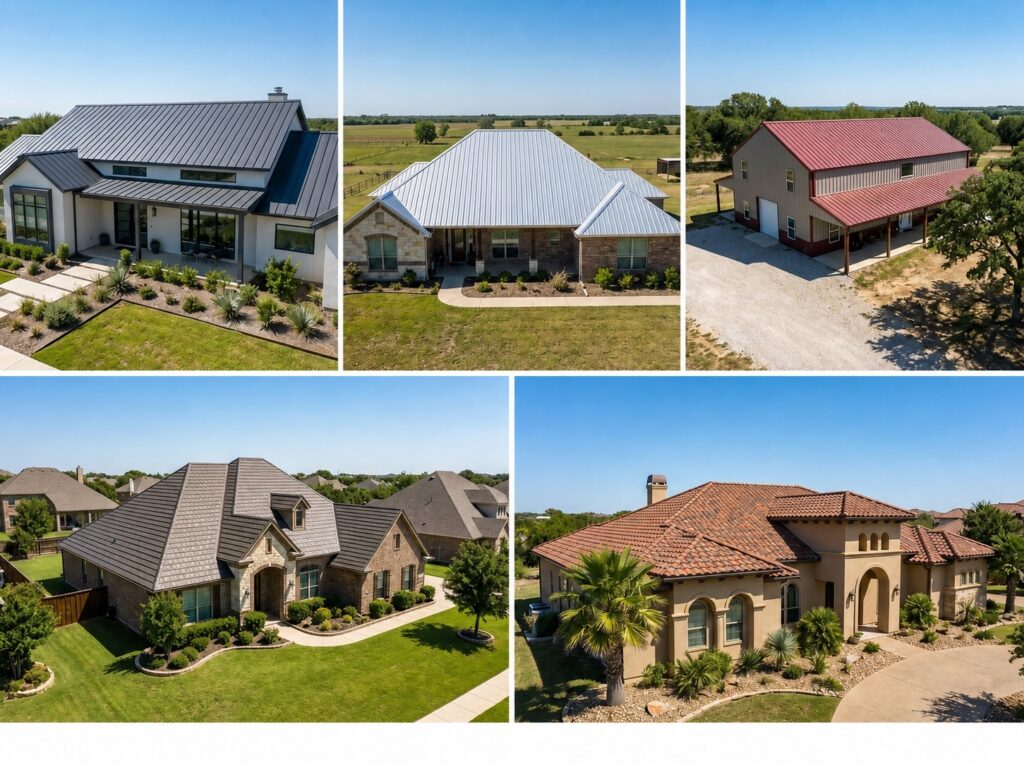





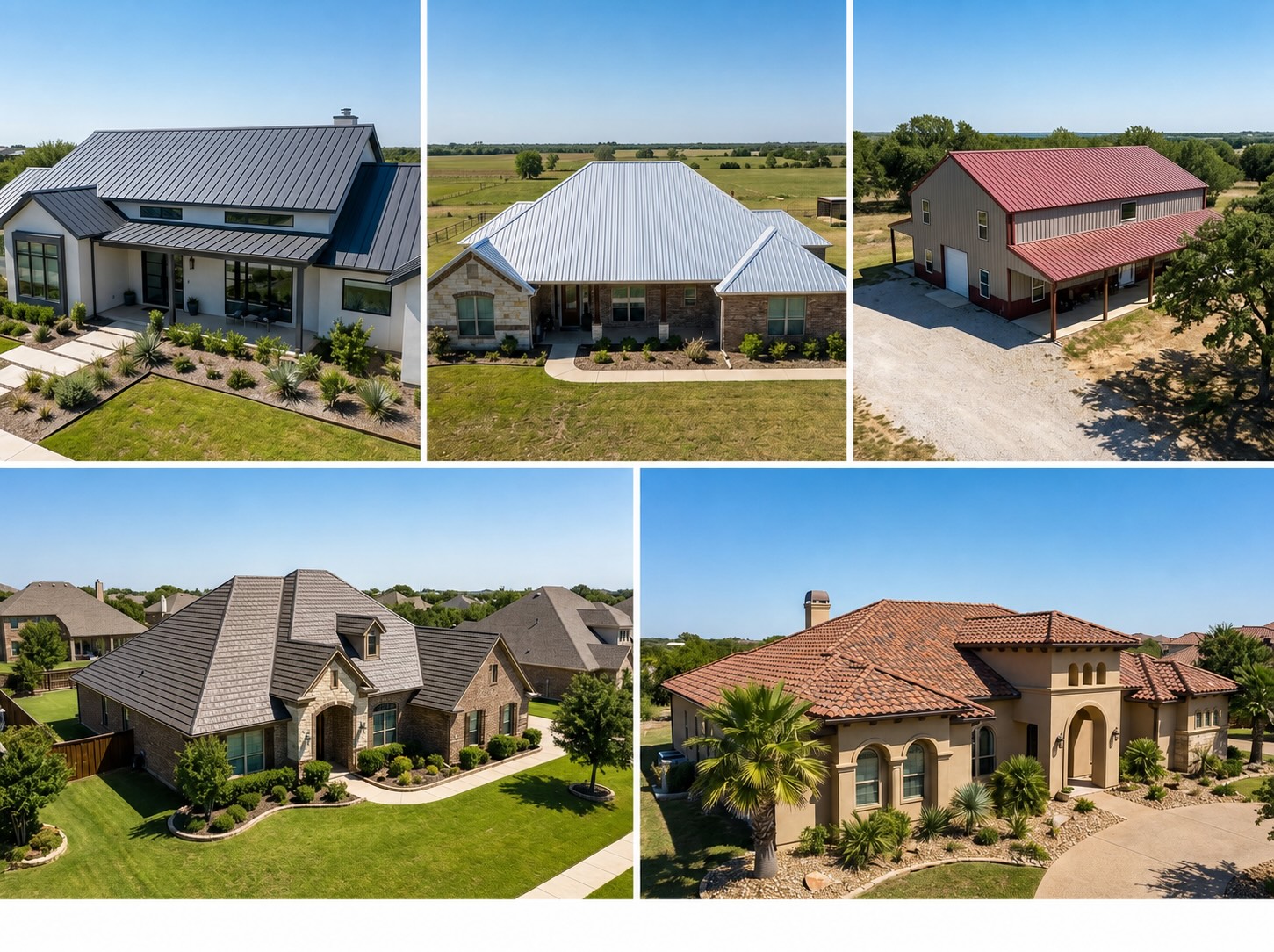
The five main types of metal roofing are standing seam (concealed fastener), corrugated metal (exposed fastener, wave profile), R-panel (exposed fastener, ribbed profile), metal shingles (stamped to mimic traditional materials), and stone-coated steel tiles. For Texas specifically, where summer roof deck temperatures exceed 165°F, daily thermal cycling is extreme, and UV intensity degrades exposed materials faster than manufacturer testing conducted in moderate climates, standing seam consistently outperforms exposed fastener systems over a 15–25 year horizon because concealed fasteners eliminate the primary long-term maintenance failure point. M&M Roofing has installed all five types across Houston, Austin, and San Antonio over 40+ years and, for most Texas residential applications, recommends standing seam as the best long-term value, with specific exceptions depending on budget, aesthetics, and roof slope.
When a Texas homeowner asks M&M, “What type of metal roof should I get?” most contractors give a neutral comparison chart. M&M is going to tell you what would go on our own house. After 40+ years and over 100,000 projects installing metal roofs across Houston, Austin, San Antonio, and everything between them, M&M has strong opinions. Here they are.
The most expensive mistake Texas homeowners make when choosing a metal roof is selecting based solely on upfront cost, without accounting for the maintenance differences between exposed- and concealed-fastener systems in Texas’s specific climate. That difference is what this article is about.
Why Metal Roofing Makes Sense in Texas — And Why the Type Matters
Metal isn’t just a premium option in Texas. In many cases, it’s the rational one.
Texas asphalt shingles average 15–20 years of real service life, not the 25–30 years manufacturers rate them for in moderate climates. UV intensity, thermal cycling, and hail frequency accelerate degradation in ways that national warranty language doesn’t account for. [1] If you’re replacing an asphalt roof on a house you plan to stay in for 20 years, you’re likely replacing it twice. The math on metal changes when you run the full 25-year picture.
Metal outperforms asphalt in every Texas-specific stress category. Heat: properly coated metal reflects 25–40% of solar radiation that asphalt absorbs. [2] Hail: steel metal roofing is impact-resistant, with several types qualifying for Class 4 impact ratings that reduce insurance premiums in Texas’s hail-active markets. Wind: properly installed metal handles 140 mph wind loads, relevant for Gulf Coast homeowners. Lifespan: standing seam runs 40–60+ years in Texas conditions.
But not all metal roofs perform equally in Texas. The type you choose determines maintenance requirements, the 20-year cost picture, and how well the system handles the specific stressors Texas produces. Choosing the wrong type for a Texas climate is a 30-year mistake. See M&M’s full comparison of metal roofing vs. asphalt shingles if you’re still deciding whether to go metal at all.
The 5 Types of Metal Roofing — Performance in Texas Heat
Type 1 — Standing Seam (Concealed Fastener)
What it is: Vertical panels 12–18 inches wide with raised seams at the edges. Fasteners clip under the seam and are never exposed to weather. The premium residential metal roof standard.
Texas performance: Standing seam handles thermal cycling better than any other metal roof type. Concealed clips allow panels to float, to expand and contract, without stressing fastener penetration points. There are no exposed neoprene washers to degrade under Texas UV. The seams interlock watertight at the highest points of the panel profile, which makes it especially valuable in Houston’s humidity and along the Gulf Coast, where storm exposure is frequent.
Lifespan in Texas: 40–60+ years with proper installation. That lifespan is achievable because the concealed fastener system doesn’t introduce the degradation points that shorten exposed fastener roofs in Texas conditions.
Best for: Modern and contemporary architecture, higher-budget homeowners, anyone planning to stay 20+ years, and metal roofing in Houston’s humidity zone.
Not ideal for: Very tight budgets (the highest upfront cost of the five options) or very low roof pitches without specific panel engineering.
Cost range: $12–$18 per sq ft installed in Texas markets.
Interested in standing seam for your Texas home? Get a free estimate from M&M.
Type 2 — Corrugated Metal (Exposed Fastener, Wave Profile)
What it is: The classic barn roof profile, wave or ripple pattern, screws driven directly through the panel face at wave peaks, and a neoprene washer creates the seal at each fastener point.
Texas performance: This is where M&M’s field experience diverges from manufacturer spec sheets, and it’s the most important information in this article.
Corrugated carries 20-year warranties in moderate climates. In Texas, M&M’s experience across Houston, Austin, and San Antonio tells a different story. Exposed neoprene washers under UV exposure plus extreme thermal cycling (summer roof deck temperatures exceeding 165°F combined with winter temperature drops of 50°F+) degrade faster than manufacturer testing conducted in moderate climates predicts. [3] M&M has replaced corrugated and R-panel roofs in Greater Houston at the 12–15 year mark that carried 20-year warranties because fastener washer failure was systematic and unrepairable at scale.
On a standard 2,000 sq ft corrugated roof, there are 300–500 fastener penetration points. When washers fail, they don’t fail one at a time. It’s a system-wide aging failure. Multiple failure points develop simultaneously, making individual fastener replacement economically unworkable.
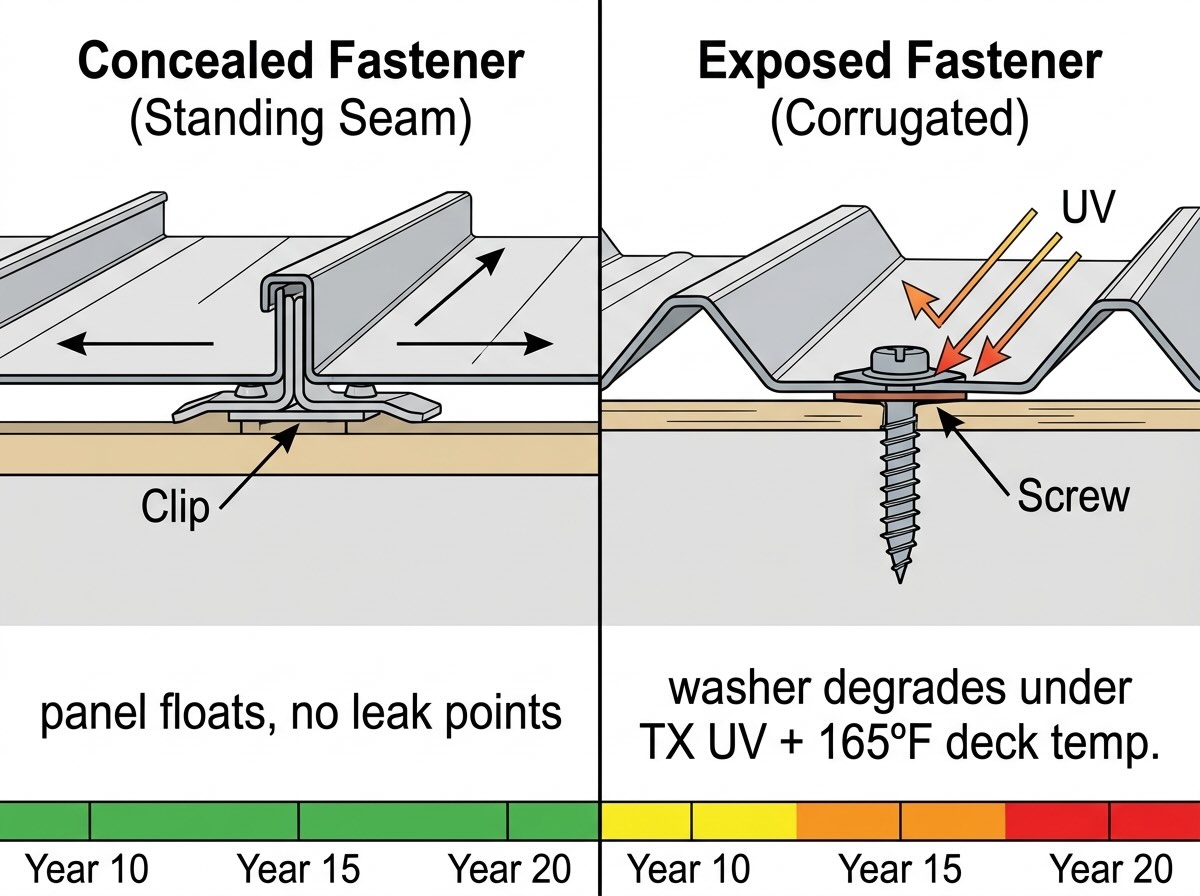
Lifespan in Texas: Panel material can last 30–40 years. The fastener system realistically needs assessment between 8–15 years. That’s the honest Texas timeline.
Best for: Agricultural and ranch-style properties where the aesthetic is intentional and the owner accepts the fastener maintenance reality. Budget-constrained projects.
Not ideal for: Primary residences in Houston’s humidity zone, high-end homes, or situations where the washer maintenance cycle is unworkable.
Type 3 — R-Panel (Exposed Fastener, Ribbed Profile)
What it is: Flat panels with vertical ribs, exposed fasteners, popular in barndominiums and modern farmhouses. Originally a structural, commercial, and agricultural panel, increasingly used residentially.
Texas performance: R-panel has the same exposed fastener concerns as corrugated, plus one additional Texas-specific issue: oil-canning. Oil-canning is the visible waviness that appears on flat metal panel surfaces when they expand and contract with temperature. In Texas heat, south-facing residential slopes in full sun develop visible waviness that many homeowners find objectionable. Corrugated’s wave profile naturally accommodates thermal movement; R-panel’s flat sections show it.
Lifespan in Texas: Panel material 30–40 years. Fastener maintenance needed at 10–15 years, similar to corrugated.
Best for: Barndominiums, modern farmhouse, and agricultural applications, commercial projects.
Not ideal for: Traditional neighborhood aesthetics, high-humidity coastal areas, applications where oil-canning on south-facing slopes would be objectionable.
Type 4 — Metal Shingles (Stamped Metal)
What it is: Steel or aluminum stamped and formed to mimic wood shake, slate, or asphalt shingle profiles. Installed like traditional shingles in overlapping courses. Fasteners are concealed by the next overlapping course (a partially concealed fastener system).
Texas performance: Handles UV and heat well because the metal base is durable. The partially concealed fastener system is better than fully exposed systems, but doesn’t achieve the full thermal float of a standing seam. The stamped texture profile holds debris in the detail, requiring more maintenance cleaning in Texas conditions. Performs well in hail. The steel base is impact-resistant.
Lifespan in Texas: 30–50 years. Better than exposed fastener systems because fasteners are covered by overlapping courses.
Best for: HOA-restricted neighborhoods, homeowners who want metal durability with the look of slate or wood shake, and historic district applications.
Not ideal for: Budget-conscious buyers (cost approaches standing seam without all the concealed-fastener benefits), very flat slopes.
Type 5 — Stone-Coated Steel Tiles (e.g., DECRA, Gerard)
What it is: Corrugated steel base panel coated with stone granules and an acrylic binder. Creates a tile, shake, or slate appearance with a stone texture finish. Distinct from plain metal shingles. The stone coating meaningfully changes the performance profile.
Texas performance: The stone coating adds thermal mass and UV resistance beyond plain metal shingles. Granules provide a Class 4 hail impact rating in most products, directly relevant in Texas’s hail corridor from Austin through San Antonio and north. [4] That Class 4 rating qualifies for insurance premium discounts in many Texas markets. The coating also significantly reduces metallic rain noise. Stone-coated steel performs well in both Houston’s humidity and Austin’s and San Antonio’s heat.
Lifespan in Texas: 40–50 years. Coating can fade under intense UV over 20–25 years; full granule adhesion loss is the long-term failure mode, similar to asphalt shingles but on a dramatically longer timeline.
Best for: Homeowners who want metal durability with traditional aesthetics, hail-prone markets (Austin, San Antonio) where the Class 4 insurance discount is meaningful, and situations where noise reduction matters.
Not ideal for: Modern or contemporary aesthetics, lowest-slope applications.
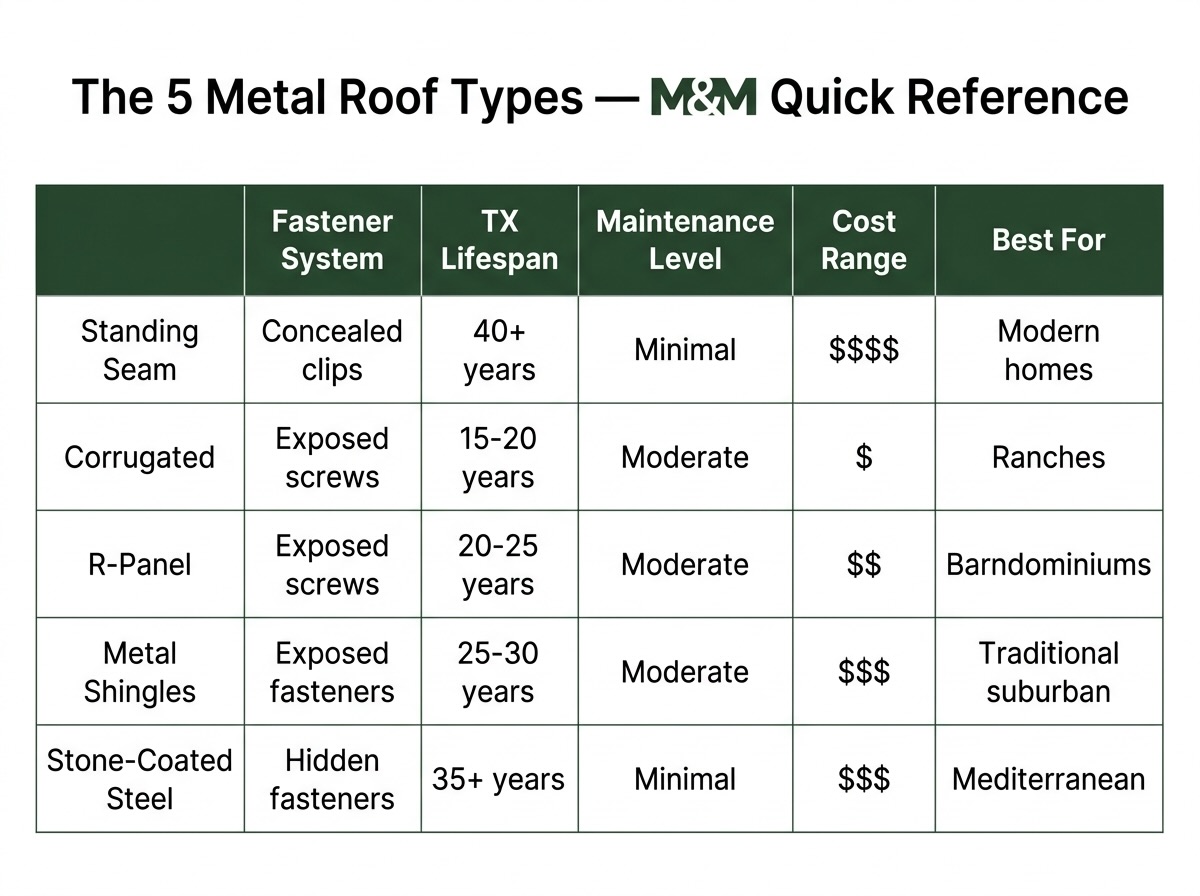
Here’s What M&M Would Put on Our House (And Why)
This is the section most metal roof articles won’t write. The honest recommendation, backed by 40 years of Texas installations.
For a primary residence with a 15+ year horizon in the Houston metro: standing seam, full stop.
In Houston’s specific combination of heat, humidity, and storm frequency, the concealed fastener advantage isn’t primarily aesthetic. It’s about eliminating the maintenance scenario where hundreds of screw points start failing simultaneously at year 12. M&M has replaced enough corrugated and R-panel roofs in Greater Houston at the 12–15 year mark to know that the upfront premium for standing seam pays for itself before you’d face your first major fastener maintenance cycle on an exposed system.
If a standing seam roof costs $30,000 on a 2,000 sq ft home and a corrugated roof costs $18,000, the $12,000 upfront difference looks significant. Factor in fastener assessment and maintenance on the corrugated system at years 10 and 18, plus the energy cost differential from standing seam’s superior thermal performance, and the 30-year cost picture favors standing seam in most Houston scenarios. The math is real.
For a budget-constrained project or rural property: corrugated metal, with a specific material spec.
If budget is the primary constraint, corrugated is a legitimate choice, but M&M would insist on Galvalume steel rather than paint-over-galvanized, and would accept the washer maintenance reality upfront. Build it into the ownership model, not as a surprise. At the 10-year mark, plan a fastener inspection and budget $500–$1,000 every 5–7 years for selective fastener replacement on areas showing washer degradation.
For an HOA-restricted neighborhood or homeowner who wants traditional aesthetics: stone-coated steel tile.
It’s the best balance in this category. Metal durability, traditional appearance, and the Class 4 hail rating that earns meaningful insurance discounts in Texas’s hail corridor. For homeowners in Stone Oak, Helotes, or other San Antonio suburbs where HOA restrictions and hail frequency both apply, this is the answer. Learn more about metal roofing in San Antonio.
The type M&M would avoid for most Texas residential applications: R-panel.
R-panel is designed as an agricultural and commercial panel. The oil-canning appearance issue in Texas heat, visible on south-facing residential slopes in full sun, makes it aesthetically problematic on homes where the panel will be seen daily for 30 years. There are better options at similar price points.
The honest final note: The type matters, but installation quality matters more. M&M has seen standing seam roofs fail at 8 years because of improper clip spacing and inadequate seam sealing. M&M has also seen corrugated roofs hit 25 years because of meticulous fastener installation and disciplined maintenance. In Texas, you need both the right type and the right installer.
M&M backs all new roof installations with a lifetime labor warranty, because recommending the right work is only meaningful if the work holds. Ask any contractor you’re comparing what their installation warranty covers and for how long.
Want M&M’s recommendation for your specific home and climate zone? Request a free consultation.
Metal Roof Type Comparison for Texas Homes
| Type | Fastener | TX Lifespan | Maintenance | Installed Cost | Best For |
|---|---|---|---|---|---|
| Standing Seam | Concealed | 40–60+ yrs | Very Low | $12–18/sq ft | Primary residences, modern architecture, long-term owners |
| Corrugated | Exposed | Panel: 30–40 yrs / Fasteners: 8–15 yrs | Moderate (assess every 7–10 yrs) | $7–10/sq ft | Rural/ranch, budget-constrained, agricultural |
| R-Panel | Exposed | Panel: 30–40 yrs / Fasteners: 10–15 yrs | Moderate | $6–9/sq ft | Barndominiums, agricultural, commercial |
| Metal Shingles | Partially Concealed | 30–50 yrs | Low-Moderate | $10–15/sq ft | HOA-restricted, traditional aesthetics |
| Stone-Coated Steel | Partially Concealed | 40–50 yrs | Low | $10–16/sq ft | Hail corridor, traditional look with metal durability |
Cost ranges reflect 2024–2025 Texas market installation pricing. Actual costs vary by home size, roof complexity, and regional labor market.
What to Ask Your Contractor Before Choosing a Metal Roof Type in Texas
Five questions that reveal whether a contractor is steering you toward the right option or just toward their preferred product.
“What metal roof type do you install most in Texas, and why?” A good answer includes Texas climate reasoning. A bad answer is “that’s what we have in stock” or a generic manufacturer talking point.
“What’s the expected maintenance schedule for exposed fastener systems in this climate?” A good answer acknowledges the washer replacement reality in Texas heat and UV. “None” is an honest answer. Exposed fastener systems in Texas require fastener assessment at 8–15 years.
“What’s your installation warranty on the seam or fastener system specifically?” Manufacturer warranties cover materials. Contractor warranties cover the labor and installation quality. M&M backs all new metal roof installations with a lifetime labor warranty. Ask any contractor you’re comparing what they cover and for how long.
“Can you show me a comparable installation from 10+ years ago in this climate zone?” References from installations that have aged in Texas conditions reveal real-world performance. A contractor who can’t show you a decade-old local installation hasn’t been here long enough.
“What does the manufacturer specify for panel float and clip spacing in a Texas thermal environment?” This tests whether the contractor knows Texas-specific installation requirements. Thermal movement specs in Texas heat are different from those written for moderate-climate markets. Read more about what to look for in a roofing contractor in Texas.
Frequently Asked Questions
What type of metal roof is best for Texas heat?
Standing seam is the best long-term performer in Texas, specifically because concealed fasteners eliminate the washer degradation problem that causes exposed fastener systems to develop maintenance issues at 8–15 years in Texas’s extreme thermal cycling environment. For budget-constrained projects, corrugated metal with Galvalume steel is the next best option if the owner plans for a fastener maintenance cycle at the 10-year mark.
Does metal roofing get hot in Texas?
Metal roofs reflect more solar heat than asphalt, not less. Properly coated metal roofing reduces cooling load by 15–25% compared to dark asphalt shingles. The roof surface itself gets hot in full sun, but that heat is reflected outward rather than absorbed and conducted into the attic the way asphalt does. Light-colored coatings improve this further. For more on energy-efficient roofing options, see M&M’s guide to energy-efficient roofing systems.
How long does a metal roof last in Texas?
Standing seam: 40–60+ years. Stone-coated steel: 40–50 years. Metal shingles: 30–50 years. Corrugated and R-panel panel material: 30–40 years, with fastener maintenance needed between 8–15 years. All metal options significantly outlast Texas asphalt shingles, which average 15–20 years in Gulf Coast and Central Texas conditions.
Is metal roofing worth it in Texas?
For homeowners planning to stay 15+ years, the long-term math typically works. A standing seam roof at $15/sq ft on a 2,000 sq ft home costs $30,000 upfront. Two asphalt replacements on the same home over 30 years at $8,000–$10,000 each totals $16,000–$20,000, plus energy cost differences from lower reflectivity. Metal wins on 25-year total cost in most Texas scenarios. For detailed cost breakdowns, see M&M’s metal roof cost guide.
What’s the difference between corrugated and standing seam metal roofing?
Corrugated uses exposed fasteners driven through the panel face, creating potential leak points at every screw location as neoprene washers age under UV and heat. Standing seam uses concealed clips under raised seams. No fasteners penetrate the panel face, eliminating that maintenance point entirely. In Texas, this distinction matters more than in moderate climates because heat and UV accelerate washer degradation to 8 to 15 years rather than the 20-year warranty timeline.
The Bottom Line for Texas Homeowners
For most Texas homeowners replacing a roof for the last time on a home they plan to keep, a standing seam is the right answer. For specific budget, aesthetic, or property-type situations, the other four options each have their place. Corrugated for rural and budget-constrained. Stone-coated steel for traditional aesthetics in the hail corridor. Metal shingles for HOA-restricted neighborhoods. R-panel for barndominiums and agricultural structures.
The decision framework in this article gets you to the right category. The conversation with a qualified Texas installer fills in the specifics for your home. M&M has been having that conversation across Houston, Austin, and San Antonio for over 40 years and 100,000+ completed projects. Schedule a free metal roof consultation with M&M.
References
[1] Sheffield Metals — Standing Seam vs. Exposed Fastener Metal Roofing
[2] U.S. Department of Energy — Cool Roofs
[3] Western States Metal Roofing — Exposed Fastener vs. Standing Seam Pros and Cons
[4] Insurance Institute for Business & Home Safety — Impact-Resistant Roofing
M&M Roofing, Siding & Windows has served homeowners across Texas and Louisiana for more than 40 years. Backed by over 100,000 completed home improvement projects, M&M offers expert insight on roofing, siding, windows, gutters, storm damage, and exterior restoration, helping homeowners make confident, informed decisions about their property.